

What if an RMR result is useful without being a perfect calorie prescription? RMR test accuracy depends on more than the number on the report. The test measures energy your body uses at rest by measuring oxygen consumption and carbon dioxide production. It offers a personalized baseline, not a complete measure of the calories you burn throughout the day.
If online calculators give you conflicting estimates, or your measured result doesn’t seem to match changes on the scale, the conditions behind the number matter. Recent food, exercise, caffeine, stress, and the testing setup can affect how representative a result is. A measured value is still useful data, but it needs the right context.
In this article, you’ll learn what an RMR test can and can’t tell you, what may affect the result, and how to use it alongside your real-world progress. Dexaslim’s RMR test provides an individualized reference point beyond a generic estimate. Treat the result as a starting baseline, then interpret it alongside your activity, nutrition, and weight trends.
Key Takeaways
• RMR test accuracy describes how closely a result reflects resting energy use; repeatability describes whether results stay consistent across tests.
• When interpreting a reading, separate normal day-to-day variation from preventable testing or equipment issues.
• Compare measured RMR with estimates carefully: calculators use population-based equations, while wearables and total daily energy estimates represent different measures.
• Follow the testing instructions and review the result in context, including activity and other factors that shape daily energy needs.
• Dexaslim’s RMR test offers personalized metabolic data to help establish a resting baseline, not a complete diet plan or guaranteed outcome.
What Does RMR Test Accuracy Actually Mean?
An RMR test estimates resting energy expenditure under measured conditions. It gives you a snapshot of the energy your body uses while resting, not a fixed calorie allowance for every day. Resting expenditure is the energy used at rest; daily calorie needs also include activity, digestion, and exercise.
So, what does RMR test accuracy tell you? It describes how closely a result reflects your underlying resting energy expenditure in the conditions of that test. It doesn’t mean the result predicts exactly how much you should eat or guarantees a particular change in body weight. Use it as a personalized reference point, then interpret it alongside your routine and progress.
What an RMR test measures, and what it does not
Resting metabolic rate represents the energy needed to support essential functions while you’re at rest, including breathing, circulation, and maintaining body tissues. Basal metabolic rate (BMR) is closely related, but it is assessed under more strictly standardized conditions. The terms are often used loosely in everyday conversation, but they aren’t automatically interchangeable. This overview of basal metabolic rate explains the relationship and distinction.
An RMR reading doesn’t include the energy you use to walk, work out, or digest food. Those contribute to total daily energy expenditure, which changes with your movement, meals, and other daily demands. Comparing resting expenditure with your full-day calorie needs can therefore lead to a misleading conclusion about your actual intake.
Accuracy, precision, and repeatability in plain English
Accuracy is closeness to the underlying value. Precision is how consistently a measurement is obtained. Repeatability asks whether a test produces similar results when repeated under comparable conditions. These ideas overlap, but answer different questions. A series of similar readings can be precise without proving that they’re close to the true value.
Even when your underlying physiology hasn’t meaningfully changed, repeat tests may not match exactly. Rest, stress, recent activity, food, and other conditions can differ between appointments. Small differences don’t automatically signal a faster or slower metabolism. Before interpreting a change as real, consider whether the measurements were taken under comparable conditions.
One result is a baseline, not a verdict on your metabolism, discipline, or effort. If a number seems inconsistent with your weight trend, remember that body weight reflects more than resting energy use, and the test doesn’t measure your full day. Use the result to inform a broader assessment, not to override what sustained real-world progress shows. The practical question isn’t whether one number explains everything. It’s whether the measurement gives you a useful starting point for decisions and future comparisons.
How RMR Testing Produces a Result, and Where Measurement Error Can Enter
Many clinical RMR assessments use indirect calorimetry. The test measures respiratory gases, typically oxygen consumed and carbon dioxide produced, then uses those measurements to estimate energy use at rest. The result depends on both the measurement and the conditions around it. A reading can reflect ordinary short-term physiology, the testing setup, or both.
That distinction helps put RMR test accuracy in perspective. A different reading doesn’t automatically mean the test was flawed or that your metabolism changed. First consider whether your body was in a comparable resting state and whether avoidable disruptions affected the measurement.
Physiological factors that can shift an RMR reading
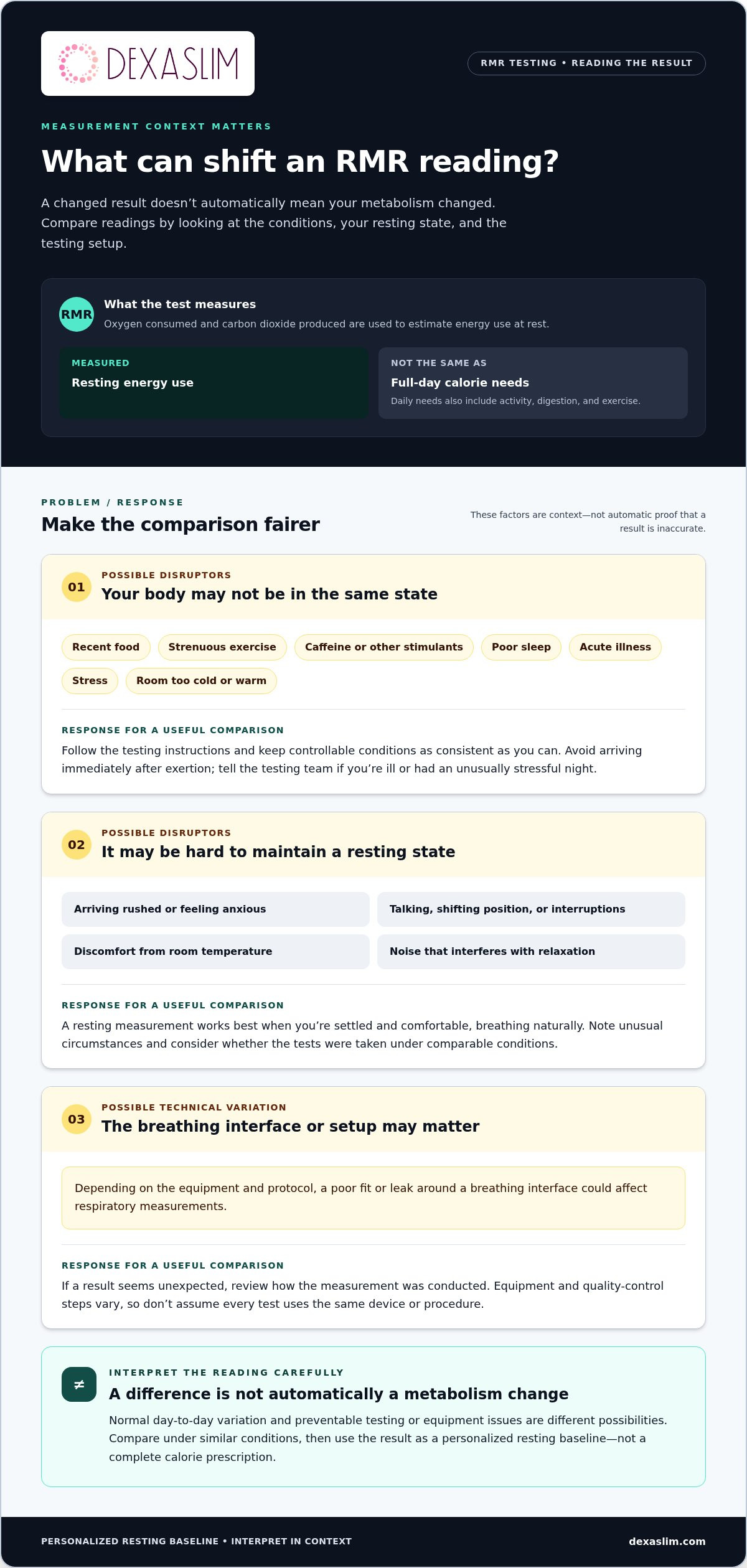
Recent food, strenuous exercise, caffeine or other stimulants, poor sleep, acute illness, stress, and a room that is too cold or warm can affect a resting measurement. These are useful context, not automatic proof of an inaccurate result. For example, a hard workout the day before may make one measurement less comparable with a later test taken after a quieter day.
Some differences reflect normal biological variation. Energy requirements are also shaped by body size, age, sex, and lean mass. These factors help explain why two people with similar weight can have different resting needs, but they don’t determine an individual’s result by themselves. Treat them as context for a measured value, not a substitute for one.
Testing conditions and technical sources of variation
A resting measurement works best when you’re settled, comfortable, and breathing naturally. Arriving rushed, feeling anxious, talking, shifting position, or being interrupted can make it harder to maintain a steady resting state. Discomfort from room temperature or noise may also interfere with relaxation. These factors can influence a reading without proving that the equipment or test has failed.
Technical variation is a separate issue. Depending on the equipment and protocol, a poor fit or leak around a breathing interface could affect respiratory measurements. Setup and quality-control steps vary, so don’t assume every test uses the same device or procedure. If a result seems unexpected, note the circumstances and review how the measurement was conducted rather than jumping to a conclusion about your metabolism.
For a fair comparison over time, keep controllable conditions as consistent as you can. Follow the testing instructions, avoid arriving immediately after exertion, and tell the testing team if you’re ill or had an unusually stressful night. You don’t need to interpret every small fluctuation as meaningful. Consider whether the broad picture fits your circumstances, then use the result as one data point alongside longer-term progress.
Dexaslim offers an individualized Resting Metabolic Rate test to establish a resting baseline. The value is most useful when you understand the conditions behind it and interpret it as a measured reference, not a complete account of daily energy use.
Measured RMR vs. Online Calculators: Which Number Is More Reliable?
A measured result and a calculator estimate can both be useful, but they answer different questions. An RMR test measures resting energy use under test conditions. An equation predicts it from selected personal details. A wearable or calorie tracker may estimate broader energy use, while total daily energy expenditure includes resting needs plus activity and digestion. Compare the same kind of number before deciding that results conflict.
| Method | What it represents | How it is generated | Best use |
|---|---|---|---|
| Measured RMR | Resting energy expenditure | Derived from measurements taken during an RMR test | A personalized resting baseline |
| Equation-based estimate | Predicted resting energy expenditure | Calculated from inputs such as age, height, weight, and sex | A convenient starting estimate |
| Wearable estimate | Often broader daily energy use | Estimated using device-specific data and methods | Observing patterns over time |
| Total daily energy estimate | Resting needs plus daily energy demands | Estimated by combining a resting value with activity assumptions or tracking data | Framing overall daily needs |
When a measured RMR test adds useful individual data
A measured baseline can add useful context to nutrition or training discussions, especially when a generic equation doesn’t seem to fit your experience. It gives you a resting value to consider alongside your activity, eating patterns, and progress. It doesn’t predict weight change by itself: changes in body weight reflect the balance of energy intake and use over time, not resting expenditure alone. Use the result to inform decisions, not replace clinical judgment.
Why calculators and trackers may show different numbers
Prediction equations use population-derived relationships, not a direct measurement of your resting energy expenditure. Different calculators may use different equations or inputs. Even selecting a different activity level can shift the estimate. Activity multipliers apply an assumption to a resting value to approximate broader daily expenditure, so the result is no longer a resting-only figure.
Wearables and calorie trackers estimate energy use across the day using device-specific methods and recorded activity. Their output may therefore differ from an RMR test without showing that the test failed. The figures aren’t interchangeable: one may describe rest, while another estimates movement and daily burn.
Takeaway: A measured RMR is a resting baseline; a daily calorie estimate includes additional energy demands and assumptions. Compare resting with resting, and daily totals with daily totals. That distinction makes RMR test accuracy easier to assess and helps you use each number for the decision it can actually inform.
How to Prepare for an RMR Test and Interpret the Result
Consistent preparation makes your result easier to interpret. Follow the instructions provided for your test rather than applying a universal fasting or exercise rule. Preparation supports a meaningful measurement, but it can’t turn an RMR result into a complete calorie prescription.
Before testing: follow a consistent preparation plan
Use this sequence to arrive ready and give the reading useful context:
Follow the testing instructions.
Use the specific guidance for fasting, exercise, caffeine, and other stimulants. Instructions can differ by testing protocol.
Keep medication decisions with your prescriber.
Don’t skip, stop, or change medication to influence an RMR result. Discuss medication or preparation questions with the appropriate health professional before testing.
Share relevant context.
Tell the testing team if you’re unwell or recently experienced unusual sleep, significant stress, or strenuous exercise. These details help frame the reading; they don’t automatically invalidate it.
Arrive with time to settle.
Follow the directions and allow yourself to become comfortable before measurements begin. Avoid rushing straight into the test if you can.
Stay relaxed during the measurement.
Follow instructions, breathe naturally, and mention discomfort or interruptions. Don’t try to force a particular breathing pattern unless the testing team directs you.
For a broader look at what the test can tell you and how it fits into a testing decision, see this resting metabolic rate test guide.
After testing: use the number as a baseline, not a prescription
Start by checking what the reported value represents. Compare it with an estimate only if both describe resting energy expenditure. A daily calorie target may include activity assumptions, so it isn’t a like-for-like comparison with a resting measurement. If the figures differ, review what each one measures before deciding the test was inaccurate.
Record the result alongside relevant context, such as recent illness, sleep, stress, or exercise. If you repeat the test later, notes will help you judge whether the conditions were similar. Focus on meaningful patterns over time, not a single isolated reading or a small difference that may reflect changing circumstances.
Use the measurement to support a conversation about nutrition or training, not to dictate a plan. If you’re making a substantial change to your eating plan or have health concerns, review the result with an appropriately qualified professional. RMR test accuracy matters, but so does applying the number correctly to your goals and daily life.
Ready to establish a more individualized resting baseline? Explore Dexaslim’s RMR test as a source of personalized metabolic data.
Use Dexaslim RMR Testing to Build a More Individualized Metabolic Baseline
A generic equation can offer a starting estimate. Dexaslim’s dedicated Resting Metabolic Rate test provides personalized data about energy use at rest. That result can add an individual reference point to conversations about nutrition, training, and daily energy needs without pretending to answer every question about your metabolism.
Keep the scope clear. An RMR result describes resting energy expenditure, not total daily energy expenditure. It doesn’t account for all movement, exercise, or digestion, and it isn’t a complete diet plan or a guarantee of a particular outcome. RMR test accuracy matters, but so does using the measurement for what it can tell you.
What an RMR result can contribute to a broader assessment
Resting energy data can help make discussions about daily calorie needs more individualized. It’s one input to consider alongside eating patterns, activity, goals, and progress. It doesn’t prescribe an intake by itself. Body composition can offer complementary context about the body’s makeup, while total daily energy expenditure reflects a broader set of energy demands. These are related measures, not interchangeable ones.
A DEXA body composition scan guide explains how body-composition information may complement a resting measurement. The value lies in understanding what each measure contributes, then bringing the pieces together thoughtfully rather than treating any single result as the whole picture.
Choose the next step based on the question you need answered
Start with the question. If you want a reference point for energy use at rest, a dedicated RMR test is directly relevant. For a broader assessment, Dexaslim also offers a VO2 Max and DEXA bundle. Consider it when you want to look beyond a single measure, while keeping in mind that each test answers a different question.
To make the data useful, keep your goal specific. You might want to compare a measured resting value with a calculator estimate, or bring more individualized information into a nutrition discussion. The measurement can sharpen that conversation; it doesn’t replace professional judgment or account for every factor that shapes real-world weight change.
Choose the next step that matches the information you’re seeking. For a personalized resting baseline, explore Dexaslim’s dedicated RMR test. Use the result as one data point, then interpret it in context with your habits and progress. That’s a practical way to turn a measured number into a clearer starting point, without expecting it to function as a full metabolic assessment or a guaranteed outcome.
Turn Your Metabolic Data Into a Clear Next Step
Use testing to replace guesswork with a better question: what information would help you make your next health or performance decision? A result is most useful when it gives you a reference point you can interpret thoughtfully, rather than a number to obey. Keep your goals in view, note what changes over time, and let evidence guide your next adjustment.
RMR test accuracy matters, but no single measurement can define your entire metabolism or determine your progress for you. Pair data with your lived experience and, when appropriate, guidance from a qualified professional. That approach keeps the focus on decisions you can refine, not conclusions drawn from one reading.
Ready to add a measured resting baseline to your health data? Explore Dexaslim RMR testing and take a practical next step toward more individualized insight. Use the information to move forward with clarity and confidence.
Frequently Asked Questions
Is an RMR test accurate?
An RMR test can provide a useful estimate when the measurement method and test conditions are appropriate. RMR test accuracy doesn’t mean the result is an exact, permanent value. If you’re using it to inform a nutrition conversation, note the date and any unusual circumstances around testing. That record helps distinguish a meaningful change from a one-off result and keeps the number in proportion to the decision you’re making.
How accurate is an RMR test compared with a calorie calculator?
An RMR test measures your resting energy use under test conditions, while a calculator predicts it from details such as age, height, weight, and sex. For a fair comparison, check whether both figures refer to resting energy, not one resting value and one daily total. For example, an estimate that includes an activity setting shouldn’t be compared directly with a resting-only test result.
Can an RMR test give different results on different days?
Yes, repeat results may differ. Before treating the change as meaningful, consider what was different between test days, such as a poor night’s sleep, illness, a recent workout, or a rushed arrival. Keep a simple note of these factors and share it with the testing team if the difference surprises you. That context can help with interpreting both readings.
How should I prepare for an RMR test?
Follow the testing instructions, since preparation guidance can differ by protocol. Check the directions for food, caffeine, exercise, and arrival timing. Don’t stop or change prescribed medication just to affect the result. If you’re unsure how medication, recent illness, or an unusual schedule might affect your appointment, raise the question before testing so the team can advise on the appropriate next step.
What happens if my RMR test result is much higher or lower than expected?
First, verify that you’re comparing the same measure, such as resting energy with resting energy. Then review the circumstances of the test and share anything unusual with the testing team. One surprising number isn’t enough reason to make a drastic change to your eating plan. If the result raises health concerns or conflicts with your ongoing experience, discuss it with an appropriately qualified professional.
Does an RMR test tell me how many calories to eat each day?
No, an RMR test alone doesn’t set a daily calorie target. Daily needs also depend on how active you are and other factors, so don’t use the resting result as your full-day allowance. If you’re planning a nutrition change, use the measurement as background information and consider how your energy, routine, and progress respond. A qualified professional can help interpret it in relation to your goals.
How often should I repeat an RMR test?
There isn’t one retesting schedule that suits everyone. Consider repeating only when there’s a clear reason to update the baseline, such as a meaningful change in health, body composition, or training goals. If you do retest, keep notes on preparation and circumstances so you can compare the results fairly. A qualified professional can help decide whether another measurement would answer a useful question.