.svg)


What if the calorie target guiding your plan is only an estimate? When generic calculators don’t match your progress, a resting metabolic rate test can provide a more individualized baseline by measuring the energy your body uses at rest. That’s useful data, but it isn’t a complete calorie prescription.
Your RMR reflects resting energy use, not the calories you burn across a full day of movement, work, and exercise. The result can help inform nutrition or fitness planning, but it needs context, including your activity and goals. Before testing, find out how the assessment works and follow the provider’s preparation instructions.
This guide explains what an RMR test measures, how the result differs from calculator estimates and total daily needs, and what it can’t tell you on its own. You’ll also learn what to ask when comparing providers, so you can choose an assessment that fits your goals. Dexaslim offers RMR testing to help calibrate daily calorie needs and fitness regimens, alongside separate DEXA and VO2 Max assessments.
Key Takeaways
• A resting metabolic rate test can add an individualized data point, but it doesn’t set your full-day calorie target.
• Ask what the provider measures, which method it uses, and what the report includes.
• Compare measured results with calculator estimates by considering their different sources, uses, and limitations.
• Follow the provider’s preparation instructions and ask how to interpret results before changing your plan.
• Consider whether an appointment and its cost are worthwhile for your goals, or whether an estimate is enough to get started.
What Does a Resting Metabolic Rate Test Measure?
Generic calorie estimates can feel disconnected from real life. A calculator may suggest one target while your hunger, energy, or progress tells a different story. A resting metabolic rate test measures a specific part of your energy use: what your body expends at rest to keep essential functions running, including breathing, circulation, and temperature regulation.
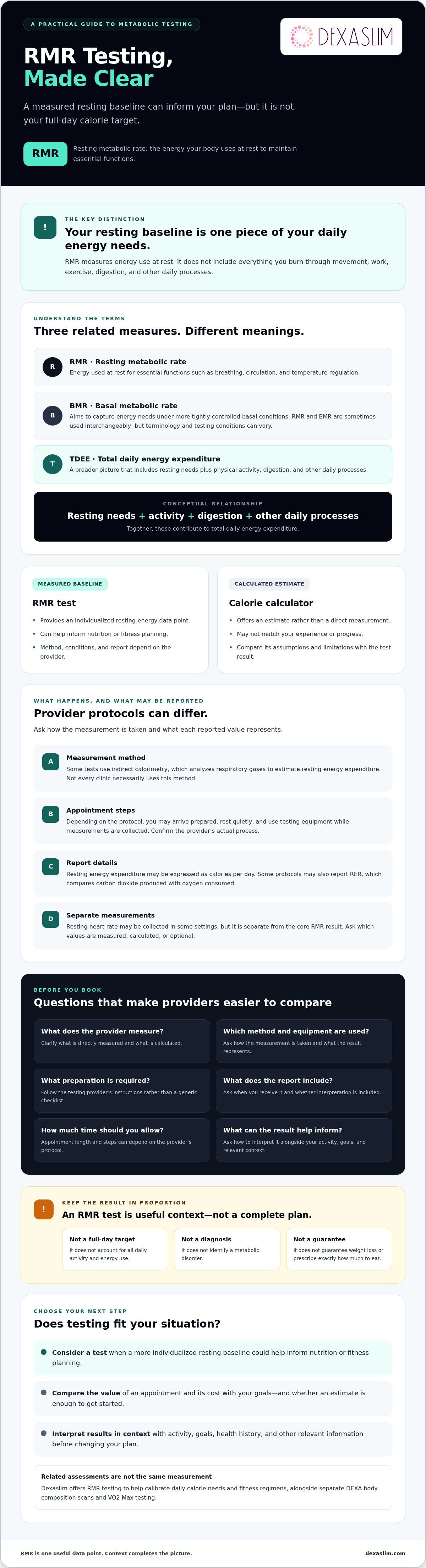
Resting metabolic rate is the energy your body uses at rest to maintain basic functions; it is not the total number of calories you burn in a day. An RMR result is a measured baseline to consider when planning, not a complete calorie prescription or a diagnosis of a metabolic condition.
RMR, BMR, and total daily energy expenditure: what is the difference?
Resting metabolic rate (RMR) refers to energy use while resting, measured under conditions that are generally less strict than those used for basal metabolic rate (BMR). BMR aims to capture energy needs under tightly controlled basal conditions. The terms are sometimes used interchangeably, but testing conditions and terminology can vary between providers.
Total daily energy expenditure (TDEE) is broader. It includes resting needs plus energy used for physical activity, digestion, and other daily processes. An RMR value alone doesn’t account for a workout, an active job, or ordinary movement throughout the day. It shouldn’t be treated as your daily calorie target without considering those additional factors.
What can an RMR test help you understand?
A measured resting baseline can help refine nutrition or fitness planning when generic estimates aren’t useful. It gives you an individualized data point to consider alongside activity level, goals, health history, and other relevant information. Dexaslim states that its RMR test is intended to help calibrate daily calorie needs and fitness regimens.
Keep the result in proportion. It doesn’t guarantee weight loss, identify a metabolic disorder, or prescribe exactly how much you should eat. Ask how to interpret the result in your circumstances and what other context matters. Dexaslim also offers DEXA body composition scans and VO2 Max testing as separate assessments. Neither measures the same thing as RMR.
How Does a Resting Metabolic Rate Test Work?
A resting metabolic rate test aims to estimate how much energy your body uses while at rest. The method, appointment steps, and report depend on the provider. Some tests use indirect calorimetry, which analyzes respiratory gases to estimate resting energy expenditure, but not every clinic necessarily uses this method. Ask how the measurement is taken and what the result represents.
Standardized test conditions help make results more interpretable by reducing the influence of recent activity and other factors that can affect resting energy use. Follow the testing provider’s preparation instructions rather than relying on a generic checklist. When comparing providers, ask how they explain the result and what decisions it can help inform.
What happens during an RMR testing appointment?
Depending on the protocol, an appointment may involve arriving prepared, resting quietly, and using testing equipment while measurements are collected. These are examples, not a confirmed description of every provider’s process. Dexaslim offers RMR testing, but confirm its specific equipment and protocol directly.
Before scheduling, ask practical questions: How much time should you allow for the appointment? What equipment and measurement method are used? What preparation instructions apply? How and when will you receive the report, and is interpretation included? The answers help you understand the experience without assuming every clinic follows the same process.
Which measurements might appear in an RMR report?
Some protocols use measured respiratory gases to estimate resting energy expenditure, often expressed as calories per day. Other report details depend on the provider. For example, a report may include a respiratory exchange ratio (RER) if the protocol measures it. RER compares carbon dioxide produced with oxygen consumed and can offer information about the mix of fuels used at rest. Don’t assume it appears in every report.
Resting heart rate may also be collected in some settings, but it’s a separate measurement, not the core RMR result. Ask which values are directly measured, which are calculated, and which are optional. A report can contain several numbers without each one representing resting calorie burn.
RMR data is one input, not a complete explanation of body weight or a standalone plan. For broader context on metabolism and weight, see Harvard Health Publishing’s discussion of metabolism and weight loss. To review the service details Dexaslim provides for its Resting Metabolic Rate test, confirm the method, preparation steps, and report contents before choosing.
RMR Test vs. Calorie Calculator: Which Gives You More Useful Data?
A calorie calculator produces an estimate from a predictive equation, often using details such as age, height, weight, and sex. A resting metabolic rate test may provide a more individualized resting baseline. If a provider uses indirect calorimetry, the estimate is based on measured respiratory gases. Confirm the method before assuming a test measures gases or offers a particular level of precision.
| Approach | Source | What it estimates | Strengths | Limitations |
|---|---|---|---|---|
| Online calorie calculator | Predictive equation using personal details | Estimated energy needs, depending on the calculator | Fast, convenient, and useful as a starting point | Prediction may not reflect individual resting energy use |
| RMR test | Provider-specific measurement method | Resting energy expenditure | Can add a measured personal baseline when the method supports it | Reflects test conditions and does not define full-day needs |
A measured result isn’t infallible. It reflects the testing method and the conditions at the time of measurement. Treat it as one data point, not an unquestionable number. Neither a test nor a calculator provides a complete individualized plan on its own.
When is an RMR test more useful than an online calculator?
A test may be worth considering if generic estimates haven’t helped you find a useful starting point, or if you want a measured baseline to discuss while refining nutrition or fitness plans. A calculator is convenient and doesn’t require an appointment. You can use its estimate to begin tracking patterns, then reassess if it doesn’t suit your needs. Testing isn’t necessary for everyone and can’t guarantee better outcomes.
Dexaslim offers an RMR test intended to help calibrate daily calorie needs and fitness regimens. Before choosing a provider, ask which method is used and how results are interpreted. Those details clarify what the measurement can reasonably contribute to your plan.
What an RMR test cannot tell you on its own
RMR does not measure all the energy you use throughout a day. It doesn’t account for your complete activity expenditure, so it can’t independently establish total daily calorie needs. A single result also can’t diagnose why your weight is changing or explain symptoms you associate with metabolism.
Consider the number alongside relevant context, including activity, goals, and health history. If you have concerns about weight change or metabolic symptoms, discuss them with an appropriately qualified healthcare professional. The test can inform planning, but it isn’t a substitute for evaluating a health concern.
How to Prepare for an RMR Test and Evaluate the Results
Preparation can affect how useful your measurement is. Instructions vary by provider and testing method, so don’t rely on a generic online checklist. Before your appointment, get the clinic’s directions and ask what the result can reasonably tell you.
What should you ask before booking an RMR test?
Use these questions to assess the testing experience and the value of the report:
What measurement method do you use?
Ask what the test measures directly and which values are calculated.
What does the report include?
Confirm which measurements are reported and whether additional metrics are optional.
How should I prepare?
Get provider-specific instructions about food, drinks, exercise, and medications. Don’t change prescribed medication unless your healthcare professional tells you to.
What are the appointment logistics?
Ask how much time to allow, what to bring, and how and when results are delivered.
Will someone review the results with me?
Find out whether interpretation is included and how the clinic accounts for your activity, goals, health history, and the test’s limitations.
Clear answers help you understand what you’re choosing. They also prevent assumptions about protocols or report features that may differ between providers.
How should you use your RMR results?
Start with the result as one baseline, then consider it alongside your daily activity, goals, health history, and other relevant data. Don’t convert resting energy use directly into a full-day calorie target. Ask how the provider distinguishes the measured value from your total daily needs and what context is needed before adjusting a plan.
Keep related assessments distinct. An RMR test estimates resting energy use; a DEXA body composition scan provides different information about body composition. Each data point answers a different question, so consider what information your goals call for rather than treating one test as a substitute for another.
Dexaslim offers RMR testing to help calibrate daily calorie needs and fitness regimens. Before proceeding, confirm the provider’s preparation instructions, measurement method, report details, and result-review process.
Is a Resting Metabolic Rate Test Right for You? Choosing Your Next Step
A measured baseline can be useful when you have a clear planning question, such as whether an individualized resting-energy estimate could help refine your nutrition or fitness approach. If you need an initial reference point, a calculator may be a practical place to start. Neither option guarantees a particular result. Choose based on the decision you’re trying to make.
A quick decision framework for choosing an RMR test
Consider testing
if generic estimates haven’t given you a useful baseline and you want measured data to inform planning.
Start with an estimate
if you want a convenient first reference and don’t yet have a specific reason to seek measurement.
Evaluate the provider
by asking about the measurement method, preparation instructions, report details, and how results are explained.
Weigh the practical trade-offs, too. Testing may offer a more personalized resting baseline, but it requires an appointment and has a cost to confirm with the provider. An estimate is convenient and accessible, but relies on a predictive equation rather than a measurement. Either way, RMR alone doesn’t account for all daily energy needs or replace the context needed to make a plan.
Explore Dexaslim's resting metabolic rate testing
Dexaslim offers a Resting Metabolic Rate test intended to help calibrate daily caloric needs and fitness regimens. Treat it as one diagnostic option and a data point for planning, not as a substitute for comprehensive medical care or a standalone solution. Its separate DEXA body composition scans and VO2 Max assessments measure different aspects of health and performance.
Before deciding, confirm Dexaslim’s testing protocol, preparation instructions, report contents, whether results are reviewed with you, and appointment availability. These details help you judge whether the testing experience matches your goals. If a measured resting baseline could answer a useful planning question, review the details of Dexaslim's RMR testing directly.
Turn a Metabolic Baseline Into a Better-Informed Plan
A resting metabolic rate test measures resting energy use, not everything you burn in a day. Its value is in adding a personal data point to nutrition and fitness decisions, not in providing a complete calorie prescription or diagnosing a health condition.
Choose testing when a measured baseline could answer a clear planning question. If you only need a starting reference, a calculator may be enough. In either case, check what the provider measures, how to prepare, what the report includes, and how to interpret the result alongside activity, goals, and health history.
Dexaslim offers a dedicated Resting Metabolic Rate test intended to help calibrate daily caloric needs and fitness regimens. Confirm the specific protocol, preparation instructions, report details, and appointment availability before deciding whether it fits your needs. To discuss this option, explore Dexaslim's resting metabolic rate testing.
Use data with purpose. A clear baseline can help you make your next planning decision with greater confidence.
Frequently Asked Questions
What is a resting metabolic rate test?
A resting metabolic rate test measures or estimates the energy your body uses at rest to support essential functions, depending on the provider’s method. This resting baseline differs from total daily energy expenditure, which also includes activity and other energy costs. The result can add context to nutrition or fitness planning, but it isn’t a diagnosis or a complete prescription for what to eat.
How is resting metabolic rate measured?
Methods vary by clinic. Some protocols measure respiratory gases while a person rests, then use those measurements to estimate resting energy expenditure. Don’t assume every provider uses the same equipment or reports the same metrics. Before choosing a clinic, ask what method it uses, how you should prepare, and which results are included. Confirm these details directly rather than relying on another provider’s description of its testing process.
How should I prepare for an RMR test?
Follow the testing clinic’s preparation instructions, since requirements depend on its protocol. Before your appointment, ask specifically about food, drinks, exercise, caffeine, and medications. Consistent conditions help make a measurement easier to interpret, but there isn’t one preparation schedule for every test. If you’re unsure whether a medication or health condition could affect your preparation, contact the provider before making any changes.
Is an RMR test more accurate than a calorie calculator?
An RMR test may provide a measured resting baseline, while a calculator estimates energy needs using predictive equations and personal details. Neither is perfect, and neither alone captures your full daily calorie requirements. The testing method, preparation, and interpretation all matter. A calculator can be a convenient starting point. Consider testing when an individualized resting measurement would help answer a specific planning question, not because testing is necessary for everyone.
Can an RMR test tell me how many calories to eat to lose weight?
No. An RMR result describes energy use at rest, not your total daily expenditure or a personalized weight-loss calorie target. A suitable plan may also depend on activity, goals, health history, and other relevant factors. Don’t treat one measurement as a guaranteed path to a particular outcome. If you have medical or nutrition concerns, discuss how to use the result with an appropriately qualified professional.
How much does an RMR test cost?
Fees vary by provider and by what the appointment includes, so request current details from the clinic before deciding. Ask whether the fee covers the test itself, a written report, and a review of your results. Don’t assume interpretation or additional services are included. For Dexaslim’s current RMR testing details, confirm the fee, appointment information, and what is included directly with the provider.
What happens if my RMR result is different from an online estimate?
A difference doesn’t automatically signal a problem or prove that either number is universally correct. Online calculators use predictive equations, while a test may measure resting energy under specific conditions. Ask the provider to explain its method, your preparation, and the context of the report. Avoid making major nutrition changes based on one number alone. Consider your broader needs and seek qualified guidance when you’re unsure how to interpret it.