.svg)


Your bathroom scale is a clinical blind spot. It cannot differentiate between a pound of metabolic muscle and a pound of dangerous visceral fat. To truly optimize your physical potential, you need an exact physiological map. Investing in a medical-grade dexa scan provides this baseline, eliminating the frustration of fluctuating weight and the fear of silent muscle loss during aging. Consumer smart scales carry a massive 5% to 10% error rate. You don't need more guesswork; you need clinical precision.
It is completely rational to demand absolute certainty about your internal health risks. Discover why medical-grade DEXA imaging is the only definitive method to accurately track fat, muscle, and bone health for peak performance. This guide reveals how this clinical navigation system maps your lean muscle distribution, calculates precise body fat percentages, and identifies critical internal health risks. It's time to abandon intuition, stop guessing, and deploy data for long-term longevity.
Key Takeaways
• Understand why a medical-grade dexa scan is the only definitive method to differentiate between metabolic muscle and dangerous fat distribution.
• Identify hidden visceral fat levels to mitigate systemic inflammation and metabolic risks that standard scales cannot detect.
• Map lean muscle distribution across your body to identify functional imbalances and refine high-performance training protocols.
• Learn to calibrate caloric intake and protein requirements by integrating body composition data with Resting Metabolic Rate (RMR) testing.
• Establish a precise physiological baseline to objectively track the effectiveness of longevity interventions like GLP-1 or hormone therapies.
Beyond the Scale: Why DEXA is the Diagnostic Gold Standard
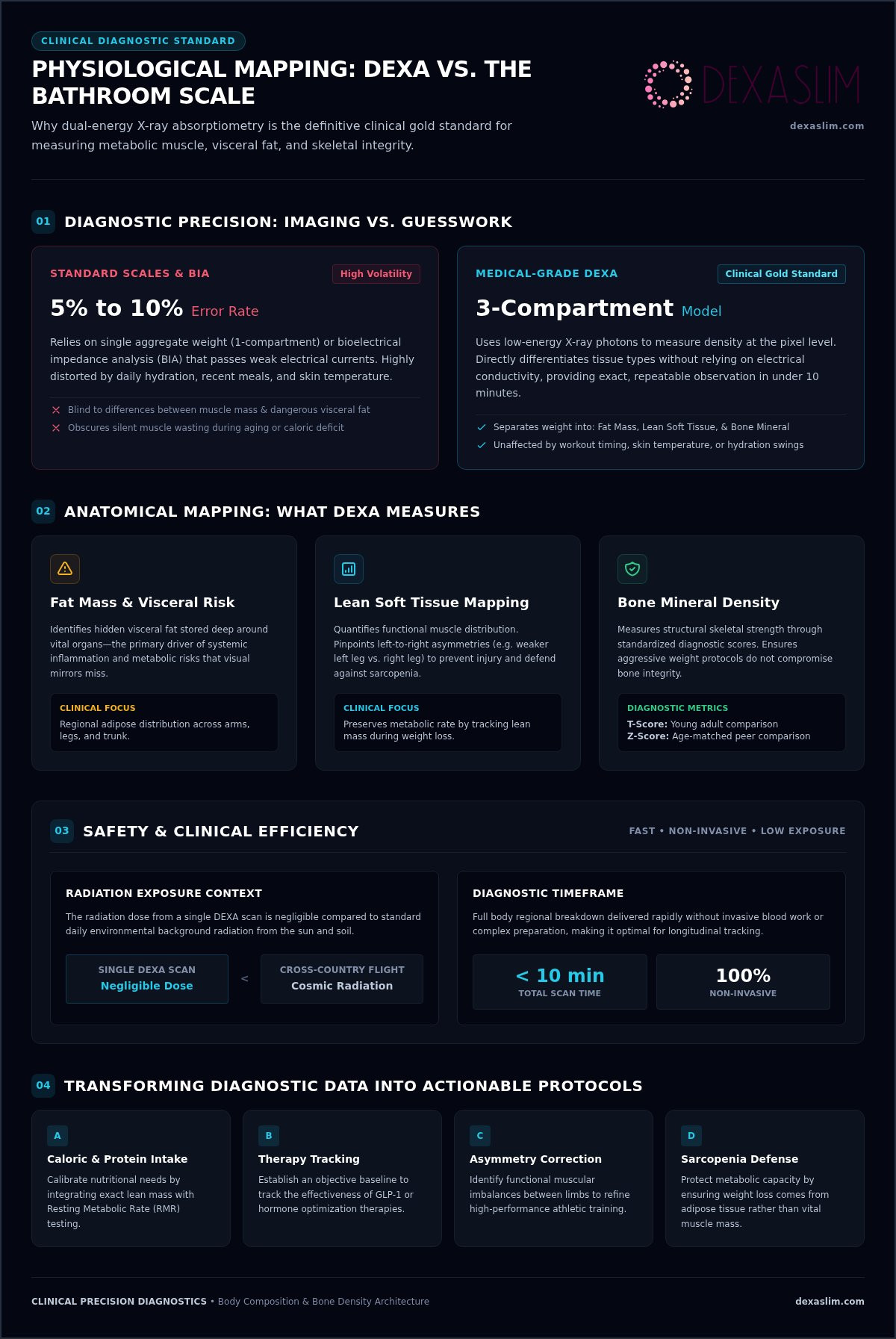
The bathroom scale is an obsolete diagnostic tool for anyone serious about longevity. It provides a single, aggregate number that obscures your true physiological state. You might lose weight while sacrificing vital muscle mass, or gain weight while successfully reducing systemic fat. A dexa scan eliminates this ambiguity by providing a medical-grade internal map. Unlike basic scales or BMI, which rely on height-to-weight ratios, Dual-energy X-ray absorptiometry utilizes a three-compartment model. It precisely separates your total weight into fat mass, lean soft tissue, and bone mineral content. This is the clinical baseline required for any data-driven health strategy.
DEXA vs. InBody: Imaging vs. Electrical Impedance
Many fitness enthusiasts rely on bioelectrical impedance analysis (BIA), such as InBody scales, to track progress. These devices send a weak electrical current through the body to estimate composition. The results are highly volatile. Your hydration levels, recent meals, and even skin temperature can trigger a 5% to 10% swing in fat percentage readings. Clinical imaging doesn't rely on conductivity. A dexa scan uses low-energy X-ray photons to physically differentiate between tissue types. The technology measures the density of every pixel in the scan, ensuring your data remains consistent regardless of whether you just finished a workout or drank a liter of water. It is the difference between an estimate and an observation.
The Safety Profile of Modern DEXA Scans
Diagnostic imaging often triggers unnecessary anxiety regarding radiation. Modern DEXA technology is engineered for extreme efficiency and minimal exposure. The radiation dose is negligible compared to the background environmental exposure you receive every day from the sun and soil. To put this in perspective, the radiation dose from a single scan is significantly lower than the cosmic radiation you encounter during a standard cross-country flight. It is a safe, non-invasive procedure that provides actionable intelligence without compromising your long-term health. Precision diagnostics should empower you, not intimidate you. You get clinical-grade insights with a safety profile that fits seamlessly into a proactive wellness routine.
The Science of Precision: Measuring Fat, Lean Mass, and Bone Density
A single dexa scan session delivers a comprehensive anatomical breakdown that no other non-invasive technology can match. It segments the body into distinct regions, providing a granular look at the arms, legs, and trunk. This regional analysis is vital. It allows you to see exactly where you are storing fat and where you are building muscle. According to the clinical definition of DEXA, this imaging technique is the primary method for evaluating bone mineral density while simultaneously quantifying soft tissue. It provides a complete metabolic profile in under ten minutes. By identifying where adipose tissue accumulates, you can better understand your specific metabolic risks. Not all fat is equal. Regional distribution tells the story that your total weight hides.
Skeletal Health and Bone Mineral Density (BMD)
Skeletal integrity is the foundation of longevity. A Bone Density Scan provides two critical metrics: T-scores and Z-scores. Your T-score compares your bone mass to that of a healthy young adult, while your Z-score compares you to your age-matched peers. Athletes and longevity seekers shouldn't ignore these numbers. High lean muscle mass creates mechanical tension that strengthens bones. If you are aggressive with weight management, you must ensure your skeletal structure isn't being compromised. Monitoring these scores allows you to intervene before bone loss becomes irreversible. Skeletal strength is a proactive metric, not a reactive one.
Lean Mass Mapping for Performance Optimization
Precision performance requires identifying muscular asymmetries. DEXA mapping reveals if your left leg is significantly weaker than your right, which is a primary predictor of injury. For those aging or in a caloric deficit, tracking lean mass is non-negotiable to prevent sarcopenia. You don't want to lose weight; you want to lose fat. If your lean mass drops, your metabolic rate follows. Mapping your progress with a 1 Session Dexa Scan ensures your body recomposition goals remain grounded in data rather than hope. It allows you to set realistic targets based on your actual physiology. You can finally stop chasing a number on the scale and start building a functional, resilient body.
Data allows for total control over your physical evolution. When you identify a muscle imbalance early, you can adjust your training load to prevent a catastrophic tear. When you see bone density trending downward, you can implement nutritional interventions immediately. This is the essence of high-performance physiology. You aren't just measuring your body; you are refining it through objective, clinical-grade evidence.
Visceral Fat: Identifying the Internal Health Risks Your Mirror Misses
Visceral adipose tissue (VAT) is not the soft fat you can pinch. It's a metabolically active organ packed deep within your abdominal cavity. It surrounds your heart, liver, and kidneys. Unlike subcutaneous fat, VAT secretes pro-inflammatory cytokines directly into your portal vein. This drives systemic inflammation and serves as a primary catalyst for metabolic syndrome. You cannot see this fat in a mirror. You cannot measure it with a tape. A dexa scan is the only accessible clinical diagnostic that quantifies this internal health risk with precision. It transforms a hidden threat into a measurable metric.
Visceral vs. Subcutaneous Fat: The Longevity Gap
Subcutaneous fat is an aesthetic concern; visceral fat is a survival concern. "Skinny fat" individuals often harbor dangerous VAT levels despite a normal BMI. This hidden fat compresses organs and impairs metabolic efficiency. Clinical data establishes clear risk thresholds. A VAT area below 100 cm² is considered low risk. Readings between 100 and 160 cm² indicate elevated risk. Once you cross the 160 cm² threshold, you face a high risk for cardiovascular disease and type 2 diabetes. High VAT levels are strongly correlated with all-cause mortality. Knowing your number is the first step toward extending your healthspan. Precision diagnostics reveal the truth that your reflection hides.
Tracking VAT Reduction During Metabolic Therapy
Optimization requires more than just a lower number on the scale. If you are utilizing GLP-1 Peptide Therapy, you need to verify that your weight loss is coming from the right compartments. Rapid weight loss can lead to significant muscle wasting if not monitored. A baseline dexa scan allows you to track the specific reduction of visceral fat over time. It confirms that your metabolic therapy is working as intended. This data ensures you are losing toxic fat stores rather than functional lean muscle. Using internal data allows you to adjust your protein intake or resistance training volume in real time. It prevents the metabolic slowdown associated with losing lean tissue. Objective internal data is the ultimate validator of your lifestyle interventions. Stop guessing about your internal health. Measure it. Establish a baseline before starting any intensive metabolic protocol.
Data-Driven Optimization: Transforming Results into Actionable Protocols
Data without execution is useless. A clinical dexa scan provides the precise raw metrics required to build an uncompromised performance protocol. Instead of relying on generic caloric calculators, you can calibrate your exact daily energy expenditure by pairing your lean mass data with a Resting Metabolic Rate (RMR) Test. Lean tissue is the primary driver of your metabolism. Knowing your exact muscle mass allows you to adjust your protein requirements down to the gram, ensuring optimal recovery and tissue preservation. You stop guessing. You start executing based on biological fact.
Calibrating Peptide and Hormone Therapy
Advanced metabolic therapies demand rigorous diagnostic tracking. When initiating GLP-1 Peptide Therapy, a baseline scan is critical to ensure that weight loss is derived from adipose tissue rather than skeletal muscle. If the data reveals a drop in lean mass, your clinical protocol must change immediately. Similarly, tracking how Testosterone Replacement Therapy (TRT) shifts your lean mass distribution allows for precise optimization. You can refine your dosage, duration, and lifestyle support based on real tissue response diagnostics. It transitions hormone management from a subjective guessing game into a precise clinical science.
Synergistic Testing: The VO2 Max + DEXA Bundle
True human optimization requires analyzing both structural composition and aerobic capacity. Your body composition directly dictates your aerobic efficiency; excess fat mass acts as dead weight that compromises your power-to-weight ratio. Combining composition data with VO2 Max Performance Testing provides a complete cardiorespiratory and metabolic profile. You get a clear picture of your cellular energy production alongside your physical blueprint. This unified approach allows you to build a definitive longevity baseline. You can target specific cardiovascular weaknesses while simultaneously protecting your muscular architecture. To establish your complete physiological baseline today, secure your VO2 Max + DEXA (BCA) Bundle and eliminate intuition from your longevity strategy.
Every adjustment you make to your training, nutrition, or clinical protocol should be validated by objective measurement. Repeat scans every three to six months create a continuous feedback loop. This loop reveals exactly how your body responds to specific interventions. If a protocol isn't generating the desired tissue response, you pivot immediately. This is how elite performance is achieved and maintained over a lifespan.
Booking Your Baseline: The Dexaslim Clinical Diagnostic Experience
Establishing a baseline is the final step in moving from speculation to strategy. A 1 Session Dexa Scan at Dexaslim is an efficient, clinical procedure designed for absolute data integrity. You aren't just getting an image; you're obtaining a digital blueprint of your internal physiology. This diagnostic event serves as the foundation for your Longevity Panel, allowing our team to cross-reference your tissue distribution with your metabolic blood markers. Precision is the priority. We ensure every variable is controlled so your results reflect your true biological state.
Preparing for Your Scan
Maximum accuracy requires strict adherence to preparation protocols. Wear lightweight, athletic clothing for your appointment. Remove all metal, including jewelry, zippers, and underwire, as these materials interfere with the X-ray photon absorption and skew results. Consistency is paramount for longitudinal tracking. We recommend maintaining a stable hydration status and arriving in a fasted state if possible. If you scan in the morning after a meal, ensure every subsequent re-scan follows that exact same schedule. The procedure itself is rapid and non-invasive. You simply lie flat on the padded platform while the scanner arm passes over your body. The entire process takes approximately 6 to 10 minutes. Your comprehensive report is available immediately, providing instant visibility into your fat, muscle, and bone health.
From Diagnostics to Treatment
Raw data is only valuable when translated into a clinical action plan. After your dexa scan, you will review your anatomical mapping with a clinical performance strategist. This session identifies the specific interventions required to optimize your profile. If the scan reveals elevated visceral fat, we may explore Advance Peptide Treatment or GLP-1 Peptide Therapy to aggressively target metabolic dysfunction. If muscle mass is insufficient, the data may justify a Testosterone Replacement Therapy protocol to drive lean mass accretion. Data eliminates the need for intuition-based health decisions.
Diagnostics shouldn't be a one-time event. To maintain high-performance standards, we recommend re-scanning every three to six months to validate your protocol's efficacy. This frequency allows for rapid adjustments to nutrition and training before plateaus become permanent. For bone health, a Bone Density Scan is typically repeated every two years, though high-risk individuals may require more frequent monitoring. You're now equipped with the clinical tools to navigate your health with absolute certainty. Stop guessing. Start measuring.
Take Command of Your Physiological Future
Intuition is a liability in the pursuit of elite longevity. You've seen how a medical-grade dexa scan transforms hidden physiological risks into actionable data. It identifies dangerous visceral fat and maps muscle distribution with clinical precision. This is the only way to validate your metabolic interventions. Whether you're refining GLP-1 Peptide Therapy or optimizing your power-to-weight ratio, you need objective proof of progress. Stop letting imprecise scales dictate your strategy.
Dexaslim provides the ultimate diagnostic ecosystem. We integrate clinical-grade diagnostic technology with medically supervised peptide and hormone protocols. For those demanding a total performance profile, our VO2 Max + DEXA bundles offer the most comprehensive baseline available. You have the intelligence. You have the ambition. Now, get the data. Schedule your clinical DEXA scan today at Dexaslim and start executing your high-performance protocol with absolute certainty. Your peak physical state is no longer a goal; it's a measurable outcome.
Frequently Asked Questions
How accurate is a DEXA scan for body fat percentage?
A dexa scan provides a precision error of approximately 0.5% to 1% for body fat percentage. This degree of exactitude far exceeds consumer-grade bioelectrical impedance scales, which often exhibit variability between 5% and 10%. By utilizing dual-energy X-ray technology, the scanner differentiates between fat, lean mass, and bone mineral content at a granular level. It eliminates the variables of hydration and food intake that compromise lesser diagnostic tools.
How often should I get a DEXA scan to track progress?
Tracking body composition requires a consistent feedback loop. For individuals pursuing fat loss or muscle hypertrophy, we recommend a scan every three to six months. This interval allows enough time for measurable physiological changes to manifest while providing the data necessary to pivot your nutrition or training protocol. If you are monitoring skeletal health, a session every two years is the clinical standard unless specific medical conditions require more frequent evaluation.
Is a DEXA scan safe for regular testing?
Diagnostic safety is a hallmark of modern DEXA technology. The radiation dose from a single session is negligible, measuring significantly lower than the cosmic radiation you encounter during a standard cross-country flight. It is a non-invasive, low-energy procedure that poses no significant risk for regular physiological monitoring. You can comfortably integrate these scans into your annual or semi-annual longevity strategy without concern for cumulative exposure.
What is the difference between a DEXA scan and a bone density test?
The primary difference lies in the data analysis rather than the hardware. A body composition scan quantifies fat and lean mass distribution across the entire body to optimize performance. A Bone Density Scan specifically evaluates the mineral density of the hips and spine to assess osteoporosis risk. While both utilize the same medical-grade technology, the bone density assessment focuses on T-scores and Z-scores to identify skeletal vulnerabilities.
Do I need a doctor referral for a DEXA scan at Dexaslim?
You don't need a doctor's referral to access diagnostics at Dexaslim. We operate as a direct-access performance clinic, allowing you to take immediate control of your physiological data. While bone density scans for medical diagnosis may involve insurance and referrals elsewhere, our body composition and metabolic testing services are available as direct-fee appointments. This autonomy ensures you can establish your baseline and begin optimization protocols without traditional healthcare delays.
Can a DEXA scan measure visceral fat accurately?
A dexa scan is the most practical clinical tool for measuring visceral adipose tissue (VAT) outside of a research setting. It accurately identifies the metabolically active fat surrounding your internal organs, which mirrors and tape measures cannot detect. The scan provides a precise VAT area measurement in square centimeters or grams. This data is critical for identifying risks for metabolic syndrome, type 2 diabetes, and cardiovascular disease.
How long does a DEXA scan take and when do I get results?
Efficiency is built into the diagnostic experience. The scan itself takes between 6 and 10 minutes to complete, during which you simply lie still on a padded platform. You receive your comprehensive results immediately following the session. Your report provides a detailed regional breakdown of fat, muscle, and bone, allowing you to review your physiological map with a strategist and implement protocol changes the same day.
Should I do a DEXA scan or a VO2 Max test first?
We recommend performing both tests as part of a VO2 Max + DEXA (BCA) Bundle to get a complete physiological baseline. If you must choose one, start with the DEXA scan. Your body composition directly impacts your aerobic efficiency and power-to-weight ratio. Establishing your lean mass and fat distribution first provides the context necessary to interpret your VO2 Max results. Together, they offer a definitive blueprint for cardiorespiratory and metabolic optimization.