.svg)


What if the most useful health measurement isn’t a label, but a baseline you can compare over time? Proactive health diagnostics can make health data more personal and specific, especially when routine care feels too general or wellness claims leave you unsure which numbers matter. A result without context, however, can raise more questions than it answers. Measurement is a starting point, not a diagnosis.
The value comes from a repeatable feedback loop: establish a baseline, review changes, and use the pattern to guide an informed conversation with a qualified clinician. A single result can’t tell the whole story, and more testing isn’t automatically better. The goal is useful context, not a pile of biomarkers.
This article explains what proactive testing can and can’t show, how to approach follow-up measurements, and how to interpret results responsibly. You’ll learn how DEXA scans, VO2 Max testing, Resting Metabolic Rate testing, and longevity blood panels answer different questions. You’ll also see how to distinguish performance assessments and screening measures from diagnostic tests, so data can sharpen your questions without replacing medical care.
Key Takeaways
• Use proactive health diagnostics to establish a baseline and track meaningful changes over time, not to collect numbers without a clear purpose.
• Match each measurement to a question: DEXA can assess body composition or bone density, while VO2 Max and RMR testing provide different insights into fitness and energy use.
• Separate screening, risk assessment, diagnosis, and performance testing. Each serves a different purpose, and testing alone doesn’t prevent disease.
• Before choosing a test, define your goal, consider the context around the result, and plan how you’ll review and reassess it.
• Dexaslim’s DEXA scans, VO2 Max and RMR testing, and longevity panels provide distinct data points for building a more measurable health baseline.
Why proactive health diagnostics are moving health conversations upstream
Health conversations often begin after a symptom appears. Proactive health diagnostics shift some attention earlier: establish a useful baseline, then use relevant measurements to make follow-up discussions more specific. A baseline gives you a reference point. A later result can show whether a measurement changed, but it can’t explain the cause or diagnose a condition on its own.
That distinction matters. How you feel is valuable information, but it may not reveal every measurable change. A scale reading offers a narrow snapshot, while body composition, exercise capacity, and blood markers address different questions. Used thoughtfully, these measurements can add context to routine care and symptom-driven evaluation. They don’t replace either one.
For a broader overview of the goals and levels of prevention, see Preventive healthcare. Proactive measurement can support prevention discussions, but testing itself isn’t a promise of prevention.
See how smart diagnostics are discussed in this overview:
What does proactive health diagnostics mean?
Proactive health diagnostics is purposeful measurement used to establish a reference point, track relevant changes, and guide informed follow-up, not a guarantee that disease will be prevented. A measurement is the result captured at a particular time. A trend is a pattern across results. Follow-up means reviewing that pattern in context, including symptoms, health history, and other relevant information. One result can prompt a useful question; it doesn’t answer every clinical question.
Why are people seeking more measurable health information?
Interest in longevity, metabolic health, and fitness has made individualized insight appealing. Wearables and more accessible testing have also made measurements more visible, encouraging people to look beyond general advice. But more data doesn’t automatically mean better decisions. A personal goal, such as understanding fitness or tracking body composition, is different from a clinical reason for testing. Start with a clear question, and keep routine care and medical evaluation in the picture.
Which proactive health diagnostics measure body composition, metabolism, and fitness?
Choose a measurement by the question you want to answer. Proactive health diagnostics can include scans, performance assessments, and blood tests, but these tools don’t measure the same thing. DEXA describes body composition or bone density, VO2 Max assesses cardiorespiratory fitness, RMR estimates resting energy expenditure, and blood biomarkers capture specific biological measurements. Each provides a distinct data point, not a complete verdict on health.
What can body composition and bone density measurements show?
A DEXA scan’s purpose shapes what its results mean. A body-composition scan estimates components such as fat and lean tissue, while a bone-density scan assesses bone mineral density for a different clinical question. These are distinct uses of DEXA, not interchangeable interpretations. Either result is a snapshot, and neither independently diagnoses overall health. For a closer look at body-composition measurement, explore this DEXA body composition scan guide.
How do metabolic, fitness, and blood tests add different context?
VO2 Max testing assesses how the body uses oxygen during exercise and evaluates cardiorespiratory fitness. Resting Metabolic Rate testing estimates energy expenditure while the body is at rest. It doesn’t, by itself, determine total daily energy needs. These assessments answer different questions: VO2 Max relates to exercise capacity, while RMR measures resting energy use. Neither substitutes for the other.
Blood tests add another layer. A longevity panel gathers multiple biomarkers, not one definitive health score. Results need interpretation alongside the specific test, reference ranges, health history, symptoms, and other relevant information. A result within a reference range doesn’t automatically settle a health question, and an out-of-range result doesn’t establish a diagnosis by itself. The comprehensive longevity panel guide and this overview of biomarker testing for longevity offer more detail on what blood results can and can’t tell you.
Interpretation matters as much as measurement. The American College of Preventive Medicine provides resources on preventive medicine, a useful wider context for considering how health information can inform decisions. Use test results to frame focused questions and clinician-guided next steps, not to self-diagnose or treat a number in isolation.
Can proactive health diagnostics prevent disease? Understand the evidence and limits
No. Testing can inform decisions, but testing alone doesn’t prevent disease. Its value depends on what is measured, why the test is used, and what happens next. A result may help guide a discussion about risk, follow-up, or health goals. It doesn’t guarantee prevention, extend lifespan, or replace appropriate medical care. Treat broad claims about disease prevention or longevity as claims to examine carefully, with evidence and qualified clinical input.
Different tests serve different purposes. Screening looks for possible signs of a condition or assesses risk before symptoms, when the test is appropriate for that person and context. Diagnosis evaluates whether a condition is present, often using clinical assessment and additional testing. Risk assessment estimates the likelihood of an outcome; performance testing measures physical capacity. A wellness or performance assessment isn’t automatically a screening test or diagnostic evaluation.
What is the difference between screening and diagnosis?
A screening result can flag a reason for follow-up, but it doesn’t confirm a disease. Diagnostic evaluation may consider symptoms, medical history, examination, and further tests. Screening decisions should align with relevant clinical guidance and individual circumstances, rather than being based only on curiosity or a desire for more data. Wellness assessments don’t substitute for guideline-based screening or medical evaluation when symptoms or concerns arise.
Why can a single test result mislead?
Results are snapshots. Biological variation and testing conditions can influence measurements, so a difference between tests doesn’t necessarily signal a meaningful change in health. Reference ranges describe how results compare with a defined population or laboratory interval. They aren’t automatically personal targets, and a result outside a range isn’t, by itself, a diagnosis. Likewise, an in-range result can’t rule out every concern.
Testing also has trade-offs. A false positive can prompt worry or further evaluation when the suspected issue isn’t present. A false negative can offer false reassurance, while incidental findings may lead to follow-up for something unrelated to the original question. These possibilities aren’t a reason to reject useful tests. They’re a reason to choose tests with a clear purpose and understand what follow-up could involve.
Interpret results in context: clinical history, symptoms, medications, age, and the reason for testing all matter. If a result is unexpected, review it with a qualified clinician before making major changes to medication, diet, or training. Use the finding to ask a focused question, not to self-diagnose. Responsible proactive health diagnostics means balancing useful measurement with sound interpretation and appropriate medical care.
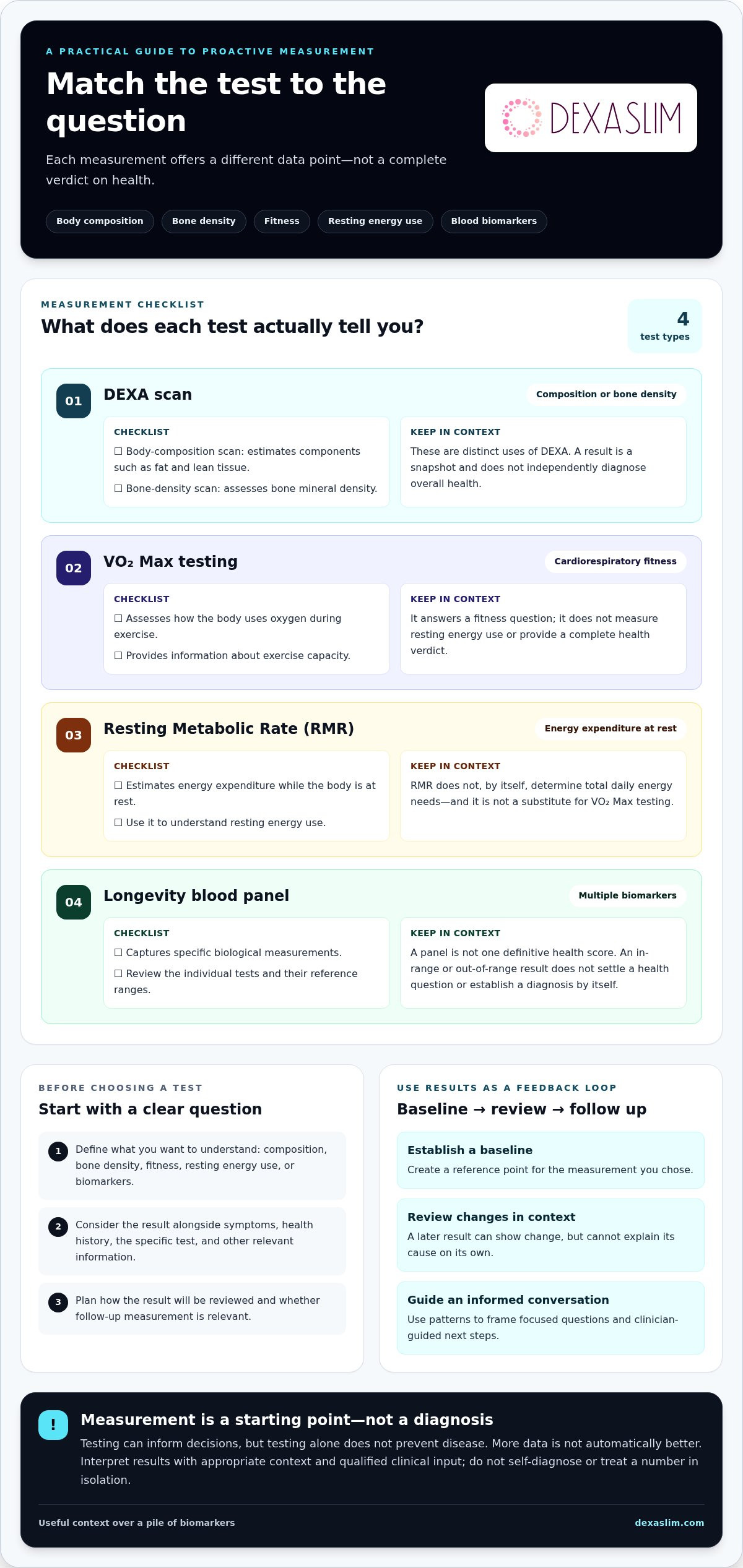
How to use proactive health diagnostics as a practical feedback loop
Turn measurements into a process, not a one-time data grab. Useful diagnostics answer a defined question and lead to an informed next step. Before selecting a test, name the goal: understand exercise capacity, track body composition, or clarify a specific clinical question with a qualified clinician. The goal determines which measurement is relevant and how its result should be used.
1. Define the question.
Be specific about what you want to understand or track.
2. Select a relevant measure.
Match the test to the question rather than choosing tests simply because they’re available.
3. Establish context.
Record the purpose, date, method, and conditions that could affect the result.
4. Review the result.
Consider it alongside your circumstances and, when appropriate, discuss it with a clinician.
5. Reassess thoughtfully.
Decide whether another measurement could answer a useful follow-up question.
How should you set a meaningful baseline?
Make the first result interpretable. Keep a record of when and how it was measured, why you chose the assessment, and relevant conditions such as recent activity or preparation instructions. For follow-up, keep conditions as consistent as practical when clinically appropriate. Don’t treat results from different methods as interchangeable: a difference may reflect how the measurement was taken, not a meaningful shift in your health. For more detail on energy-use testing, see the resting metabolic rate test guide.
How should you interpret changes over time?
Look for repeatable patterns, not a story in one isolated result. If measurements differ, consider whether the method, conditions, or your personal circumstances changed between assessments. A result can help you prepare a focused question for a clinician, but it can’t diagnose a condition or justify changing treatment on its own.
There’s no universal retesting schedule. The right interval depends on the measure, the reason for testing, your clinical context, and professional guidance. Reassess when there’s a clear reason to do so, not simply to generate more data. That discipline keeps proactive health diagnostics focused on decisions rather than numbers alone.
Dexaslim offers diagnostic testing options including DEXA, VO2 Max, and RMR assessments. Choose the measure that best fits your health or performance question.
How Dexaslim diagnostics can support a more measurable health baseline
A useful assessment starts with a clear question, not a presumption that more testing is always better. Dexaslim provides body composition and bone density scans, metabolic and performance assessments, and longevity panels. Each gathers different information. The right fit depends on your goals, health history, and clinical context. Results can help establish a baseline and support clinician-guided discussion, but they don’t diagnose every condition on their own or guarantee a particular outcome.
Which Dexaslim assessments address different health questions?
Each assessment measures something different. Match the measure to what you want to understand:
DEXA body-composition scan
Provides information about body composition, including fat and lean tissue.
Bone density scan
Assesses bone density for a distinct purpose and can help evaluate osteoporosis risk. It shouldn’t be treated as interchangeable with a body-composition scan.
VO2 Max testing
Assesses cardiorespiratory fitness by measuring oxygen use during exercise. It can provide a performance baseline, not a complete picture of health.
Resting Metabolic Rate testing
Estimates energy expenditure at rest. It offers a specific metabolic measure, not a standalone determination of total daily energy needs.
Longevity panels
Measure blood biomarkers that can contribute information about health. Findings need appropriate interpretation in context, rather than being reduced to a single definitive score.
These options make proactive health diagnostics more focused: a body-composition question calls for a different measure than a fitness or blood-marker question. Even a precise measurement has limits. Its value comes from understanding what it assesses, how it relates to your goal, and what a result can reasonably inform.
What is a useful next step after learning about testing?
Start by writing down the question you want a measurement to help answer. Are you seeking a body-composition baseline, insight into cardiorespiratory fitness, a resting energy-use estimate, or blood biomarker information? Bring relevant results and specific questions to an appropriate clinician, especially if a finding is unexpected or connects to symptoms, medication, or an existing health concern. Use data to support the conversation, not to self-diagnose or change treatment on your own.
Explore Dexaslim diagnostics to learn about assessments that can help establish a measurable baseline.
Make your next health decision more measurable
Proactive health diagnostics are most useful as a feedback loop: define a question, choose a relevant measure, establish a baseline, and review changes in context. A result can sharpen a conversation with a clinician, but it isn’t a diagnosis or a guarantee of prevention.
Different measurements answer different questions. Medical-grade DEXA scans assess body composition or bone density, while VO2 Max testing evaluates cardiorespiratory fitness and Resting Metabolic Rate testing estimates energy use at rest. Longevity blood panels add biomarker data that also needs careful interpretation. The right starting point depends on your goals and clinical context.
Ready to turn a health question into a clearer measurement plan? Explore Dexaslim’s diagnostic testing to learn about DEXA and bone density scans, VO2 Max and RMR testing, and longevity panels. Use the data thoughtfully, bring relevant questions to an appropriate clinician, and take your next step with greater clarity.
Frequently Asked Questions
What is proactive health diagnostics?
Proactive health diagnostics means using purposeful measurements to establish a baseline, assess a specific health or performance question, and inform appropriate follow-up. Depending on your goal, this may include body composition, bone density, cardiorespiratory fitness, resting energy expenditure, or blood biomarkers. These measurements can help frame a conversation with a qualified clinician. They don’t mean everyone needs every test, and testing alone doesn’t prevent disease or replace medical care.
Can proactive health testing prevent disease?
No. Testing alone cannot prevent disease. A well-chosen assessment may reveal information worth discussing with a qualified clinician, but its value depends on the test, your circumstances, and what happens next. Screening recommendations vary according to factors such as health history. Treat claims that a test guarantees prevention, extends lifespan, or produces a particular outcome with caution. Use appropriate screening and clinical guidance to make informed decisions, not promises.
Which tests are commonly used for proactive health diagnostics?
Common examples include DEXA assessments for body composition or bone density, VO2 Max testing for cardiorespiratory fitness, Resting Metabolic Rate testing for energy expenditure at rest, and blood panels that measure selected biomarkers. Each test addresses a different question. No single assessment provides a complete picture of health. Interpret results according to the test’s purpose and your clinical context, and discuss findings with a qualified clinician when needed.
How often should you repeat proactive health tests?
There’s no single retesting schedule for every test or person. The appropriate interval depends on the measurement, reason for testing, previous results, and relevant clinical guidance. Repeating a test too soon may not provide useful information. Discuss appropriate timing with a qualified clinician. For meaningful comparisons, try to use the same measurement method and similar conditions, while following any test-specific preparation instructions.
Are proactive health diagnostics the same as preventive screening?
No. The terms overlap, but they aren’t interchangeable. Preventive screening refers to tests used in specific populations or circumstances to look for certain conditions. Proactive health diagnostics is broader and may include fitness, body-composition, metabolic, or biomarker assessments. A wellness measurement doesn’t automatically meet screening guidelines or diagnose a medical condition. Keep recommended screening and medical evaluation distinct from assessments chosen to understand personal health or performance goals.
Can blood biomarkers tell you your biological age?
Blood biomarkers can provide information about selected biological processes, but a panel isn’t a definitive measure of biological age or future health. What results mean depends on which markers are included, how they’re interpreted, and your individual circumstances. Treat panel findings as points for discussion, not a standalone score or prediction. Review unexpected results with a qualified clinician before making major health or treatment decisions.