.svg)


A longer list of biomarkers doesn’t automatically make a longevity panel more useful. A comprehensive longevity panel earns its value when its results connect to clear health questions, personal context, and practical next steps. Without that structure, more data can create more confusion.
If you’re unsure which markers matter for long-term health, start by identifying what you want to understand. Panel contents vary, and a result outside a reference range isn’t a diagnosis or a prediction of lifespan. Dexaslim’s Longevity Panel and blood diagnostics assess biological markers, organ function, and metabolic balance to provide a measurable starting point for proactive health discussions.
This guide explains what longevity blood testing can assess, how to judge whether a panel’s scope fits your goals, and what to consider when reviewing results. You’ll learn how to connect findings with relevant health questions and clinical context, rather than treating every number as a problem to fix. The goal is to use data to make more informed decisions about your next steps.
Key Takeaways
• A blood panel captures selected biomarkers at a point in time. Use it to inform focused health discussions, not to diagnose every condition or predict lifespan.
• Compare a comprehensive longevity panel by the health questions it can help explore, not simply by the number of tests it includes.
• Look at broad categories such as metabolic balance and organ function to judge whether a panel’s scope fits your goals.
• Prepare and review results in sequence: clarify your goals, follow the test-specific instructions, then consider appropriate follow-up.
• Dexaslim’s Longevity Panel evaluates biological markers, organ function, and metabolic balance to support proactive health tracking and informed next steps.
What a Comprehensive Longevity Panel Can, and Cannot, Tell You
A blood panel measures selected biomarkers at a particular point in time. A comprehensive longevity panel can provide a snapshot of biological signals related to areas such as metabolic balance and organ function. Used thoughtfully, that snapshot can establish a baseline and help focus health discussions on questions relevant to your goals.
Think of results as data to interpret, not a verdict. A measurement can fall outside a reference range without explaining why, while a result within range doesn’t guarantee that every aspect of health is optimal. A panel’s usefulness depends on the measures included, your personal health context, and how the findings inform reasonable follow-up.
What does a longevity blood panel evaluate?
Longevity panels can assess broad categories such as metabolism and organ function. The right selection depends on the health question being explored, relevant history, and the decisions the results could help inform. To compare panels, look at the categories each evaluates and how they relate to your goals. A longer test list isn’t automatically a better match.
Some tests measure laboratory values directly. Others combine data to estimate biological age, a concept that compares aspects of biological aging with chronological age. Biomarkers of aging offers background on this distinction. Treat an age-related score as a model-based estimate, not a direct measurement of lifespan or a guaranteed forecast of future health.
What can one panel not predict?
One result cannot determine how long an individual will live or precisely predict future health. Biomarkers can change, and a reading may be influenced by when testing occurs, current medications, recent illness, and other personal factors. That’s why a result is most useful alongside relevant context and, when appropriate, repeat measurements or further evaluation.
A biomarker measurement is a signal to interpret, not a diagnosis on its own. Use results to identify focused questions and discuss what they may mean in context. Avoid drawing conclusions from a single flagged value or treating a biological-age score as a complete picture of health. The goal is a clearer starting point for informed decisions, not certainty from one snapshot.
Which Biomarker Categories Matter When Comparing Longevity Panels?
Start with the health question, not the test count. A comprehensive longevity panel is useful when its measurements relate to a clear goal and can inform a relevant next step. Since panel contents vary, compare the categories assessed and the context needed to interpret them. A longer list alone doesn’t make a panel more informative for you.
How do metabolic and organ-function markers differ?
Biomarkers reflect different processes. Metabolic measures can offer information about how the body manages energy and blood sugar, while organ-function markers can help assess aspects of how particular organs are working. These are broad categories, not interchangeable readings.
For example, HbA1c is a measure related to average blood glucose over time, while lipid testing assesses fats in the blood. These examples illustrate different types of laboratory tests. Their relevance depends on a person’s health history, goals, and other findings. When comparing a panel, ask what each category could help clarify and whether that information supports a practical follow-up discussion.
Blood biomarkers also differ from metabolic-rate testing. A blood test measures laboratory values, while a resting metabolic rate test estimates energy use while the body is at rest. Learn more in this resting metabolic rate test guide.
How can body-composition data add context?
Blood biomarkers and body-composition measurements answer different questions. Blood testing evaluates selected biological markers. A body-composition assessment provides information about the body’s makeup. One can’t substitute for the other, but together they may add distinct context to a broader health discussion.
Complementary measurements broaden the picture; they don’t measure the same thing. A DEXA scan, for example, assesses body composition, while blood testing measures selected markers in a sample. Explore the DEXA body composition scan guide to understand how that assessment differs from blood diagnostics.
Choose categories based on what you want to understand and how the information could shape an informed next step. Dexaslim’s Longevity Panel evaluates biological markers, organ function, and metabolic balance as a structured starting point for proactive health tracking. Explore the Longevity Panel to learn about Dexaslim’s blood diagnostics.
How to Compare Comprehensive Longevity Panels Before Choosing
Compare what a panel is designed to help you understand, not just how many measurements it lists. A structured comparison makes the decision more practical: connect your health question to the panel’s stated categories, the context needed to interpret results, and the kind of follow-up the data could inform.
Which questions should guide a panel comparison?
Start by defining what you want testing to clarify. Then compare panels against that goal and your health context. Use a simple framework like this:
| Comparison area | What to assess |
|---|---|
| Purpose | What health questions is the panel designed to inform? |
| Biomarker categories | Do the stated categories align with your goals? |
| Personal context | What history, medications, or other factors may matter when interpreting results? |
| Follow-up usefulness | Can you identify what questions or next steps the findings may help guide? |
This framework keeps attention on relevance and interpretability. It also separates what the laboratory measures from what happens next. A panel provides results for selected tests. Interpretation considers those findings alongside individual context, and any subsequent clinical decisions are separate from the measurements themselves. Don’t assume a list of results automatically explains what they mean for you.
Does a larger panel provide better insight?
Additional measurements can add context, but they can also leave you with more values to understand. A result may raise questions without answering them on its own. If a measure doesn’t connect to your goals or lead to a useful discussion, its presence may add complexity rather than clarity.
A useful panel is defined by relevant measurements and actionable context, not by its test count. Prioritize whether the stated categories fit your question, whether results can be considered alongside your health background, and whether the findings could inform a sensible follow-up conversation. Avoid choosing by the headline number alone or expecting any panel to guarantee a particular outcome.
Use this decision framework to narrow your priorities before testing. Dexaslim’s Longevity Panel evaluates biological markers, organ function, and metabolic balance as a structured starting point for proactive health tracking. Explore the Dexaslim Longevity Panel for blood diagnostics that support informed next steps.
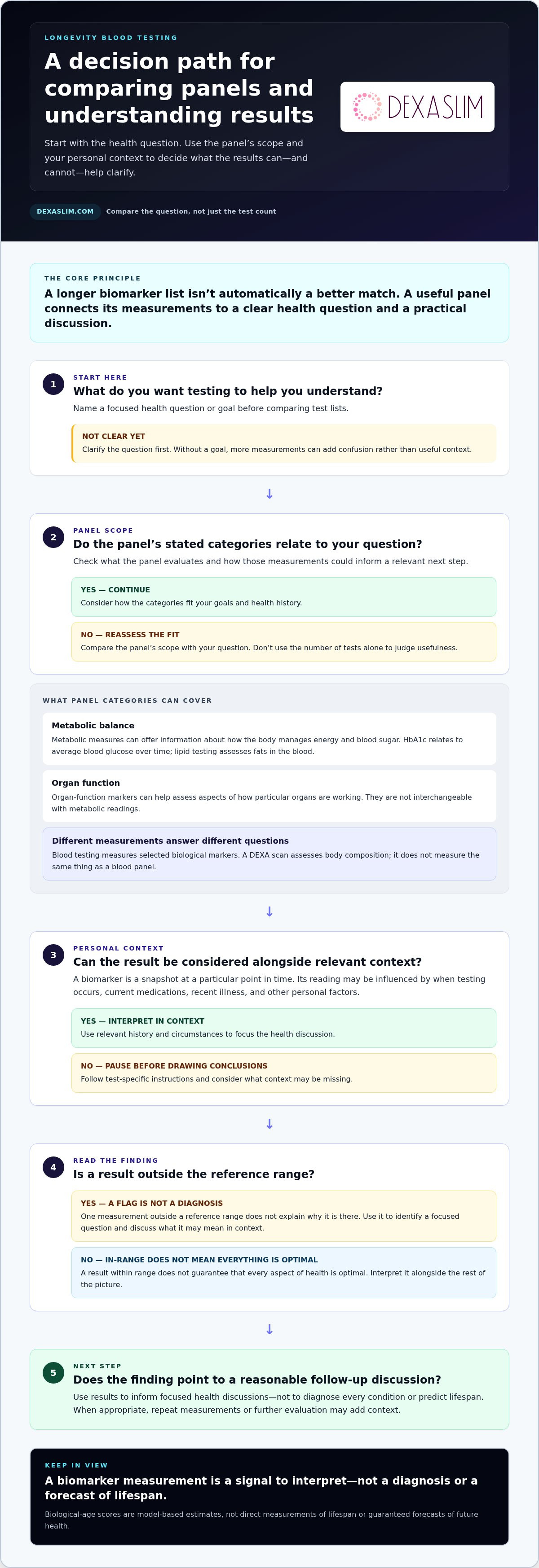
How to Prepare for Testing and Make Sense of Results
Use a simple sequence to keep testing focused: clarify what you want to learn, follow the instructions for your specific test, review the findings in context, then plan appropriate follow-up. A comprehensive longevity panel can generate useful data, but preparation and interpretation shape how well those results serve your goals.
What should you do before a blood panel?
Start by defining your testing goals. Follow the collection and preparation instructions provided for your specific test rather than assuming every blood panel has the same requirements. Before testing, share relevant medications and supplements with the appropriate clinician. These details can provide context when reviewing results. Don’t change or stop a medication or supplement based on assumptions about how it may affect a test.
When results are available, review them alongside relevant health history, current medications, recent illness, and other factors that may affect interpretation. A number on a report is one part of the picture. It doesn’t explain its cause by itself, and it shouldn’t be treated as a complete assessment of health.
How should you respond to an unexpected result?
An out-of-range result can prompt a useful question, but it doesn’t automatically confirm disease. Reference ranges help frame a lab value; clinical meaning depends on the specific test and individual context. Discuss concerning or unexpected findings with a qualified healthcare professional. Avoid making treatment decisions from one isolated marker. Consider what the result means alongside other relevant information and what follow-up, if any, is appropriate.
Keep the process deliberate:
Clarify
Identify the health question behind testing.
Prepare
Follow the instructions for your specific test and share relevant medication and supplement information.
Review
Consider results alongside your health history and other context.
Plan
Discuss unexpected findings and determine appropriate next steps with a qualified healthcare professional.
This approach turns results into a basis for informed discussion, not a reason to self-diagnose or rush into an intervention. Dexaslim’s Longevity Panel evaluates biological markers, organ function, and metabolic balance as a starting point for proactive health tracking. Explore Dexaslim’s Longevity Panel to learn about its structured blood diagnostics.
How Dexaslim’s Comprehensive Longevity Panel Supports Proactive Health Tracking
Dexaslim’s Longevity Panel provides structured blood diagnostics to evaluate biological markers, organ function, and metabolic balance. These measurements offer a data-informed starting point for discussions about aging, vitality, and proactive health maintenance. Their value comes from connecting relevant findings with personal context and evidence-informed follow-up, not treating a lab report as a complete picture of health.
A comprehensive longevity panel supports assessment. It doesn’t guarantee that an intervention will produce a particular result, diagnose every condition, or predict how long someone will live. Use the data to sharpen questions and consider priorities, not to replace qualified clinical guidance or make major health decisions from results alone.
Who may find structured longevity testing useful?
Structured testing may appeal to people who want a measurable baseline for proactive health discussions. It can organize information around areas such as metabolic balance and organ function, then provide a starting point for considering which questions deserve attention. Whether testing fits depends on your goals, health history, and circumstances. A panel is one input alongside personal context and guidance from a qualified healthcare professional, not a universal answer for every person or concern.
What is the next step after choosing a panel?
Clarify what you hope to learn and how the results could support focused follow-up conversations. Once available, findings can help frame health priorities and inform discussions about tailored next steps. They don’t dictate a treatment plan on their own.
Keep the purpose clear: collect relevant data, interpret it in context, and use it to support informed decisions. That disciplined approach makes testing more meaningful than collecting numbers without a plan. Dexaslim’s Longevity Panel is a direct option for people seeking structured blood diagnostics as part of proactive health tracking.
Explore Dexaslim’s Longevity Panel and take a focused next step toward proactive health tracking.
Turn Biomarker Data Into a Clearer Next Step
A comprehensive longevity panel is most useful when its measurements match your health questions and lead to informed follow-up. Biomarkers can establish a point-in-time baseline, but they aren’t standalone diagnoses or predictions. Interpret results in personal context, then use them to guide focused health discussions.
Dexaslim offers longevity panels and blood diagnostics that evaluate biological markers, organ function, and metabolic balance. The resulting data is intended to support tailored interventions and proactive health maintenance, not guarantee outcomes. Make your next move with a clear purpose: Explore Dexaslim’s comprehensive longevity panel.
Use objective measurements to ask better questions, refine your priorities, and take a more informed step toward long-term health.
Frequently Asked Questions
What is included in a comprehensive longevity panel?
There’s no single standardized list of tests for a comprehensive longevity panel, so contents vary by offering. Panels may assess broad areas such as biological markers, organ function, and metabolic balance. Evaluate individual tests according to their purpose and relevance to your health questions. Dexaslim’s Longevity Panel assesses biological markers, organ function, and metabolic balance. Use test-specific information to understand what measurements can and can’t help assess.
Can a longevity blood test tell me my biological age?
Some tests use selected biomarkers in a model to estimate biological age, but a blood panel doesn’t necessarily include this type of score. An estimate is not a direct measurement of lifespan or a reliable forecast of future health. Check what the specific test measures and how any age-related result is calculated. Interpret it as one data point, not a complete assessment of your health.
Are comprehensive longevity panels worth it?
A panel may be useful if its measurements address relevant health questions and can support informed follow-up. Value depends on the panel’s scope, your goals, and whether you can interpret the results in context. More tests don’t automatically mean more insight. Before testing, consider what you want to learn and how the findings could guide a focused discussion or next step.
How often should you get a longevity panel?
There’s no single testing interval that fits everyone. Timing depends on the purpose of testing, your health context, and whether repeating measurements would help answer a specific question. Don’t schedule repeat panels simply to collect more data. Discuss appropriate timing with a qualified healthcare professional, especially if you’re monitoring a result or considering changes to your health plan.
Do I need to fast before a longevity blood test?
Follow the preparation instructions provided for your specific test. Fasting requirements can depend on the measurements being taken, so don’t assume every longevity panel requires fasting or use instructions meant for another test. If the guidance is unclear, clarify it with the appropriate testing or healthcare professional before your appointment. Share relevant medications and supplements as part of the testing context.
Can a longevity panel diagnose a health condition?
A longevity panel can measure selected biomarkers, but its results don’t diagnose every condition. A value outside a reference range is a signal to interpret, not a diagnosis by itself. Clinical meaning depends on the test, personal health history, medications, and other relevant findings. Use results to guide focused discussion with a qualified healthcare professional rather than drawing conclusions from one number.
What should I do if a longevity panel shows an abnormal result?
Discuss an unexpected or concerning result with a qualified healthcare professional. A flagged value doesn’t automatically confirm disease, and a result within range doesn’t rule out every concern. Review the finding alongside your health history, medications, and other relevant information. Don’t start, stop, or change treatment based on one isolated marker. Ask what the result may mean and whether follow-up is appropriate.