
A VO₂ max score is a starting point, not a training plan. The test measures the maximum amount of oxygen your body can use during intense exercise, but the number alone doesn’t tell you what pace to hold or how hard every session should feel. Knowing how to use VO2 max results to train smarter means reading the score alongside thresholds, heart rate, pace or power, and recovery.
A higher VO₂ max can indicate greater aerobic capacity, but performance also depends on how efficiently you use it. Train with the full picture in mind, not one number in isolation.
This guide explains what VO₂ max testing measures, how to interpret results alongside other performance markers, and how to use them to plan training intensities. Learn how to structure endurance, threshold, and interval sessions around your data, then adjust your plan as fitness and performance change. Objective measurements can replace guesswork with a more targeted approach.
Key Takeaways
• Use VO₂ max as a measure of aerobic potential, not a complete verdict on endurance performance.
• Interpret the result alongside markers such as pace, power, heart rate, thresholds, and recovery.
• Build training around a clear balance of comfortable endurance work and targeted higher-intensity sessions.
• Use personal performance trends to assess progress, even when your VO₂ max score stays the same.
• Turn test data into practical training zones and a plan that reflects your current fitness.
VO₂ max testing for runners, cyclists, and triathletes
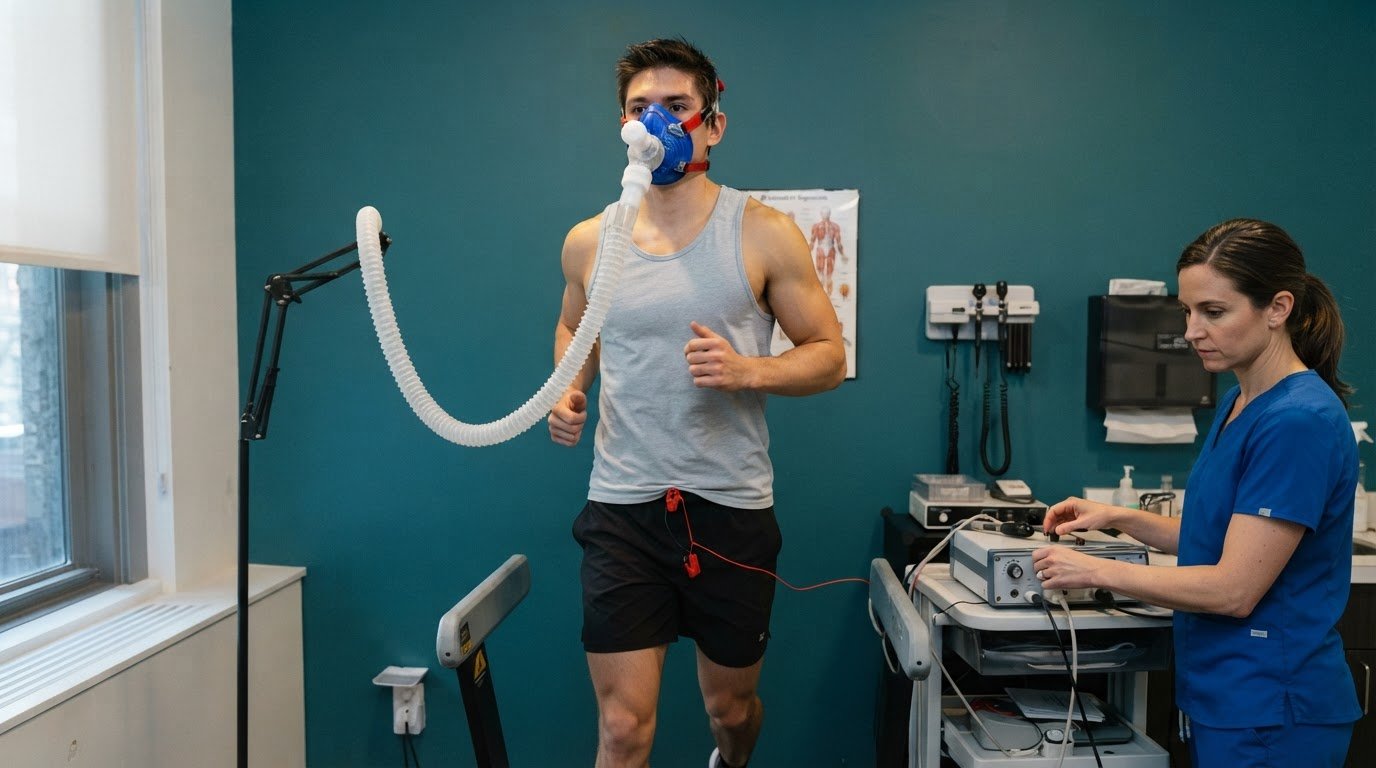
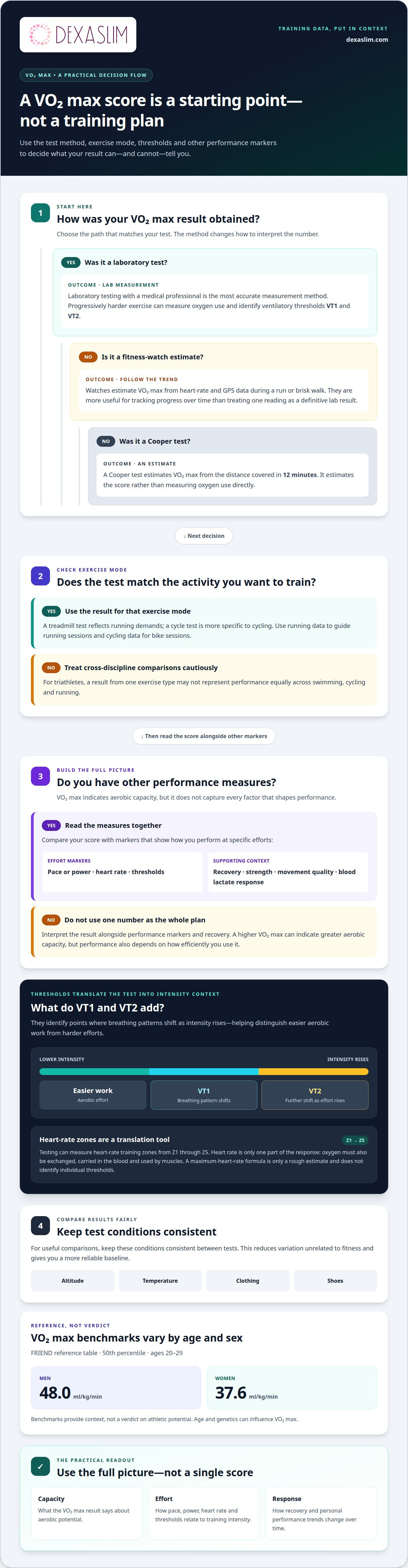
VO₂ max testing measures the maximum amount of oxygen your body can use during intense exercise. Results are expressed in milliliters of oxygen per minute per kilogram of body weight (ml/kg/min). A treadmill test reflects running demands, while a cycle test is more specific to cycling. For triathletes, test mode matters: a result from one exercise type may not represent performance equally across swimming, cycling, and running.
Laboratory testing uses progressively harder exercise to measure oxygen use and identify ventilatory thresholds VT1 and VT2. These thresholds show where breathing patterns shift as intensity rises. Metabolic testing can also track fat and carbohydrate use at different efforts, helping explain which fuel sources contribute during easier and harder work. A Cooper test offers a different approach: it estimates VO₂ max from the distance covered in 12 minutes, rather than measuring oxygen use directly.
How accurate are VO₂ max estimates from fitness watches versus lab tests? Laboratory testing with a medical professional is the most accurate measurement method. Fitness watches estimate VO₂ max using heart-rate and GPS data collected during a run or brisk walk, so they’re more useful for tracking progress over time than treating one reading as a definitive lab result.
Age and sex shape how VO₂ max benchmarks should be interpreted, while fitness level helps explain an individual score. In the FRIEND reference table, the 50th-percentile value for men ages 20-29 is 48.0 ml/kg/min; for women in that age group, it’s 37.6 ml/kg/min. VO₂ max benchmarks vary by age and sex, so interpret them as context rather than a verdict on athletic potential. Age and genetics can influence VO₂ max, so use benchmarks as context, not a verdict on athletic potential.
Blood lactate analysis adds context to VO₂ max testing. Together, the measures can help show how your body produces and uses energy during exercise, informing training zones and race pacing. This can help a runner refine threshold work, a cyclist set effort targets, or a triathlete balance training across disciplines. Lactate response can also help distinguish a sustainable threshold effort from one that is difficult to maintain.
Watch estimates and laboratory measurements serve different purposes. A watch can track trends across regular runs, while a controlled treadmill or cycle test provides a structured assessment under standardized conditions. For useful comparisons, keep altitude, temperature, clothing, and shoes consistent between tests. This reduces variation unrelated to fitness and gives you a more reliable baseline. Interpret the result alongside exercise mode and thresholds, not as a stand-alone measure of race readiness.
Heart, lung, circulation, and muscle contributions to VO2 max
VO₂ max reflects a chain of oxygen delivery and use, not one organ working alone. The lungs move oxygen into the blood, and the heart pumps that oxygen-rich blood through the body. Working muscles extract oxygen and use it for aerobic energy production. Limitations anywhere along this chain can affect oxygen use during intense exercise, so the same score can reflect different physiological strengths and constraints.
During exercise, heart rate generally rises as intensity increases, helping circulate more oxygen to active muscles. But heart rate is only one part of the response. The lungs must exchange gases, blood must carry oxygen, and muscles must use it efficiently. VO₂ max testing can measure heart-rate training zones from Z1 through Z5. Those zones help translate physiological response into intensity targets, rather than treating a faster heartbeat as proof of better aerobic capacity.
A maximum-heart-rate formula offers only a rough estimate and does not identify your individual thresholds. Athletes of the same age can respond differently at the same heart rate because fitness, exercise mode, and physiology vary. A runner’s heart-rate response on a treadmill may also differ from cycling. Refine training zones with measured thresholds and perceived effort instead of assuming a formula defines every training boundary precisely.
Personalized zones connect heart-rate response with the demands of a training plan. A controlled test can show where breathing shifts at VT1 and VT2, then help distinguish easier aerobic work from harder efforts. Apply those results to the activity being trained: use running data to guide running sessions and cycling data for bike sessions. Reassess when performance changes, rather than carrying an old zone prescription forward indefinitely.
Readiness monitoring adds daily context to your training zones. Compare each planned session with your recent heart-rate response, perceived effort, and recovery. If an easy effort feels unusually demanding or your heart rate responds differently than expected, reduce the intensity or choose recovery work. Look for patterns rather than letting one unusual reading dictate your plan. Consistent records make adjustments more useful.
Can VO₂ max improve without risking overtraining or injury? Structured training can manage avoidable strain by building volume progressively, alternating hard sessions with easier exercise, and adjusting work when recovery lags. No heart-rate zone removes the need to respond to your body’s signals.
For a more individualized aerobic baseline, VO₂ max measurements can help connect oxygen use with heart-rate response and exercise intensity.
Interpreting VO2 max alongside other performance measures
VO₂ max measures aerobic capacity, but it does not capture every factor that shapes race performance. Pair it with measures that show how you perform at specific efforts.
Tracking Progress With Performance Measures
Build a baseline using VO₂ max, pace or power, heart rate, threshold, recovery, strength, movement quality, and blood lactate response. Compare these measures over time under similar training conditions. For example, a runner may hold a faster pace at the same heart rate even if VO₂ max remains unchanged. Personal records over a specific distance can also reveal gains that a laboratory score may not capture.
Combining VO₂ Max With Training Feedback
Read heart rate, pace or power, and perceived effort together. Heart rate tracks cardiovascular response, pace or power measures output, and perceived effort shows how demanding that output feels. If pace slows while heart rate and effort rise, adjust the session rather than forcing the target.
VO₂ max is expressed as milliliters of oxygen consumed per minute per kilogram of body weight. That relative measure helps compare aerobic capacity, but it does not predict identical performance across athletes. A 55 kg athlete and a 65 kg athlete with the same VO₂ max may perform differently over a given distance because body weight affects the demands of movement. Running economy, threshold, and event-specific skill also influence what an athlete can sustain.
Laboratory testing is the most accurate way to measure VO₂ max. During a graded exercise test, a medical professional can measure oxygen use and establish a structured baseline for interpreting other performance data. Treat the result as one part of a broader profile: high aerobic capacity alone does not mean an athlete can hold a fast pace, produce cycling power efficiently, or recover quickly between efforts.
Use a repeatable review process to turn measurements into training decisions:
• Compare VO₂ max with threshold, pace or power, and heart-rate response.
• Check whether the same output requires less perceived effort over time.
• Track recovery, strength, movement quality, and blood lactate response.
• Use personal records to confirm whether laboratory changes translate into performance.
Wearable VO₂ max estimates are most useful for tracking progress over time. If the estimate stays level while race times improve, the performance gain still matters. Let the overall pattern, not a single score, guide your next training adjustment.
Structuring speed, threshold, and endurance sessions
Use your thresholds and VO₂ max data to give each session a clear purpose. Balance low-intensity endurance with targeted speed and threshold work, then adjust volume to your fitness and recovery.
Training Relative to Threshold
VT1 and VT2 mark ventilatory thresholds that help distinguish changes in breathing and exercise intensity. Use threshold measurements to anchor training effort, rather than relying on pace alone. For aerobic-capacity improvement, one example is training at 85 to 95 percent of threshold. Match the effort to the session goal, then monitor how breathing and perceived exertion respond.
Threshold Training Methods
Controlled threshold sessions build your ability to sustain demanding work without making every workout an all-out effort. Everyday athletes can use one or two controlled threshold sessions per week. The Norwegian double-threshold method involves completing two controlled lactate-threshold workouts in one day. It is demanding, so it is not a default template for every fitness level.
Structuring Speed and Endurance Sessions
Keep endurance runs as the bulk of a runner’s training. Lower-intensity work strengthens the aerobic system and supports longer sessions. One example is 60 to 90 minutes at a comfortable pace. Short intervals can add speed stimulus: begin with efforts of 20 to 30 seconds at a 6 to 7 effort level, then extend them as fitness improves.
Build the week around distinct workloads. A sample aerobic-base approach is 3 to 5 hours per week in Zones 1 and 2. VO₂ max intervals can appear 1 to 2 times per week, while interval and sprint sessions should stay within the recommended weekly limit for runners. Preserve easier training between demanding efforts to maintain session quality and support recovery.
Endurance
Keep most running comfortable, using conversation as an effort check.
Threshold
Schedule one or two controlled sessions weekly for everyday training.
VO₂ max
Try 4 to 6 intervals of 3 to 5 minutes at 90 percent maximum effort, with equal rest.
Progression
Extend short efforts toward a minute or two as fitness improves.
Keep the interval prescription tied to its purpose. The 3-to-5-minute format targets VO₂ max work, while short 20-to-30-second efforts offer a more accessible starting point. Don’t combine every hard format in one week by default. Use threshold response, recovery, and session execution to guide progress.
Using test results to adjust training intensity
Turn a VO₂ max test into decisions about effort, not a demand to train harder every day. The practical question is how to use VO2 max results to train smarter: connect the score with heart-rate zones, threshold, pace or power, and recovery. A useful starting point is to keep 80% of weekly training volume at low intensity and an easy conversational pace. Reserve harder work for sessions with a defined physiological goal.
A case study shows how test data can redirect training. Ben had been training above 180 bpm, then shifted to an aerobic zone of 135-155 bpm. His threshold heart rate was 165 bpm. Those figures are his individual results, not universal targets. For another athlete, the useful adjustment depends on measured response, sport, and current training baseline. A reliable way to decide how to use VO2 max results to train smarter is to apply your own test data, not copy someone else’s zones.
Set easy-session intensity by breathing and conversation, then compare heart rate with your test-derived zones. If an easy effort feels unusually demanding or heart rate rises beyond the expected response, reduce pace and protect the session’s aerobic purpose. For high-intensity work, the guidance is 85-95% of maximum heart rate. Match that target to the planned interval or sustained effort instead of chasing maximum effort in every workout.
Use the max test to refine session structure. One workout example is 4-6 intervals of 3-5 minutes at 90% maximum effort, with equal rest periods. Another option is a 20-minute tempo run at about 85% of VO₂ max pace. These sessions provide different stimuli. Choose according to test results, training phase, and recovery from recent sessions. Then record how well you completed the planned effort.
Review progress using several measures, not VO₂ max alone. Compare pace or power at a similar heart rate, perceived effort, threshold response, and recovery after demanding sessions. Fitness and performance can improve even if VO₂ max does not change. A personal record over a chosen distance can show practical progress when the score stays stable.
Easy work
Keep most weekly volume conversational and low intensity.
Hard work
Use test-based heart-rate targets for selected intervals or sustained efforts.
Review
Compare output, effort, heart rate, and recovery before changing the plan.
When should a low or changing VO₂ max result prompt medical advice? Discuss a persistent decline or an unexpectedly low result with a physician, especially before starting a training program. Consider how exercise feels and whether testing conditions were consistent.
Use VO₂ max testing to refine training intensity with an objective aerobic baseline.
Dexaslim
Dexaslim helps endurance athletes turn performance questions into measurable data. VO2 Max Performance Testing assesses aerobic endurance, peak oxygen consumption, and cardiovascular efficiency, giving you an objective reference for refining training intensity. A Resting Metabolic Rate (RMR) Test can add information about daily caloric needs, while a 1 Session Dexa Scan or Longevity Panel can provide additional health measurements.
Consider testing when watch estimates leave you unsure about your aerobic baseline, or when you want to interpret training intensity with more context. Use the results alongside pace, heart rate, threshold, and recovery rather than relying on one score alone. Contact Dexaslim to discuss your testing goals.
Make Your Next Training Decision Count
Learning how to use VO2 max results to train smarter starts with one deliberate step: choose a training decision you want your data to clarify. It might be how to pace a key workout, when to ease back, or which session deserves priority in your current plan. Set that decision before your next training block, then observe how your body responds. A clear question gives your measurements a practical purpose.
Keep your approach adaptable. Training changes, conditions shift, and performance can improve even when one metric stays steady. Use evidence to make thoughtful adjustments rather than chasing a number for its own sake. This turns testing into a repeatable tool for sharper decisions and more focused preparation.
Ready to ground your next training decision in objective data? Contact Dexaslim about VO₂ max testing and take the next step with purpose. Your data can help you train with greater clarity and confidence.
Frequently Asked Questions
What Is VO₂ Max Testing?
VO₂ max testing evaluates how much oxygen your body can use during intense exercise. You exercise on a treadmill or cycle while the test measures your response as effort increases. The result provides a reference for aerobic capacity. To use it in training, connect the result to your sport and the effort levels you need to sustain, rather than treating it as a race prediction.
How is VO2max Measured?
A laboratory test measures oxygen use during progressively harder exercise, commonly on a treadmill or cycle. The result is expressed in milliliters of oxygen consumed per minute per kilogram of body weight. A Cooper test estimates VO₂ max from the distance run in 12 minutes, while a fitness watch uses heart-rate and GPS data. These methods provide different kinds of information, so interpret each result in context.
How to Improve VO2max?
Build aerobic training consistently, then add focused higher-intensity work suited to your fitness and recovery. For example, a runner might maintain comfortable endurance sessions while adding structured intervals. Increase workload based on how well you complete sessions, not simply to force a higher score. Track race pace or power too, since performance can improve even when VO₂ max stays the same.
Is VO2 Max Trainable?
Training can improve aerobic fitness, although the amount of change varies between people. Age and genetics influence VO₂ max, and the score may stay stable while an athlete becomes faster or more efficient. Treat testing as one measure of adaptation, not the only evidence that training is working. Compare it with performance in your sport and your ability to complete planned sessions.
What Is VO2 Max?
VO₂ max is the maximum amount of oxygen your body can use during intense exercise. It is commonly reported relative to body weight, in milliliters per minute per kilogram. The measure reflects aerobic capacity but does not capture every skill needed for endurance performance. Race outcomes also depend on movement efficiency, pacing, and how well your body handles the event’s demands.
What is VO2max and Why Does It Matter?
VO₂ max gives athletes a measurable view of aerobic capacity and a basis for training decisions. It can help you assess whether a plan’s intensity matches your physiology and whether performance changes alongside the score. The result is most useful when tied to a clear purpose, such as setting training targets or establishing a baseline for later comparison. On its own, it cannot tell you exactly how fast you will race.
Where Can VO2max Be Limited?
VO₂ max depends on oxygen moving from the lungs into the blood, circulating through the heart and blood vessels, and being used by working muscles. A limitation anywhere along this chain can affect the result. Testing conditions also matter when comparing results: keep altitude, temperature, clothing, and shoes consistent. The score is most useful when you understand both the physiological context and how the test was performed.
What does VO2 max measure, and what do the results mean?
VO₂ max measures the maximum oxygen use achieved during intense exercise, adjusted for body weight. A higher result indicates greater measured aerobic capacity, but does not guarantee better performance in every sport or distance. Read it alongside your event’s demands and your own performance history. If the number changes, consider whether testing conditions changed too before interpreting it as a shift in fitness.