
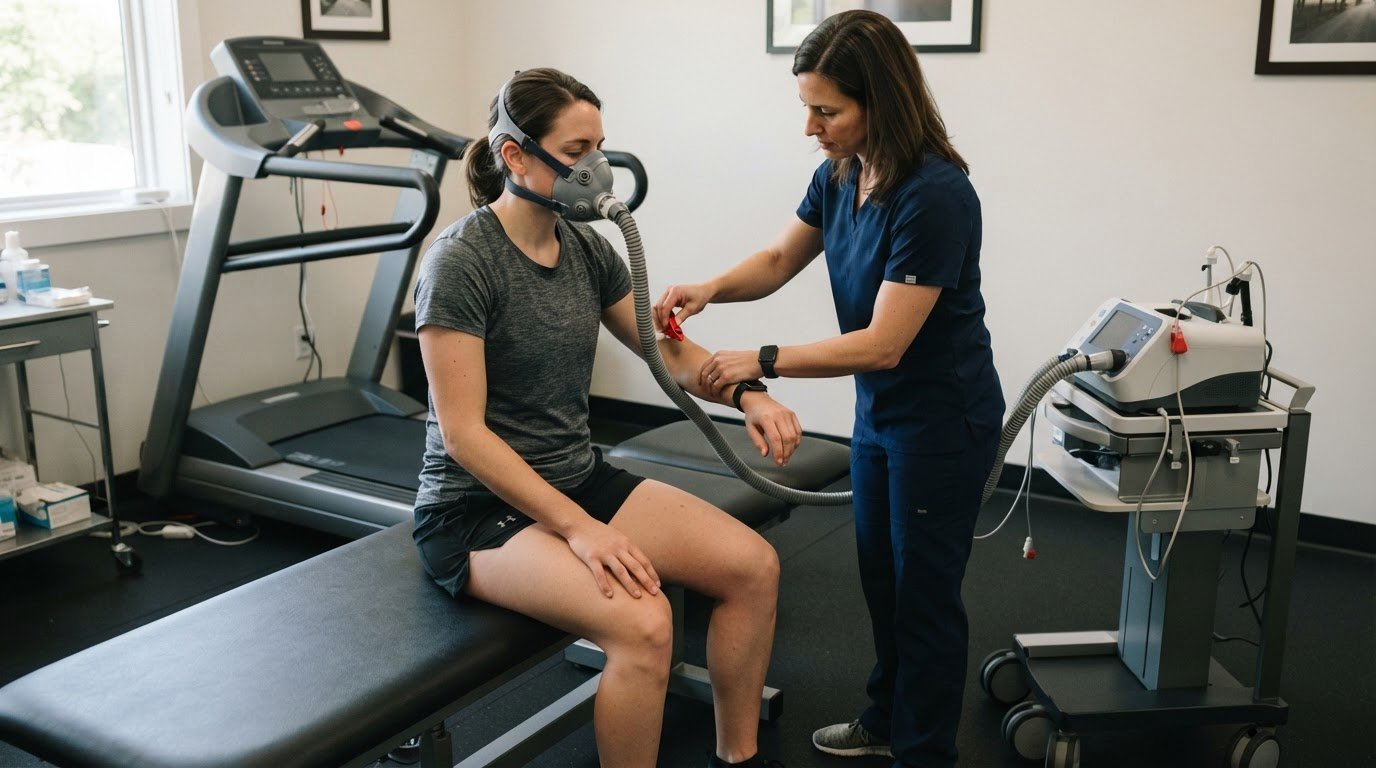
A watch doesn’t measure oxygen use. It estimates VO₂ max from exercise signals, such as heart rate and pace, combined with profile data. A laboratory test measures respiratory gas exchange directly during exercise, which is why a lab VO₂ max test is better than a watch estimate when you need a measured physiological baseline.
Wearable estimates are useful for tracking trends, and it makes sense to want them to reflect your actual fitness. But GPS errors, wrist-based heart-rate errors, and workout conditions can affect the estimate. Treat your watch as a tracking tool, not a direct measurement of oxygen uptake.
Learn how watch algorithms estimate VO₂ max, what a lab test measures, and how both kinds of data can inform training. You’ll see what lab results can reveal about aerobic capacity and exercise response, and why comparisons are most useful when testing conditions are similar.
Key Takeaways
• A lab test measures respiratory gas exchange during exercise, while a watch estimates VO₂ max from exercise signals and profile data.
• Use watch readings to follow trends, but interpret them in light of factors such as GPS quality, heart-rate signals, and workout conditions.
• Lab results can help establish an aerobic baseline and inform training zones; comparing tests under similar conditions makes changes easier to interpret.
• Heat, fatigue, sleep, hydration, altitude, and medication-related changes in heart-rate response can affect wearable estimates.
• Dexaslim’s VO2 Max Performance Testing can provide a measured assessment of aerobic endurance and peak oxygen consumption.
What happens during a laboratory VO₂ max test?
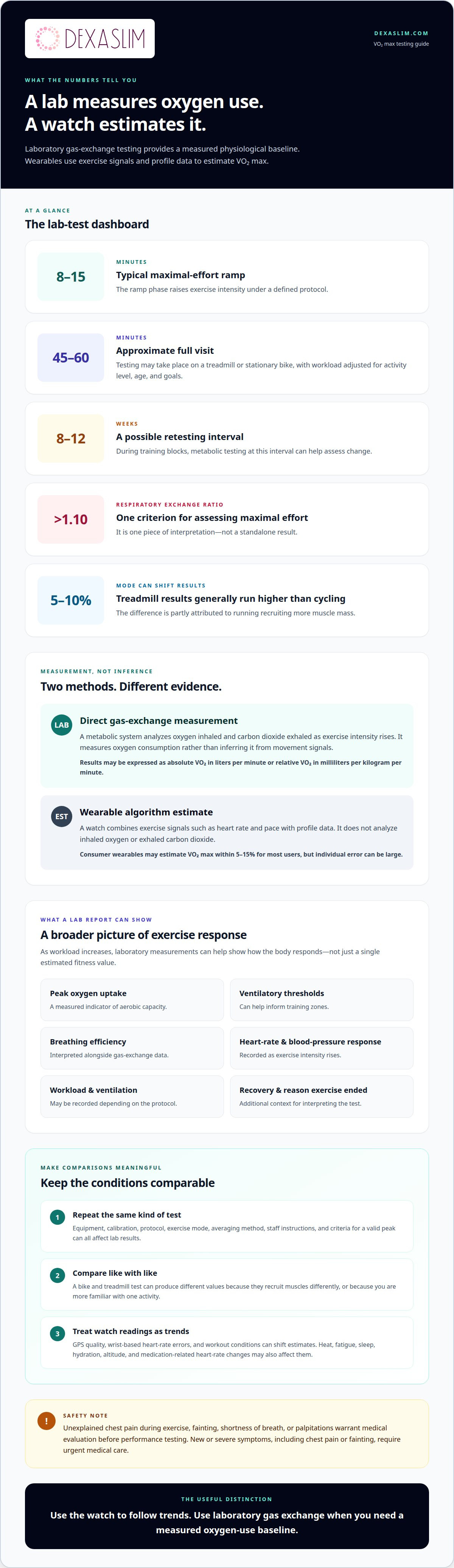
A laboratory VO₂ max test measures oxygen use while exercise intensity rises under a defined protocol. The maximal-effort ramp phase typically lasts 8-15 minutes, and the full visit takes approximately 45-60 minutes. Testing may use a treadmill or stationary bike, with workload adjusted for activity level, age, and goals.
During the test, a metabolic system analyzes oxygen inhaled and carbon dioxide exhaled through a mouthpiece or mask. The report may include peak oxygen uptake, ventilatory thresholds, breathing efficiency, heart-rate and blood-pressure responses, and the reason exercise ended. Depending on the protocol, technicians may also record ventilation, workload, perceived exertion, respiratory exchange ratio, and recovery. In clinical diagnostic settings, ECG monitoring may assess heart rhythm.
These measurements can inform training by showing how the body responds as workload increases. They can also contribute to clinical cardiopulmonary exercise testing, or CPET. A respiratory exchange ratio above 1.10 is one criterion technicians use to assess whether effort was maximal. It is one piece of interpretation, not a standalone result.
How often should athletes repeat a lab VO₂ max test? During training blocks, metabolic testing every 8-12 weeks can help assess change. For an event-focused block, testing before and after the block can show whether the same protocol produces different results. Keep conditions comparable: treadmill results generally run 5-10% higher than cycling results, partly because running recruits more muscle mass.
Lab results also vary with equipment, calibration, protocol, exercise mode, averaging method, staff instructions, and criteria for a valid peak. A bike test may produce a different value from a treadmill test because it recruits muscles differently or because you’re more familiar with one activity. Compare like with like; unrelated protocols can obscure real trends.
Field tests offer alternatives when lab testing isn’t practical. A beep test uses progressively faster running intervals, while a submaximal cycle test estimates VO₂ max from your exercise response. These methods predict rather than directly measure gas exchange. Different routes and activities, including hilly walks, outdoor runs, and swimming, also place distinct demands on the body.
A watch estimate can track trends, but it isn’t a lab measurement. Performance testing also isn’t the right first step for unexplained symptoms. Chest pain during exercise, fainting, unexplained shortness of breath, or palpitations warrant medical evaluation before testing. New or severe symptoms, including chest pain or fainting, require urgent medical care.
Direct laboratory gas-exchange measurement versus wearable algorithm estimates
A laboratory test measures oxygen consumption from respiratory gases; a smartwatch estimates it from exercise signals. A lab result directly measures oxygen use, while a wearable provides an algorithm-derived fitness estimate. This distinction explains why a lab VO₂ max test is better than a watch estimate when you need a measured physiological baseline.
Indirect Calorimetry
Indirect calorimetry measures oxygen consumption by analyzing the gases you inhale and exhale during exercise. It calculates oxygen use from gas exchange instead of inferring it from pace or heart rate. That matters when you want a measured value to anchor training decisions. Results can be expressed as absolute VO₂ in liters per minute or relative VO₂ in milliliters per kilogram per minute.
Laboratory Gas Exchange
In a lab, a metabolic system captures respiratory gases as exercise intensity rises. The data show how oxygen uptake changes with workload, alongside carbon dioxide output. This direct measurement helps distinguish your body’s response from an estimate based on movement signals. A result reported relative to body weight provides context for comparing aerobic capacity across individuals, while absolute oxygen use describes total uptake.
What does a lab VO₂ max test measure that a smartwatch cannot? It measures respiratory gas exchange directly instead of predicting oxygen consumption from exercise signals. That difference explains why a lab VO₂ max test is better than a watch estimate when you need direct evidence of oxygen use. A lab test and a wearable estimate answer different measurement questions.
Wearable Algorithm Estimates
A smartwatch uses signals such as heart rate and pace, then applies an algorithm to estimate VO₂ max. It doesn’t analyze inhaled oxygen or exhaled carbon dioxide. Consumer wearables may estimate VO₂ max within 5-15% for most users, although individual error can be large. GPS errors and wrist heart-rate errors can also shift the estimate, even when the workout appears consistent.
A difference between a watch reading and a lab result doesn’t automatically mean fitness changed. Errors of 10-15% can misclassify cardiovascular fitness, mask change, or delay decisions about training and wellness. Interpret a single watch value with that limitation in mind.
Use wearable data for convenient ongoing tracking, then use a lab result as a physiological reference point. Compare watch trends with the measured baseline rather than treating every estimate as a direct reading. For a direct measurement, consider laboratory VO₂ max testing.
Using lab results for baseline measurements and training zones
A lab result gives your training a measured reference point: aerobic capacity, heart-rate response, and ventilatory thresholds. Use that baseline to interpret effort during workouts, then compare it with watch trends between tests. The practical benefit is that training targets can reflect measured physiology instead of relying only on an algorithm.
Start with the report’s ventilatory thresholds. These mark changes in breathing response as exercise intensity rises, helping distinguish easier aerobic work from harder efforts. If the report identifies these thresholds, they can guide personalized training zones. For example, an athlete can compare a steady run with the effort associated with a measured threshold, rather than treating pace alone as the whole picture.
Heart-rate zones are more useful when viewed alongside the workload and breathing response recorded during testing. The same heart rate can feel different across sessions, especially as fatigue builds. Compare your heart-rate response with the test’s ventilatory thresholds and perceived effort. This gives you a fuller picture than heart rate alone and can reveal when a familiar workout is becoming more demanding.
Use threshold information to shape a workout, not just label it. An easier session can stay below a measured ventilatory threshold, while a harder interval can approach a higher-intensity boundary. These are examples, not universal prescriptions: the report’s values and the athlete’s event goals determine the relevant targets. A runner and a cyclist may need different applications because their activities place different demands on the body.
Lactate threshold information, when included, can help athletes identify a sustainable pace or power. That can inform tempo and threshold workouts. For example, a runner can use the result to plan a sustained-pace session, while a cyclist can apply it to power-based efforts. Lactate threshold and ventilatory threshold are related training markers, but they are not interchangeable measurements.
Build the baseline into your training plan by pairing lab findings with daily observations. Watch data can track trends between tests, while lab measurements anchor those trends to physiological responses. If your heart rate rises during a familiar effort, consider the workload and recovery context before changing zones. One reading doesn’t explain the whole session.
For a specific event, testing before and after a major training block can show how measured capacity and thresholds have changed. Keep the protocol comparable to make the comparison meaningful. For ongoing interpretation, use the report’s zones as a reference, then adjust training decisions for event demands, effort, and recovery. This turns a test result into a practical framework, not a standalone fitness score.
Effort, recovery, medication, and environmental influences
Watch-based VO₂ max estimates can shift when heart-rate or pace signals change for reasons unrelated to aerobic fitness. Heat, poor sleep, dehydration, illness, altitude, accumulated fatigue, and medication-related changes in heart-rate response can all affect readings. These factors help explain why your watch value may move even when your underlying cardiovascular capacity hasn’t changed.
Consider a hot outdoor run. Heat can alter your heart-rate response, while a hilly route can change pace and effort compared with a flat route. A watch may register those differences as reduced performance and adjust its estimate. Trail running and altitude exposure also change exercise demands. Compare similar workouts and conditions before interpreting a new reading as a change in fitness.
Recovery matters too. A watch records exercise signals, but it may not fully capture muscle soreness, tendon irritation, sleep debt, emotional stress, or nutrition deficits. For example, accumulated fatigue can make a familiar treadmill pace feel harder and affect your heart rate. The device sees the signals it collects; it doesn’t directly measure every recovery factor influencing your effort.
Medication can also affect the relationship between heart rate and workload. If a medication changes your heart-rate response, a wearable algorithm may interpret that response differently, even when oxygen capacity hasn’t changed in parallel. Illness can also affect how exercise feels and how your body responds. Interpret a sudden estimate change alongside workout conditions, recovery, and health context, not as a standalone measure.
Preparation affects laboratory testing differently. To support a comparable result, avoid hard training for 24-48 hours before a VO₂ max test. Avoid caffeine for 3-4 hours beforehand, or keep your usual amount consistent between tests. These steps reduce differences in effort and conditions when comparing results. Follow the testing instructions provided for your scheduled assessment.
Effort also shapes what a laboratory test captures. The test records gas exchange as workload rises, so stopping before maximal effort can limit the result’s interpretation. Technicians use multiple indicators, including respiratory exchange ratio, to assess whether effort was maximal. A value above 1.10 is one criterion, not the only measure of effort or test quality.
What factors make watch-based VO₂ max estimates inaccurate? GPS errors, irregular wrist heart-rate signals, heat, hills, altitude, illness, fatigue, poor sleep, dehydration, and medication-related heart-rate changes can influence the estimate. A loose watch fit or mismatched workout type can add further noise.
Use watch readings to track trends across comparable sessions, not to diagnose a medical issue. If an estimate drops after a hot, hilly run, note those conditions before changing your training plan. For metabolic testing, consistent preparation and comparable effort make repeated results more useful.
How watches estimate VO₂ max from exercise signals and profile data
A wearable estimates aerobic capacity by combining exercise signals with profile data and applying an algorithm. It doesn’t sample respiratory gases. Understanding this process helps you interpret why the estimate changes, what makes it useful, and where its limits begin.
During an outdoor run, a watch may combine pace data with heart-rate readings and GPS. The algorithm uses those signals to estimate the effort required for the recorded movement, then relates that pattern to profile information to produce a VO₂ max estimate. The displayed value is a model output, not a direct measurement of oxygen consumption.
Signal quality shapes the calculation. A loose watch fit can disrupt wrist heart-rate readings. Irregular heart-rate signals can weaken the relationship between effort and pace. Poor GPS can misrepresent distance or speed, changing the exercise data the algorithm processes. An unusual route, such as a hilly trail instead of a familiar flat run, also changes the demands represented by those signals.
Workout type matters. A watch may interpret a recorded outdoor run differently from a cycling session or a workout labeled with the wrong activity. If the device expects one movement pattern but receives another, the signals may not match the assumptions behind its estimate. Incomplete profile information can also affect the result because the algorithm uses those inputs alongside exercise data.
Consider two runs at a similar pace. On one, GPS performs well and the watch fits snugly. On the other, the route is hilly and the heart-rate signal is irregular. The second session can produce a different estimate without proving that aerobic fitness changed. Review the route, activity selection, device fit, and signal consistency before treating a single reading as a reason to adjust training.
Wearables remain useful for tracking patterns across repeated, comparable workouts. Look for trends across familiar routes and exercise types instead of reacting to each isolated update. Keep profile information complete and select the activity that matches the session. These steps improve input quality, but they don’t turn an algorithm into direct gas-exchange testing.
Use the estimate as context, not as a standalone verdict on training zones. A watch can help reveal how recorded exercise signals change over time. A laboratory protocol answers a different question by measuring respiratory gas exchange during exercise. For a measured reference point, book VO₂ max performance testing.
Dexaslim: VO2 Max Performance Testing
Dexaslim offers VO2 Max Performance Testing to assess aerobic endurance, peak oxygen consumption, and cardiovascular efficiency. Choose this test when a watch estimate leaves you without a measured baseline, or when you want data to interpret training progress. The results can help connect your aerobic capacity with the training questions explored above, including how to track change under comparable conditions.
For a broader metabolic picture, a Resting Metabolic Rate (RMR) Test measures a different aspect of energy use and can complement performance testing. These assessments answer distinct questions, so select the one that fits your goal. If you’re ready to move from estimates to direct performance testing, contact Dexaslim to discuss VO2 Max Performance Testing.
Turn Measurement Into Your Next Training Decision
Your next step is to decide what you want better data to change. You might want to set a more relevant training focus, understand your aerobic capacity, or establish a reference point for future decisions. Knowing why a lab VO₂ max test is better than a watch estimate can help you choose a measurement when an algorithmic trend leaves questions unanswered.
Keep your goal specific. Choose the result you want to use, then connect it to a practical decision in your training or health routine. A useful measurement is one you can interpret and act on, not simply another number to monitor.
Dexaslim offers performance testing to support a more measured approach. Contact Dexaslim to discuss testing and take the next step toward clearer direction. Build your plan around evidence, stay focused on your goals, and keep moving forward.
Frequently Asked Questions
How do watches estimate VO₂ max?
Watches infer VO₂ max by combining exercise data, such as running pace and heart rate, with profile information. Their algorithms use patterns in those signals to estimate aerobic capacity; they don’t analyze respiratory gases. For example, a loose fit can affect wrist heart-rate readings, while poor GPS can distort pace. Confirm the activity type and profile details to help the device interpret your workout consistently.
What does VO₂ max actually measure?
VO₂ max describes the maximum rate at which your body uses oxygen during intense exercise. It’s commonly expressed relative to body weight in milliliters of oxygen per kilogram per minute, or as total oxygen use in liters per minute. The relative value helps put aerobic capacity in the context of body mass. By itself, it doesn’t determine race readiness, which also depends on training specificity, fueling, recovery, and pacing.
How do body weight and laboratory methods affect the number?
Relative VO₂ divides oxygen uptake by body weight, so the same absolute oxygen use can produce different relative values at different weights. Lab method also matters: treadmill and cycle testing can yield different results, and equipment calibration, protocol, averaging method, and peak criteria can vary. For a useful comparison, repeat testing with the same exercise mode and a comparable protocol rather than comparing unrelated results.
How do effort and recovery conditions affect the estimate?
Effort and recovery can influence both exercise signals and test interpretation. Poor sleep, dehydration, illness, heat, altitude, or accumulated fatigue may alter heart-rate response or perceived exertion. A watch may register the resulting signal change without identifying its cause. Before interpreting a changed reading, consider whether the workout, route, and recovery context differed from previous sessions. A trend across comparable workouts is more informative than one isolated update.
How do labs confirm you reached true VO₂ max?
Technicians assess whether the test reflects maximal effort using several observations, not one number alone. A respiratory exchange ratio above 1.10 is one criterion used during VO₂ max testing. The result is interpreted alongside the exercise protocol and recorded responses. If effort ends before a valid peak is reached, the report may describe peak oxygen uptake rather than treating the value as a confirmed maximum.
How is VO₂ max measured in a lab with a metabolic cart?
A metabolic cart analyzes respiratory gases as you exercise through a mouthpiece or mask. It measures oxygen inhaled and carbon dioxide exhaled as workload increases, allowing oxygen uptake to be calculated from gas exchange. The test may use a treadmill or stationary bike. Results can report total oxygen use in liters per minute or adjust it for body weight in milliliters per kilogram per minute.
How accurate are smartwatch VO₂ max estimates compared with lab tests?
Consumer wearables may estimate VO₂ max within 5-15% for most users, but individual error can be large. That range doesn’t mean every reading is equally close to a laboratory result. GPS quality, wrist heart-rate signals, route, and workout type can affect the estimate. Use the watch to follow patterns across similar sessions, and interpret a single value cautiously rather than treating it as a direct measurement.
How long does a lab VO₂ max test take and how should you prepare?
A full lab visit takes approximately 45-60 minutes, while the maximal-effort ramp typically lasts 8-15 minutes. Avoid hard training for 24-48 hours beforehand. Avoid caffeine for 3-4 hours before testing, or keep your usual intake consistent between tests. Consistent preparation helps make results more comparable, especially when you plan to repeat testing after a training block.