
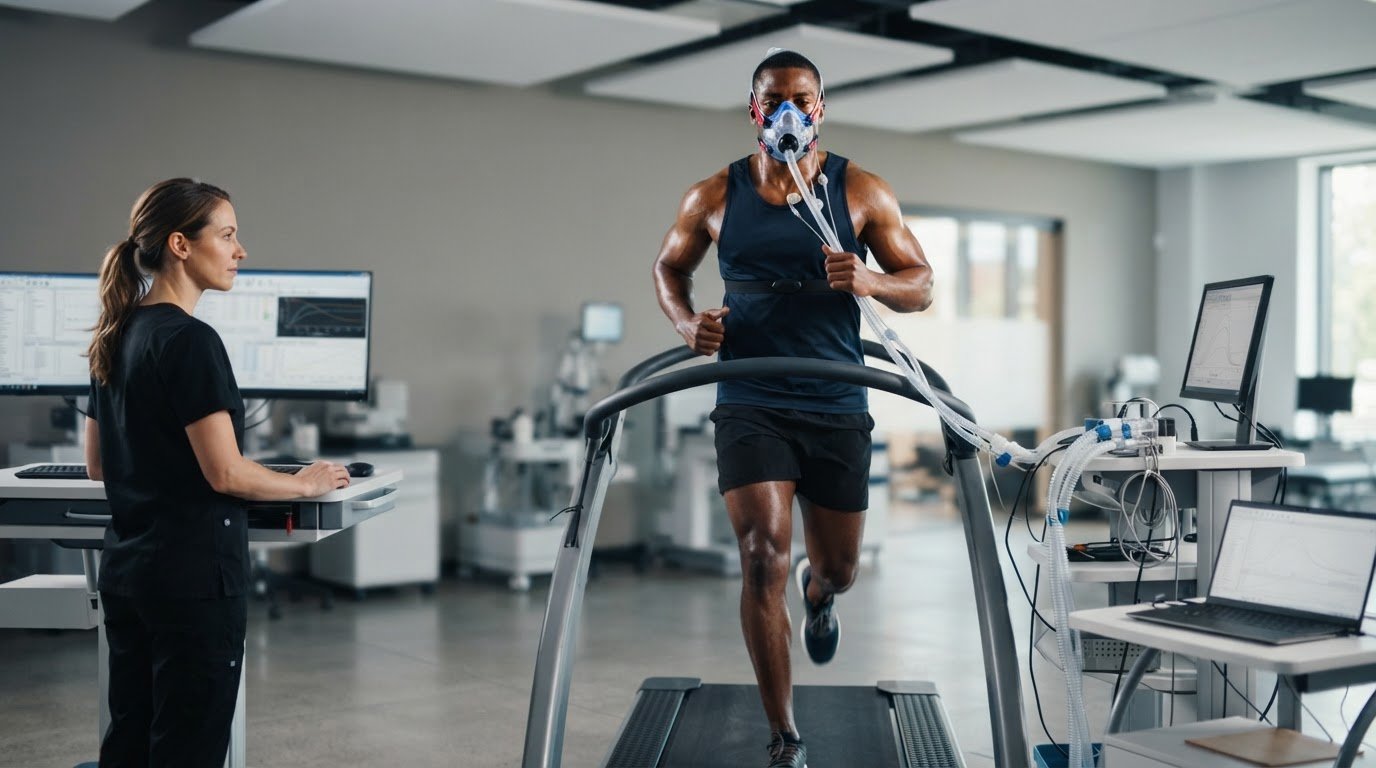
VO2 max performance testing measures how much oxygen your body uses during progressively harder exercise. Johns Hopkins describes the test as a maximal effort on a treadmill or bike while your expired air is analyzed. Intensity rises gradually until exhaustion, while a mask measures your breathing.
A hard workout can show effort, but it can't tell you exactly how efficiently your body uses oxygen or where your sustainable intensity begins. A laboratory test turns those signals into measurable results, including peak oxygen consumption and information that can help define personalized training heart rate zones.
Learn what to expect before, during, and after a test, how treadmill and bike protocols differ, and how to interpret results in context. You’ll also see what ventilatory and lactate thresholds can reveal and when retesting may help track fitness changes. Use the data to establish a clearer performance baseline.
Key Takeaways
• A graded exercise test measures oxygen use as intensity rises, giving you a direct performance baseline rather than a device-based estimate.
• Choose the treadmill or bike based on your primary training mode; results can differ between the two.
• Use threshold and heart rate data to shape training intensity, not just your peak oxygen score.
• Retest every three months to assess a training program, or annually when tracking overall fitness and health.
• Interpret your score in context, including age, training status, and the activity used for testing.
How is a VO2max test performed?
VO2 max performance testing measures your oxygen use during progressively harder exercise. Johns Hopkins describes the assessment as a maximal test on a treadmill or bike while expired air is analyzed. You wear a breathing mask, and the equipment tracks oxygen consumption as the workload rises. The test continues toward exhaustion, creating a direct measure rather than a wearable estimate.
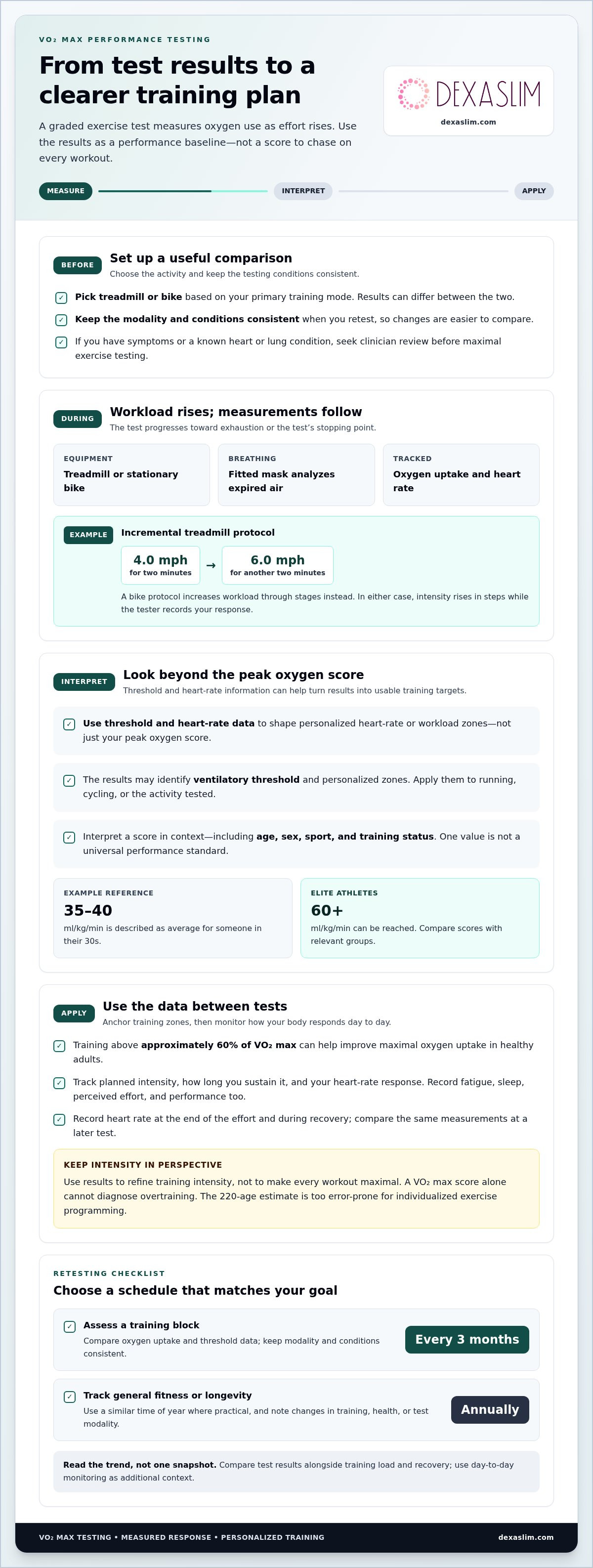
Each stage shows how your body responds to increased effort. An incremental treadmill example starts at 4.0 mph for two minutes, then increases to 6.0 mph for another two minutes. A bike protocol raises workload through stages instead. During either protocol, the tester records oxygen uptake and heart rate, helping map your response from easier work toward maximal intensity.
What equipment and protocols are used for VO2 max testing? The test uses a treadmill or stationary bike, a fitted breathing mask, and equipment that analyzes expired air and monitors heart rate. A graded exercise protocol increases workload in stages until exhaustion or the test’s stopping point.
Those measurements can guide practical training targets. The results may identify ventilatory threshold and personalized heart-rate zones. Runners can apply the data to pace, while cyclists can use workload and heart-rate responses to shape bike sessions. VO2 max performance testing makes those targets more specific to measured exercise response than a generic age-based estimate.
Heart-rate recovery adds another useful data point. Record your heart rate at the end of the effort and during recovery, then compare the same measurements after a later test. Keep the activity and protocol consistent so changes reflect your fitness trend, not a switch from treadmill to bike. Use the results to refine training intensity, rather than making every workout maximal.
What are typical VO2 max test prices in the United States? Prices depend on the protocol, equipment, and reporting included, and are given after a quote request. Where can you get a VO2 max test near you? Look for a local facility offering maximal exercise testing with a treadmill or bike and expired-air analysis.
What VO2 max scores are considered good by age, sex, and sport? For someone in their 30s, 35-40 ml/kg/min is described as average; elite athletes can reach 60 ml/kg/min or higher. Interpret a score in relation to age, sex, and sport, rather than treating one value as a universal performance standard.
Testing frequency for training and health tracking
Set a retesting schedule around your goal: measure your response to training at regular intervals, or use a longer interval for general fitness tracking. Compare results alongside training load and recovery, not as a verdict on their own.
Testing Frequency
For a training block, repeat testing every 3 months to assess whether the program is changing aerobic capacity. Johns Hopkins notes that testing can help evaluate a program’s effectiveness. Keep the testing modality and conditions consistent, then compare oxygen uptake and threshold data across sessions.
For general fitness or longevity tracking, annual testing can offer a broader progress check. Use a similar time of year where practical, and note changes in your training routine, health, and test modality. A single result is a snapshot; the trend can show whether your capacity is moving in line with your goals.
Progress Monitoring and Training Guidance
Use results to set personalized heart-rate or workload zones, then apply them to running, cycling, or another tested activity. Training above approximately 60% of VO2 max can help improve maximal oxygen uptake in healthy adults. Build intensity around measured capacity, rather than relying on the 220-age estimate, which is too error-prone for individualized exercise programming.
Track your training sessions against the zones. Note the planned intensity, how long you sustain it, and how your heart rate responds. If the same cycling workload feels easier over time, that provides useful context, while the test offers a more direct comparison of oxygen use.
Retesting can guide adjustments, but it does not replace day-to-day monitoring. Record fatigue, sleep, perceived effort, and performance alongside test results. If progress stalls while training load remains high, review recovery and intensity distribution before adding harder sessions. A VO2 max score alone cannot diagnose overtraining.
VO2 max improves through structured work, not constant maximal effort. Use the test to anchor zones, then alternate demanding sessions with easier training. Reassess after a training block instead of reacting to every daily fluctuation. That approach gives athletes a clearer signal of adaptation while reducing the temptation to push every workout at peak intensity.
What are the risks and contraindications of VO2 max testing? The test involves maximal exercise, so symptoms or a known heart or lung condition warrant clinician review before testing. Stop if concerning symptoms arise during exertion.
For a baseline you can use to guide training and monitor progress, consider VO2 max performance testing as part of a structured fitness assessment.
VO2 max as an indicator of aerobic fitness
VO2 max measures the maximum rate of oxygen consumption during incremental exercise. It gives athletes and active adults a measurable indicator of aerobic capacity, but it is only one part of fitness.
VO2 Max and Aerobic Capacity
During exercise, muscles use oxygen to produce energy. A higher VO2 max generally reflects a greater capacity to sustain demanding aerobic work. For someone in their 30s, a score of 35-40 ml/kg/min is described as average; elite athletes can reach 60 ml/kg/min or higher. Compare scores within relevant age, sex, and sport groups, and consider the test modality.
Treat the score as a baseline, not a complete verdict on performance. Two athletes with similar oxygen uptake can differ in pacing, efficiency, and recovery. Track the result alongside training performance: note whether a familiar route, pace, or workload feels more manageable after a training block. That context turns a lab value into a practical fitness measure.
Aerobic and Anaerobic Thresholds
Thresholds show how exercise intensity relates to sustainable effort. Johns Hopkins describes ventilatory threshold as the point when muscle fatigue from lactic acid buildup limits how long an intensity can be maintained. A VO2 max test can identify ventilatory or lactate threshold, helping endurance athletes set training efforts below or around those transitions.
Threshold data adds detail that a peak score cannot provide. A test can estimate lactate threshold using metabolic measures such as VO2 and VCO2. Elite endurance athletes typically have a lactate profile at 80 to 90% of their VO2 max. Use your measured threshold to distinguish controlled aerobic sessions from harder intervals.
Training can target different points in that range. Workouts above approximately 60% of VO2 max can help improve maximal oxygen uptake in healthy adults. Higher-intensity intervals around 80-92.5% of VO2 max may also support improvement. Set the effort using measured capacity, then monitor how pace, power, and recovery respond across sessions.
Build aerobic training around repeatable efforts, not constant maximal exercise. For example, use threshold information to keep a steady run controlled, and reserve harder intervals for planned sessions. Compare the same activity over time. A faster pace at similar effort, or a higher sustainable workload, can help put changes in oxygen uptake into context.
VO2 max is therefore a strong aerobic fitness indicator, not a standalone scorecard. Pair it with threshold results, training response, and recovery patterns. That combination helps you monitor adaptation and choose exercise intensities that match your current capacity.
VO2 max differences between treadmill and bike testing
Both treadmill and bike protocols measure maximal oxygen uptake during an incremental exercise test. Choose the modality that matches your primary training activity, because results from the two are not directly interchangeable.
Progressive Treadmill and Bike Protocols
In either protocol, workload rises in stages while equipment measures exhaled air and tracks heart rate. On a treadmill, progression may involve faster running or a steeper incline; on a bike, resistance or cadence increases. The test moves toward maximal effort, measuring oxygen uptake across changing intensities.
Look for a protocol that captures your response throughout the test, not just the final score. Measurements at different stages can help identify when effort becomes harder to sustain and how your aerobic capacity responds as workload rises. Future comparisons are most useful when you repeat the same modality and a similar protocol.
Choosing a Testing Modality
Choose the treadmill if running is your main sport, and the bike if cycling is your priority. The UCSF Human Performance Center advises matching the test modality to the client’s primary training. That choice makes the workload more specific to the movement and effort patterns you want to evaluate.
For the same person, VO2 max is about 10% higher on a treadmill than on a bike. This difference matters when interpreting a score: a treadmill result and bike result do not provide a clean before-and-after comparison. Keep the modality consistent when tracking progress, or interpret a change alongside the equipment used.
Treadmill and Stationary-Bike Testing
A treadmill test reflects running, with speed and incline shaping the workload. A stationary-bike test measures cycling effort, making it a practical match for cyclists. In both cases, a breathing mask collects exhaled-air data as the test progresses. The equipment differs, but the goal is to measure oxygen use under increasing demand.
Comfort and familiarity with the movement also affect how you approach a maximal test. A runner who rarely cycles may stop because pedaling feels unfamiliar; a cyclist unused to running may be limited by treadmill movement. Choose the setup that lets you produce a strong, controlled effort using movements familiar to your sport.
Use the test to answer a specific training question. A runner may want a running-specific measure of aerobic capacity, while a cyclist may need data reflecting bike workload. Record the modality with your result, then use the matching pace or power context when planning training. This keeps maximal oxygen uptake data useful instead of treating every score as equivalent.
VO2 max, ventilatory threshold, and lactate threshold
A maximal oxygen score shows peak capacity, while ventilatory and lactate thresholds reveal how effort changes below that peak. Together, these measures can help endurance athletes understand cardiovascular demands and structure training intensity.
How accurate is a VO2 max lab test compared with smartwatch estimates? A lab test analyzes expired air during exercise, directly measuring oxygen consumption. Smartwatch readings estimate VO2 max using signals such as heart rate, speed, and movement, so treat them as general indicators rather than exact measurements.
Ventilatory Thresholds VT1 and VT2
VT1 and VT2 describe successive changes in breathing response as exercise intensity rises. They help mark transitions between more manageable effort and harder work that becomes difficult to sustain. Use the measured thresholds to define distinct aerobic training ranges, instead of treating every pace below maximal effort as equivalent.
For example, an endurance athlete can compare a steady session with the effort associated with each threshold. The resulting heart-rate or workload targets make it easier to pace long efforts and identify when intensity is approaching a less sustainable level. Thresholds add training detail that a peak VO2 value alone cannot provide.
Ventilatory Threshold Assessment
During an incremental test, expired air is analyzed as workload increases. The assessment tracks changes in breathing and metabolic measures across stages, helping identify ventilatory threshold in relation to VO2 max. Johns Hopkins describes ventilatory threshold as the intensity at which muscle fatigue from lactic acid buildup limits how long exercise can continue.
That threshold is useful because athletes often train below maximal effort. Compare the threshold with your peak oxygen uptake, then use the relationship to plan controlled aerobic sessions and harder intervals. Training can increase ventilatory threshold and bring it closer to VO2 max, according to Johns Hopkins.
Lactate threshold focuses on how lactate relates to rising exercise demand. A VO2 max test can estimate lactate threshold using metabolic parameters such as VO2 and VCO2. A blood lactate profile offers another way to assess the response. Elite endurance athletes typically have a lactate profile at 80 to 90% of their VO2 max.
Apply threshold results to the demands of your sport. A distance runner might use them to set a sustainable training pace; a cyclist can use corresponding workload data. Revisit the same measures after a training block and compare results using the same activity and modality. This helps distinguish changes in threshold from differences caused by switching equipment.
Use measured oxygen uptake and threshold data to make your next training plan more specific. Book VO2 Max Performance Testing to assess aerobic capacity and identify performance-relevant thresholds.
Dexaslim: 1 Session Dexa Scan
Dexaslim offers a 1 Session Dexa Scan for people seeking body composition and bone density measurements alongside exercise data. VO2 max performance testing assesses aerobic capacity, while a DEXA scan adds information about body composition and bone health. These distinct measurements can inform different parts of a fitness plan.
Choose VO2 max performance testing when you want an exercise-based view of oxygen use. A DEXA scan may fit goals focused on body composition or bone density. Dexaslim also offers a Resting Metabolic Rate (RMR) Test and a Longevity Panel.
Contact Dexaslim to discuss which assessment aligns with your goals.
Turn Your Baseline Into a Training Decision
Make your next training phase intentional. Choose one performance goal, decide what change would be meaningful to you, and record the workouts that support it. This creates a clear framework for applying objective data instead of reacting to a single strong or difficult session.
Use VO2 max performance testing as a checkpoint in a wider process of refining your routine. Keep your focus on consistent effort, recovery, and the demands of your chosen sport. When your priorities change, revisit the questions you want your next assessment to answer. A measurement becomes useful when it shapes a decision you can act on.
Dexaslim offers VO2 Max Performance Testing, a Resting Metabolic Rate (RMR) Test, and a 1 Session Dexa Scan. Contact Dexaslim about VO2 max testing to take the next step toward a more deliberate performance plan.
Plan your next training phase with purpose, then refine it as your goals evolve.
Frequently Asked Questions
How is VO2 Max Measured?
A laboratory measures oxygen use from your breathing during progressively harder exercise. Results are commonly expressed relative to body mass, which helps compare oxygen uptake across people of different sizes. The test also records workload and heart rate, adding context to the oxygen figure. For a useful comparison later, note the exercise mode and repeat the same type of assessment when evaluating change.
Is the assessment covered by insurance?
Exercise testing is generally not covered by insurance. Dexaslim’s services are cash-pay only and are not billed to insurance or Medicare. Coverage rules can vary by plan and testing setting, so distinguish a general exercise assessment from a test ordered as part of clinical care. At Dexaslim, plan to pay directly rather than through insurance billing.
What is tested?
A VO2 max assessment evaluates oxygen use during exercise and tracks how your body responds as workload rises. Depending on the protocol and analysis, results can include peak oxygen consumption, heart-rate response, and ventilatory or lactate threshold estimates. VO2 max performance testing can offer useful context for planning a sport-specific training block, such as adjusting running effort or cycling workload.
Why is VO2 Max Important?
VO2 max gives you an objective reference point for aerobic performance. It can help you decide whether to focus training on endurance, sustaining a higher workload, or monitoring adaptation over time. Pair the result with your sport and training history. A score alone doesn’t capture technique, strength, pacing, or how consistently you can apply effort during a competition or demanding workout.
How Is a VO2 Max Test Done?
You exercise on a treadmill or stationary bike while wearing a mask that collects breathing data. The testing team increases effort in stages and monitors your response as workload rises. You continue toward maximal effort, then the test ends. Equipment records measurements throughout, so the result reflects your response across the protocol, not simply how hard the final stage felt.
What is VO2 max testing and what does it measure?
VO2 max testing is a graded exercise assessment that measures the highest rate of oxygen consumption reached during exertion. The result reflects oxygen use relative to body size and provides an aerobic-capacity marker. It doesn’t measure every component of fitness. Pair the value with sport-specific performance, training consistency, and recovery patterns to build a more complete picture of physical capacity.
How is VO2 max performance testing conducted step by step?
The assessment begins with a fitted breathing mask and monitoring equipment. You then start the selected treadmill or bike protocol. The tester raises intensity in stages while recording breathing and exercise responses. You continue toward maximal effort until the test ends, and the collected measurements are analyzed. This sequence helps you understand what to expect, rather than treating the assessment as a single instantaneous reading.
How should you prepare for a VO2 max test?
Follow the testing facility’s preparation instructions, since protocols can differ. Wear exercise clothing and footwear suited to your chosen activity, and bring details about your usual training to help interpret the results. Tell the testing team about relevant health conditions, symptoms, or medications before starting. VO2 max performance testing is most useful when the assessment reflects your current health and typical training context.