.svg)


What if your VO2 max score says less about your fitness than you think? A vo2 max chart can help you compare your result with age- and sex-specific reference ranges, but charts and wearable estimates don’t always use the same categories or measurement methods. One score can look excellent on one chart and ordinary on another.
If you’re wondering what counts as a good VO2 max for your age, look beyond a single label. Your score reflects aerobic capacity, but it isn’t a diagnosis or a guarantee of health or longevity. Age, sex, testing method, and whether your score was measured or estimated all affect how much you can infer from it.
This guide explains how to choose a relevant reference, interpret your score without overreading it, and understand what a chart can’t tell you. You’ll also learn when VO2 Max Performance Testing may offer a useful individual baseline beyond a chart or wearable estimate, and what details to track next.
Key Takeaways
• Use a vo2 max chart that matches your age, sex, and the reference population behind its categories.
• Check how the score was measured. Treadmill and cycle results may differ, so compare like with like.
• Read your category as a reference point, not a diagnosis or a complete measure of health.
• Record the test date, modality, source, and training context so changes over time are easier to interpret.
• Consider VO2 Max Performance Testing when you need a more direct individual baseline than a chart or wearable estimate can provide.
VO2 Max Chart by Age: Find the Reference Range That Fits
VO2 max measures the peak rate at which your body uses oxygen during intense exercise. It’s commonly reported in milliliters of oxygen per kilogram of body weight per minute (ml/kg/min). For a foundational overview of VO2 max, including how it’s measured, see the linked reference.
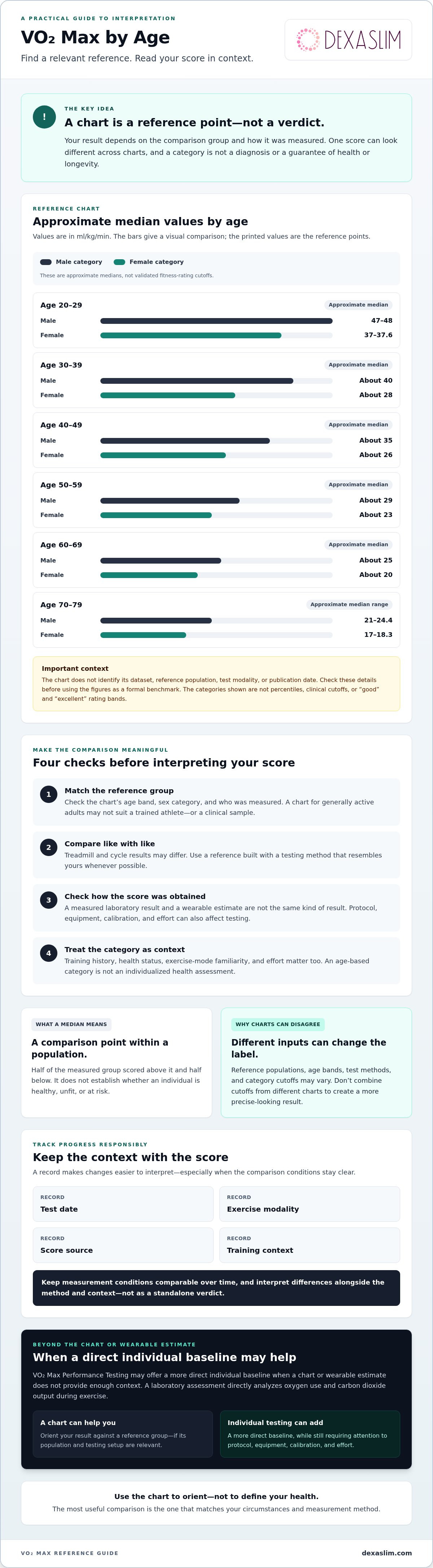
The chart below shows approximate median values by age and sex category. These are reference points, not validated fitness-rating cutoffs. The chart does not identify its dataset, reference population, test modality, or publication date, so check those details before using the figures as a formal benchmark.
| Age band | Male category: approximate median (ml/kg/min) | Female category: approximate median (ml/kg/min) | What the label means |
|---|---|---|---|
| 20-29 | 47-48 | 37-37.6 | Approximate median |
| 30-39 | About 40 | About 28 | Approximate median |
| 40-49 | About 35 | About 26 | Approximate median |
| 50-59 | About 29 | About 23 | Approximate median |
| 60-69 | About 25 | About 20 | Approximate median |
| 70-79 | 21-24.4 | 17-18.3 | Approximate median range |
How to read a VO2 max chart by age and sex
Find your age band, then compare your result with the column that matches the chart’s stated category. Here, the labels indicate approximate medians, not percentiles, descriptive fitness ratings, or clinical cutoffs. The chart lists male and female groupings but does not explain how those categories were defined or provide other demographic groupings. Don’t assume the figures apply equally to groups the chart does not describe.
What the chart’s fitness categories actually represent
A median is a comparison point within a population: half of the measured group scored above it and half below. It doesn’t establish whether an individual is healthy, unfit, or at risk. Because the figures don’t include defined rating bands, adding labels such as “good” or “excellent” would imply thresholds the data does not provide.
Reference categories depend on the population they describe. A vo2 max chart can help orient your comparison, but only if its population, age bands, sex categories, exercise modality, and category definitions fit the score you’re interpreting. Don’t combine cutoffs from different charts to create a more precise-looking result.
What Changes VO2 Max Reference Values Beyond Your Age
Age and sex are common chart variables, but they don’t explain every difference between scores. The reference population and testing setup matter, too. A chart based on generally active adults may not be a fair comparison for a trained athlete, and a chart based on a clinical sample may not fit either. Check who was measured before using the chart to judge your result.
Why reference population and testing method matter
Look for the reference population, exercise modality, and test protocol alongside the values. A treadmill test and a cycle test don’t necessarily produce interchangeable results: they involve different movements and muscles, and you may be more accustomed to one mode than the other. Your comparison is more relevant when your test resembles the method used to establish the reference.
A laboratory assessment directly analyzes oxygen use and carbon dioxide output during exercise. The University of Virginia School of Medicine explains this process in its overview of a VO2 max test. Results can still be affected by the protocol, equipment, calibration, and how consistently you sustain effort. A mismatch between your test and the reference can make an accurate measurement look unexpectedly high or low on a chart.
How age, sex, and training influence comparisons
Age and sex help organize reference groups, but they don’t fully explain an individual score. Training history, health status, familiarity with the exercise mode, and effort during testing can also affect results. Don’t treat an age-based category as a forecast of your future health. It compares your result with a defined group, not with an individualized assessment.
Before interpreting a score, check whether the chart represents general adults, trained athletes, or another population. Then match its age and sex categories and testing method as closely as you can to your circumstances. If key details are missing, treat the comparison as limited instead of assuming the chart’s labels apply to everyone.
Two valid charts can classify the same score differently because they may use different populations, age bands, test methods, or category cutoffs. Use a vo2 max chart to guide interpretation, not deliver a verdict. For an individual performance assessment, consider VO2 Max Performance Testing and check the testing details before comparing your result with a reference.
Is Your VO2 Max Score Good? Interpret the Chart Without Overreading It
A score is meaningfully “good” only in relation to a suitable reference and a comparable testing context. There’s no single threshold that applies across every age, sex category, exercise modality, and test method. Treat a chart label as a population comparison, not a diagnosis or definitive verdict on your fitness.
A practical checklist for interpreting your score
Before comparing results, check the details behind the score and the reference. Confirm the units, test date, age band, chart source, and exercise modality. Then check whether your number came from direct measurement during a dedicated test or an estimate from a wearable. These methods provide different kinds of information.
Match the context
Compare results from similar test methods and exercise modes.
Check the category
Find out whether the chart reports a percentile, a descriptive rating, or a median. Don’t treat one as another.
Keep the conditions in view
Consider whether effort, equipment, or measurement quality may have affected the result.
For example, a wearable estimate and a measured treadmill result may place you in different chart categories. That doesn’t automatically mean one number is wrong. The difference may reflect how each value was produced and which reference you’re using. The VO2 Max test guide explains more about testing and interpretation.
Why one chart cannot define your whole fitness profile
VO2 max is one measure of cardiorespiratory fitness. It doesn’t capture every aspect of health, and a chart category alone can’t predict an individual’s future health. Results can also vary with testing effort, measurement quality, and day-to-day conditions. A single score is one data point; interpreting it well requires context.
Use the chart to ask a more specific question: does this result fit a reference group and method that resemble mine? If you can’t tell, don’t force the score into a category. A standardized assessment may provide a more direct individual baseline than a chart or wearable estimate alone.
If you have symptoms during exercise or concerns about what your result means for your health, discuss them with a qualified healthcare professional. Don’t use a vo2 max chart to diagnose a condition or decide that symptoms are harmless. Interpret the score carefully, and seek appropriate guidance when health concerns are part of the picture.
How to Use a VO2 Max Chart to Track Progress Responsibly
A single score is a snapshot. A useful progress record shows how the score changes and the conditions under which it was collected. Establish a baseline, document the measurement, repeat under comparable conditions, and assess the trend instead of reacting to one reading.
Build a repeatable VO2 max tracking baseline
Start by recording your score and its context. Note the test date, units, reference source, exercise modality, and relevant training circumstances. Identify whether the number came from a laboratory test, field test, or wearable estimate. Keep these measurement types separate in your log, since switching between them can make a trend harder to interpret.
When you repeat a test, use a comparable protocol and equipment when practical. Keep the same modality, such as treadmill or cycle, and follow the same test instructions. A wearable can help you observe patterns over time, but label its scores as estimates and don’t treat them as interchangeable with measured results.
Record the baseline
Save the score, date, units, and source.
Document the conditions
Note the modality, testing method, and relevant training context.
Repeat consistently
Use a comparable approach when you measure again.
Review the trend
Look for a pattern across comparable results, not a small change in isolation.
Consistent testing conditions make comparisons more useful by reducing differences caused by the measurement setup rather than a real change in performance. A vo2 max chart can put each result in context, but use the same reference framework when reviewing progress.
What to do when your score changes
If a new result surprises you, check the context before drawing conclusions. Did the modality, equipment, protocol, or effort change? Consider whether your health, recovery, or other testing conditions differed. A single reading may not represent a lasting shift, especially if the measurement source or setup changed.
Keep the entry in your log, note what was different, and compare it with later results collected under similar conditions. Don’t dismiss a meaningful pattern, but don’t infer a decline or improvement from one isolated number either. The goal is a clearer personal baseline, not a perfect-looking chart category.
If exercise brings on concerning symptoms, or you have questions about what a change means for your health, seek guidance from a qualified healthcare professional. For a performance assessment of aerobic fitness, explore VO2 Max Performance Testing.
When a VO2 Max Test Adds More Than a Chart or Watch Estimate
A vo2 max chart shows how a result compares with a reference group. A dedicated performance assessment can add individual information, depending on the testing method. Wearables offer convenient estimates that can help you notice patterns, but they use inputs such as heart rate and activity data rather than directly measuring oxygen use. Each has a role. Choose the method that fits the question you want answered.
Dexaslim offers VO2 Max Performance Testing for people seeking an aerobic performance assessment. Testing methods and preparation requirements can vary, so confirm those details with the provider before booking. The separate VO2 Max + DEXA (BCA) Bundle combines VO2 max testing with a DEXA assessment. DEXA is an additional assessment, not a requirement for interpreting a VO2 max score. For more about that component, see the DEXA body composition scan guide.
Questions to ask before choosing VO2 max testing
Ask how the result will be generated and interpreted. Which exercise modality is used? What measurement approach does the test use, and how are results reported? What reference supports any category or comparison? Confirm preparation instructions and whether the test is suitable for you directly with the provider. These answers help clarify what the result can show and how to compare it responsibly.
Choose your next step based on the question you have
Looking for general context?
Use an age- and sex-specific chart as a population reference, not as a diagnosis.
Tracking trends?
A wearable estimate can help you monitor patterns, especially when you interpret it consistently and understand its limits.
Need a personal baseline?
Consider performance testing when a more direct individual assessment would be useful.
Interested in two distinct assessments?
Consider the combined VO2 Max + DEXA (BCA) option, and clarify what each assessment measures.
Don’t choose a test simply because it produces a number. Choose one whose method, reporting, and comparison can help answer your specific question. A chart can orient you; testing can add individual data. Neither score is a diagnosis or a guarantee of health.
Turn Your VO2 Max Score Into a Clear Next Step
A vo2 max chart is a reference, not a personal verdict. Choose age- and sex-specific values that match the reference population and testing method, then interpret your score in that context. To track progress, record how each result was measured and compare results from similar conditions instead of reacting to one reading.
If a chart or wearable estimate leaves you uncertain, a performance assessment may provide a more direct individual baseline. Dexaslim offers VO2 Max Performance Testing. Its VO2 Max + DEXA (BCA) Bundle is a separate option if you also want a DEXA assessment; it isn’t necessary to interpret VO2 max.
Explore Dexaslim’s VO2 Max Performance Testing and check the testing details to decide whether it fits your goals. Use the data as a starting point, track it consistently, and build a clearer picture of your fitness over time.
Frequently Asked Questions
What is a good VO2 max for my age?
There’s no single score that defines a good VO2 max for everyone. Compare your result with a reference that matches your age, the chart’s sex categories, and its testing method. Check whether its labels describe percentiles or fitness categories, since those aren’t interchangeable. A suitable chart shows how your score compares with a defined population, but it can’t diagnose a condition or provide a complete assessment of your health.
How do I read a VO2 max chart?
Find your age band and the demographic category that applies, then locate your score using the units shown. Read the chart’s notes before interpreting the result. Charts may use different populations, exercise modes, and testing protocols, so a mismatch can weaken the comparison. Record the chart source and your test method alongside your score. That context supports more useful future comparisons and helps prevent misleading conclusions from a category label alone.
Does VO2 max naturally decrease with age?
Reference charts often separate results by age because aerobic capacity varies across age groups. An age-based comparison shows how your score sits within the chart’s selected population; it doesn’t predict your personal trajectory. Training, health, test effort, and measurement method also affect results. Use the chart as context, not a forecast. If you have symptoms or specific concerns about your health or exercise capacity, discuss them with a qualified healthcare professional.
Are VO2 max charts different for men and women?
Many published reference charts use separate sex categories, but the groupings and values depend on the dataset and test protocol. Check how the chart defines its categories instead of assuming every chart uses the same approach. A chart compares your result with its reference population. It can’t account for every individual factor or replace a personalized health assessment. For a fairer comparison, use a reference that fits your test method and circumstances.
Is a smartwatch VO2 max estimate accurate?
A smartwatch estimates VO2 max using its sensors and calculation method, so its result may differ from a direct performance test. Accuracy can depend on the device, activity, and quality of the data it collects. Use the same device under comparable conditions to follow general trends. Don’t treat a wearable estimate as interchangeable with a lab measurement or use it to diagnose a health condition. Keep track of how each score was produced.
Can you improve your VO2 max?
VO2 max can respond to aerobic training, but individual results vary. A chart can’t prescribe a safe or effective training plan. Consider your current fitness, health, training history, and recovery needs when planning activity. If you have symptoms or a medical concern, consult a qualified healthcare professional before making significant exercise changes. Track progress with comparable measurements rather than relying on one score alone.