

TRT can change body composition without causing major weight loss. A 2016 randomized crossover study documented significant organ-fat loss after six months of physiologic testosterone dosing, but TRT and body composition are not the same as a weight-loss treatment: for men with symptomatic hypogonadism, TRT treats the condition, not obesity. The scale alone can miss shifts between fat and lean mass.
If you’re tracking your weight and wondering whether TRT is working, the distinction matters. You deserve clear measures, not guesswork. This article explains what evidence says about fat loss, muscle gain, and the timeline for change, including why the scale may tell a different story from a body-composition assessment.
You’ll also learn how DEXA scans can help track progress, what to measure alongside body weight, and how resistance training, nutrition, and recovery support your goals. Objective data can show what’s changing and help you make informed decisions about next steps.
Key Takeaways
• TRT treats symptomatic hypogonadism, not obesity. Changes in fat and lean mass can happen without a large drop in scale weight.
• Body-composition changes typically develop over months. Track trends over time instead of judging progress by an early weigh-in.
• Testosterone and body fat can influence each other, making the relationship more complex than a single hormone level or body-weight reading.
• Resistance training, adequate protein, and a calorie-appropriate diet can support changes in muscle and fat during TRT.
• Use DEXA scans at 90-day intervals to compare body-composition changes with weight and other progress measures.
Can TRT alone cause significant weight loss?
TRT may reduce fat and increase lean mass in men with confirmed low testosterone, but it isn’t a primary obesity treatment. A six-month study documented significant organ-fat loss, even though scale weight may change less dramatically.
Changes in Fat and Lean Mass
Lean body mass includes muscle and other nonfat tissue, while fat mass measures stored body fat. TRT can affect both, so a stable scale reading may hide meaningful changes in body composition. For men with symptomatic hypogonadism, TRT treats low testosterone, not weight alone.
Resistance training, adequate protein, and a calorie-appropriate diet can support these changes. For example, someone gaining lean mass while losing fat might see little movement on the scale. Compare body measurements and body-composition results with weight, rather than treating one weigh-in as the whole picture.
Body Fat and Waist Circumference
Body-fat measurements and waist circumference reflect different aspects of change. Neither means every person will see the same change in waist size or scale weight.
A six-month randomized crossover study documented significant organ-fat loss with physiologic testosterone dosing. Waist measurements add context, but they can’t distinguish fat from lean tissue. Pair them with consistent body-composition assessments to understand whether a change reflects fat loss, muscle gain, or both.
How does TRT compare with exercise, diet, or weight-loss medications? Resistance training, adequate protein, and a calorie-appropriate diet can support body-composition goals during TRT. TRT is not a substitute for weight-loss medication or lifestyle measures.
How much does TRT cost in the United States, and does insurance cover it? TRT pricing depends on the case and is provided after a quote request; treatment and monitoring needs affect cost. Insurance coverage depends on the plan and clinical indication.
Can TRT improve body composition in men with normal testosterone levels? The clearest benefits are demonstrated in men with laboratory-confirmed low testosterone and associated symptoms. TRT isn’t a body-composition shortcut for men with normal testosterone levels.
TRT also has potential side effects. It can suppress fertility by lowering sperm production, an important consideration if you’re planning to have children. Discuss fertility goals before treatment, rather than treating this effect as separate from the decision.
Build the foundation with resistance training, protein, and recovery. The recommended protein intake is 0.8-1.0 grams per pound of goal bodyweight, and 7-9 hours of sleep supports recovery. These steps strengthen the conditions for body-composition change; TRT alone doesn’t replace them.
How long to see body composition changes on TRT?
TRT-related changes generally develop over months, not days. Energy, libido, lean mass, fat, and bone each follow different timelines.
Timeline for Body-Composition Changes
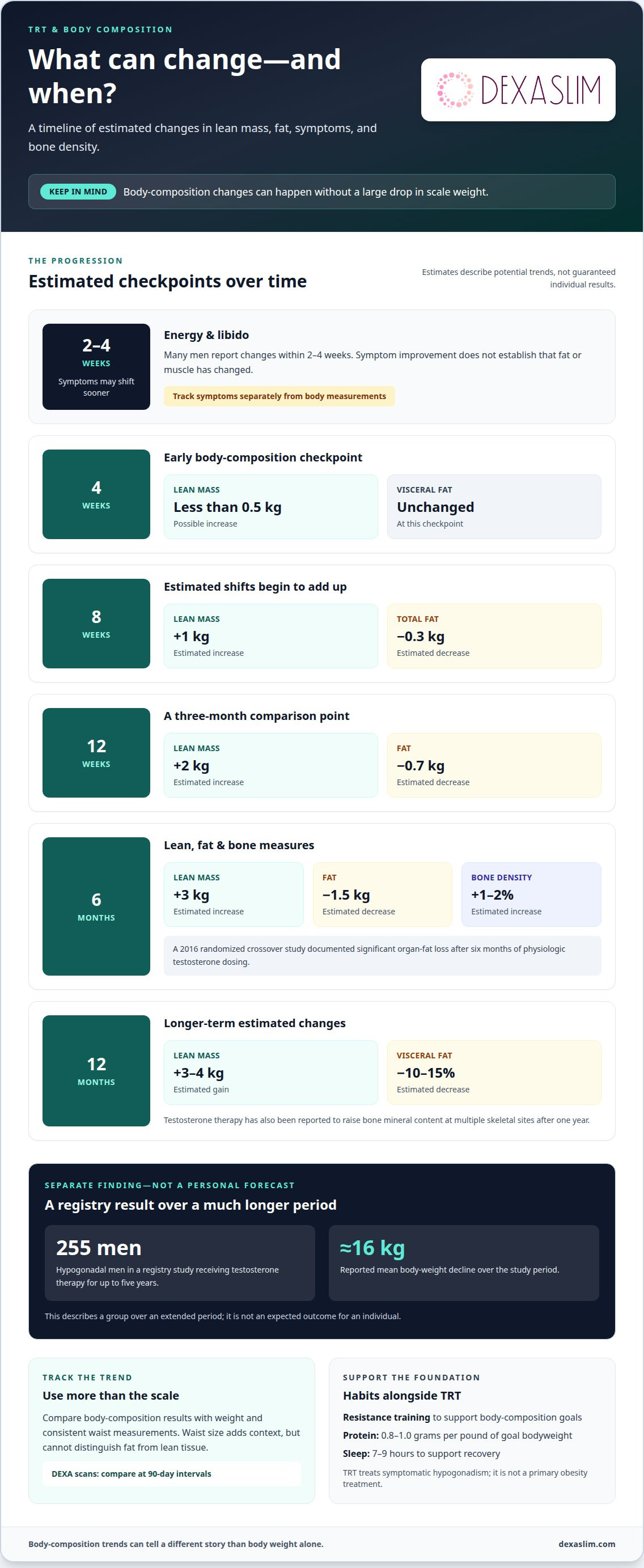
Body-composition changes are shifts in lean tissue and fat measured over time. At four weeks, lean mass may rise by less than 0.5 kg, while visceral fat remains unchanged. At eight weeks, estimates reach 1 kg more lean mass and 0.3 kg less total fat. By 12 weeks, estimates reach 2 kg more lean mass and 0.7 kg less fat. These checkpoints help set realistic expectations.
Energy and libido can follow a faster track. Many men report changes within 2-4 weeks, while visible or measurable body-composition changes take longer. Separate symptom tracking from body measurements; an early improvement in energy doesn’t establish that fat or muscle has changed.
Changes in Lean Body Mass
Lean body mass includes nonfat tissue, and its gradual increase can occur without a major change in total weight. At six months, the timeline estimates a 3 kg increase in lean mass and a 1.5 kg decrease in fat. At 12 months, estimated lean-mass gain reaches 3-4 kg. Compare measurements over time, not a single reading.
The Testosterone Trials found improved lean mass and modest fat reductions in older men with hypogonadism using testosterone gel. They did not find large changes in absolute body weight. That distinction matters: changes in body composition may be more informative than scale weight alone.
Weight and Waist Changes Over Time
Long-term weight and waist trends show how body changes accumulate, but neither measurement identifies tissue type. A registry study followed 255 hypogonadal men receiving testosterone therapy for up to five years, according to The registry-study investigators. The reported mean body-weight decline was approximately 16 kg over the study period.
That registry result describes a group over an extended period, not an expected individual outcome. The timeline estimates a 10-15% decrease in visceral fat after 12 months. Record waist measurements consistently alongside weight. Their combined pattern gives more context than either number by itself.
Expected Changes in Bone Density
Bone density measures mineral content in bone, a different outcome from fat loss or muscle gain. The timeline estimates a 1-2% increase in bone density after six months of TRT. Testosterone therapy has also been reported to raise bone mineral content at multiple skeletal sites after one year.
These changes matter because body composition includes more than visible muscle and fat. Keep bone measures distinct from lean-mass results when reviewing progress. A bone density scan provides a separate measure, while repeated body-composition assessments show how fat and lean tissue shift.
Bidirectional relationship between testosterone and body fat
Testosterone and body fat can influence one another, so a single measurement cannot explain the full pattern. Experimental suppression of testosterone in healthy men increased fat mass in a dose-dependent manner: lower testosterone levels produced greater fat accumulation. That finding shows one direction of the relationship, but doesn’t prove that every change in body fat causes testosterone to change.
This distinction helps when interpreting test results. Low testosterone and higher body fat may occur together, but one observation cannot show which came first. For example, hormone levels might change while body fat stays stable, or body fat might shift while hormone results remain similar. These patterns call for separate measurements, not assumptions about cause.
The experimental finding also shows why the amount of testosterone matters. Researchers deliberately suppressed testosterone and observed fat gain that varied with the degree of suppression. This design offers stronger evidence about direction than a simple snapshot, because hormone levels were experimentally altered. Still, it doesn’t establish that testosterone alone determines body-fat changes in everyday life.
A timeline can make the relationship easier to interpret. Record the date of each hormone assessment and body-composition measurement, then compare changes over the same period. If both measures shift, note whether the hormone change came first, the body-fat change came first, or both occurred together. That sequence adds context without treating correlation as proof of cause.
Keep the measures distinct, too. Body weight combines fat and lean tissue, while a body-composition assessment separates them. Stable weight, for example, can coincide with a change in the balance between fat and lean mass. A hormone result alone can’t reveal that shift. Pairing different measures makes the pattern clearer and reduces guesswork.
TRT is not a universal response to body fat. The clearest treatment rationale is symptomatic, laboratory-confirmed low testosterone, rather than hormone therapy solely to change appearance. In a man with normal testosterone, the suppression experiment does not establish a benefit from raising levels. It shows that experimentally lowering testosterone can affect fat mass, not that more testosterone is automatically better.
Interpret results carefully: establish a baseline, track hormone and body-composition measures separately, and compare them over time. Treat a change as a signal to examine the full pattern, not a standalone verdict. The experimental suppression finding supports a real link, but understanding an individual pattern takes more than one measurement.
Clinical trials and meta-analyses of TRT
Clinical trials test specific treatment outcomes, while meta-analyses combine findings across studies. Together, they show a consistent distinction: testosterone therapy can improve lean mass and reduce fat mass, while scale weight may tell a different story. The clearest body-composition evidence concerns men with laboratory-confirmed low testosterone and associated symptoms, not men seeking weight change alone.
A 2018 meta-analysis of testosterone trials reported roughly 1-3 kg of additional lean body mass within six months among middle-aged and older men. That pooled estimate describes a group-level result, not an individual target. It also focuses on lean mass, which is why a scale reading alone cannot capture the full response.
Another meta-analysis examined 29 randomized controlled trials of testosterone therapy and body composition in middle-aged men. Combining trials helps assess patterns across studies rather than relying on one participant group. But study populations and treatment periods differ, so the combined evidence should guide expectations, not promise identical changes for every man.
Clinical studies also report that body-composition improvements can continue at 12 months and beyond. This longer view matters because a short observation period may capture early changes without showing the later trend. Compare outcomes at consistent intervals and keep lean mass and fat mass distinct; a change in one doesn’t automatically mean the same change in the other.
A randomized controlled trial in men with hypogonadism and type 2 diabetes found reduced waist circumference and fat mass with testosterone therapy, alongside improved glycemic control compared with placebo. This result connects body composition with metabolic health in a defined clinical group. It should not be generalized to every population or treated as proof that testosterone alone causes weight loss.
To interpret a study, identify three details: who was studied, what outcome was measured, and how long participants were followed. Lean mass, waist circumference, and total body weight, for example, are different endpoints. A trial showing improved lean mass does not automatically establish substantial weight loss or the same change in abdominal fat.
The most useful conclusion is specific: TRT-related body-composition benefits are most clearly demonstrated when laboratory testing confirms low testosterone and symptoms are present. Evidence supports treatment of that condition, while changes in fat, muscle, and metabolic measures are separate outcomes to track. Before applying a finding to your own progress, consider the study population, endpoint, and duration.
DEXA scans for tracking body composition
A DEXA scan gives a clearer view of body composition than scale weight alone. It distinguishes fat mass, lean mass, and bone measures, helping you see which compartments change during TRT. The recommended follow-up interval is every 90 days. That spacing makes it easier to compare meaningful trends rather than react to small shifts between closely timed scans.
Start with a baseline scan, then compare it with a follow-up after 90 days. Review the same categories each time: total fat mass, lean mass, and bone measures. For example, if body weight stays stable but lean mass rises and fat mass falls, the scan can reveal progress the scale hides. This is the central value of measurement: identify what changed, not just whether weight moved.
TRT-related changes in muscle and fat may become detectable by DEXA around 8-12 weeks. A scan taken too early may not show a clear trend, even when other changes are underway. Use the 90-day interval as a practical comparison point, then interpret the result alongside training, nutrition, and treatment timing. A single scan gives a baseline; repeated scans show direction.
Consistent measurements make comparisons more useful. Tie each scan to its date and treatment timeline, and compare like with like. If one assessment shows increased lean mass and another shows reduced fat, record both instead of compressing the results into a single weight change. This gives you a more useful progress record than clothing fit or visual estimates alone.
DEXA results can help distinguish different goals. Someone focused on fat reduction may prioritize fat-mass trends, while someone building strength may track lean-mass changes. Bone measures provide another distinct data point. Don’t treat one category as a substitute for another: increased lean mass doesn’t automatically prove fat loss, and a lower scale reading doesn’t identify which tissue changed.
Connect scan results to the rest of your tracking. Pair each 90-day assessment with body weight, waist measurements, and notes about resistance training or diet changes. For example, a waist measurement that declines while lean mass rises offers a different picture from weight alone. Keep the dates aligned so you can see whether several measures move in the same direction.
Use DEXA as an objective checkpoint, not a verdict on treatment success. The useful signal is the pattern across repeated measurements, especially around the 8-12-week window when changes may become detectable. Compare fat, lean tissue, and bone separately. That approach turns body-composition tracking into a structured record instead of a guess based on the scale.
Dexaslim: 1 Session Dexa Scan
Dexaslim’s 1 Session Dexa Scan gives you a measurable snapshot of fat mass, lean mass, and bone measures. Use it to establish a baseline or assess how your body composition has shifted during TRT, especially when scale weight doesn’t reflect the full picture.
For a broader view of performance and energy needs, Dexaslim also offers VO2 Max Performance Testing and a Resting Metabolic Rate (RMR) Test. These evaluations add context to a scan when you’re tracking fitness or calibrating daily caloric needs.
Choose the assessment that matches the question you want answered, then use the results to guide your next progress review. Contact Dexaslim to explore a 1 Session Dexa Scan.
Make Your Next Progress Measure Count
Turn your health goal into a clear question: what change matters most to you? It might be strength, waist fit, energy, or a more precise understanding of your body composition. Choose a marker that reflects that priority, then track it consistently. This gives your next decision a stronger foundation than appearance or motivation alone.
A focused approach to TRT and body composition connects treatment goals with objective progress measures. Keep your priorities in view, review results over time, and use the pattern to guide your next health discussion. Data brings direction, and consistent tracking makes that direction useful.
If you’re ready to define your next step, contact Dexaslim to discuss your goals. Take the next step with clarity and keep building toward progress you can measure.
Frequently Asked Questions
Does TRT help with weight loss directly?
No. TRT treats symptomatic hypogonadism, not obesity as a primary weight-loss treatment. It can change the balance of fat and lean tissue without producing a large drop in total weight. For weight management, distinguish hormone treatment from a calorie-appropriate diet, resistance training, and weight-loss medication. Track body composition separately from scale weight so a tissue shift isn’t mistaken for no progress.
Does low testosterone cause belly fat?
Low testosterone and increased body fat can be linked, but one result alone doesn’t prove which change came first. Experimental testosterone suppression in healthy men increased fat mass in a dose-dependent pattern, with greater accumulation at lower testosterone levels. That finding supports a relationship, not a diagnosis based on waist size. Interpret testosterone results alongside symptoms and other clinical information, rather than assuming belly fat confirms low testosterone.
How long does it take to see results from TRT?
Different outcomes follow different timelines. Many men report higher energy and libido within 2-4 weeks, while measurable body-composition changes generally develop over months. TRT-related muscle and fat changes may become detectable by DEXA around 8-12 weeks. Keep a dated record of symptoms, weight, and scan results; comparing measurements taken at consistent intervals helps distinguish an early symptom change from a later body-composition trend.
What are the downsides of TRT?
A key downside is reduced fertility: TRT can suppress sperm production. If you’re planning to have children, make fertility goals part of the treatment discussion before starting. Consider this separately from the intended body-composition outcome. Changes in muscle or fat don’t cancel out a reproductive effect, and tracking physical progress alone won’t show whether sperm production has been affected.
What else should I do alongside TRT to lose weight?
Build a weight-management plan around consistent eating habits, resistance training, and recovery rather than relying on TRT alone. A calorie-appropriate diet supports weight goals, while resistance exercise makes training part of your body-composition strategy. Keep a simple record of meals, workouts, and weight trends. This can help you assess whether your routine is consistent before interpreting a change as a treatment effect.
Who Is Most Likely to Benefit?
Men with symptoms and laboratory-confirmed low testosterone are the group for whom TRT-related body-composition benefits are most clearly demonstrated. A low result without associated symptoms, or a body-fat concern without confirmed low testosterone, doesn’t establish the same treatment rationale. Consider symptoms and test results together. This keeps TRT focused on treating hypogonadism, rather than using it solely to change appearance.
Will I lose belly fat on TRT?
TRT may reduce visceral fat, but it doesn’t selectively target belly fat or ensure a smaller waist for everyone. Abdominal fat is part of overall fat mass, and waist size alone can’t identify which tissue has changed. Track waist measurements consistently and interpret them alongside body-composition data. This gives a more useful picture than treating one measurement as proof of fat loss.
How does testosterone replacement therapy affect body composition in men with low testosterone?
In men with low testosterone, therapy can increase lean body mass and reduce fat mass, creating a shift that total body weight may not show clearly. The pattern matters more than one isolated number: compare lean mass and fat mass separately across assessments. For TRT and body composition, a useful progress review asks which tissue changed, rather than relying on whether the scale moved.