
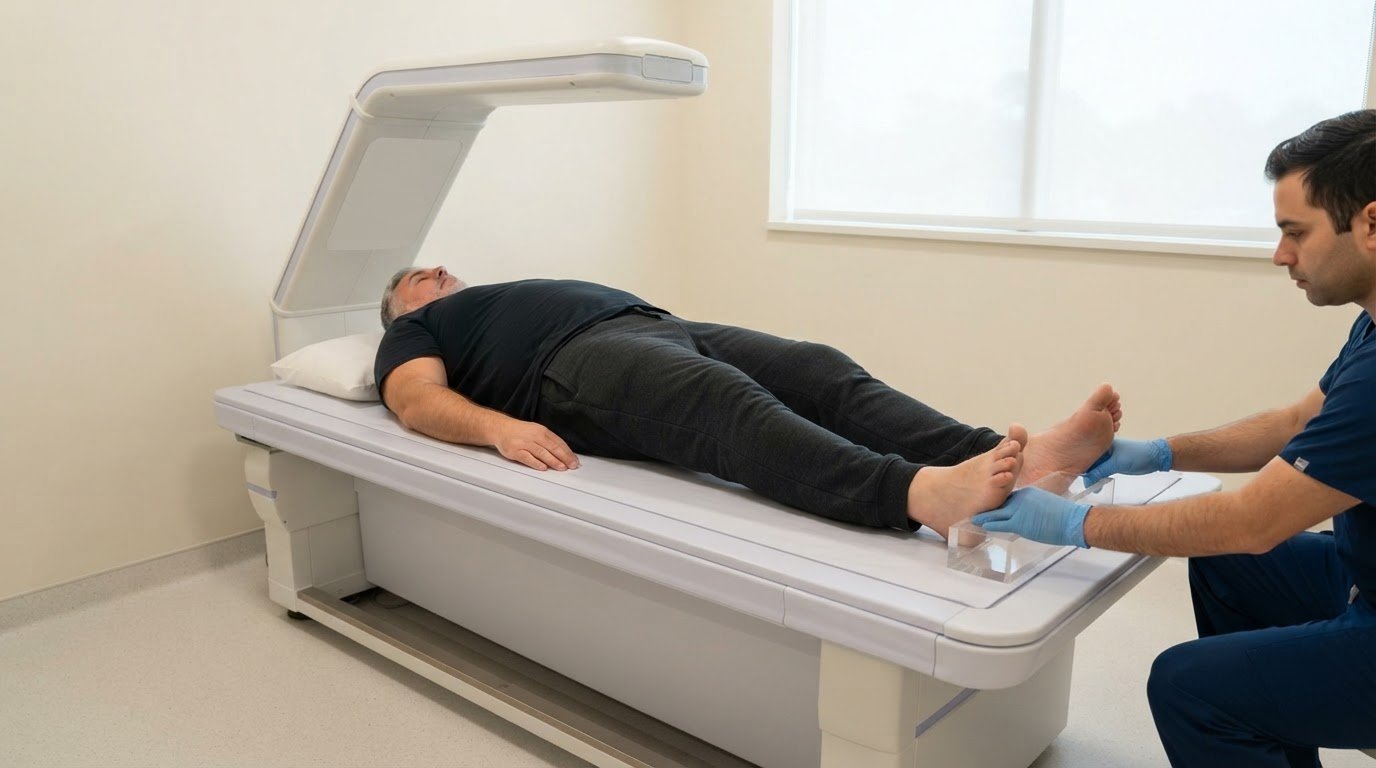
Repeat a DEXA scan every 10-12 weeks during body recomposition. That interval gives changes in fat and lean mass time to emerge, making tracking body recomposition with DEXA more useful than comparing scans taken too close together. Consistent conditions also matter: hydration, food intake, exercise, and scan timing can affect results.
It’s frustrating when the scale stays the same despite steady effort. But body weight alone can’t show whether fat is decreasing while lean mass is increasing, or how your body composition is changing by region.
This guide explains when to schedule a repeat scan, how to interpret the results in context, and how to track changes over time without overreacting to one measurement. You’ll also learn why consistent scan conditions matter and how to combine DEXA results with weight trends and other progress indicators for a clearer picture of body recomposition.
Key Takeaways
• Compare fat mass, lean mass, and regional results together; scale weight alone can’t show what’s changing.
• Interpret small shifts against DEXA’s measurement precision rather than treating every difference as definite progress.
• Look at trends across several weeks, not one weigh-in, and pair scan results with weight trends and circumference measurements.
• If progress stalls despite consistent habits, review the full pattern of results to identify what may need adjusting.
How Reliable Are DEXA Measurements?
DEXA estimates fat, lean tissue, and bone across the body and specific regions. For meaningful comparisons, repeat scans under similar conditions and allow enough time for measurable change.
DEXA Body Composition Measurements
DEXA uses low-dose X-rays to estimate fat mass, lean mass, and bone mineral content. These separate measurements can reveal changes that a scale combines into a single weight figure.
For example, weight can remain stable while fat mass decreases and lean mass increases. A whole-body scan also includes bone, so body composition results are not simply a direct measurement of muscle. A DEXA body composition scan’s price depends on the case and is provided after a quote request; cost factors include scan type and the services included.
Regional and Appendicular Lean Mass
Regional results divide body composition into areas such as the arms, legs, and trunk. Appendicular lean mass refers to lean tissue in the arms and legs, helping you assess distribution rather than just the whole-body total.
About 70% of appendicular lean mass represents skeletal muscle. A comparison might show one leg with 5% less lean mass than the other. That difference can prompt a closer look at symmetry, training patterns, or how results change across repeat scans.
Accuracy and Repeatability
DEXA provides estimates, and repeatability depends partly on keeping scan conditions consistent. Hydration, recent food intake, exercise, and timing can affect results, so a difference between scans does not automatically mean new muscle or fat loss.
For context, the Centers for Disease Control and Prevention states that DEXA scans use 0.5 to 1.0 mREM of x-ray energy, compared with 20-30 mREM for a chest x-ray. Compare trends across scans, not isolated readings. Repeating scans every 8 to 12 weeks during active transformation gives changes more time to emerge.
Tracking Lean Mass During Weight Loss
Tracking lean mass during GLP-1 weight loss helps show whether weight changes involve more than fat. Lean tissue can account for 25% to 40% of total weight lost by people using GLP-1 medications such as semaglutide.
Pair lean-mass results with fat mass and total weight to interpret the overall pattern. For example, fat mass can decrease while lean mass rises, even if scale weight changes little. Consistent 8 to 12 week scan intervals make comparisons more useful than frequent readings.
Interpreting results with a personalized consultation
A DEXA report is most useful when you interpret its measurements together, rather than in isolation. A personalized review can connect body-fat percentage and lean mass with scan timing and your current goals.
Body Fat Percentage Interpretation
Body-fat percentage is the proportion of total body weight estimated to be fat. It adds context that weight alone can’t provide, but it doesn’t show the full distribution of fat or explain every health outcome.
For example, 40 pounds of fat at 160 pounds of body weight equals approximately 25% body fat. The same percentage can accompany different amounts of muscle mass, so review fat mass and lean mass alongside the percentage. An abstract presented at the North American Menopause Society’s annual meeting reported excess fat on DXA in 18.5% of women with normal BMI.
Long-Term Trends and Scan Intervals
Long-term tracking compares consistent measurements across repeat scans to reveal whether body composition is changing in the intended direction. For active recomposition, a 10-12 week interval gives more time for changes to emerge than closely spaced scans.
Review the scan date, body-fat percentage, fat mass, and lean mass together. Then compare those results with weight trends and training performance. One reading is a snapshot; a series of measurements can help distinguish a sustained pattern from a short-term fluctuation.
A consultation can add meaning by relating the report to your nutrition, training, sleep, and consistency. For example, lower fat mass with stable lean mass suggests a different pattern from weight loss accompanied by a decline in lean mass. The figures guide the discussion, but they don’t replace the context behind them.
DEXA can also estimate visceral fat, which may help assess metabolic health alongside other findings. A personalized review considers the full report rather than treating one measurement as a diagnosis or complete risk assessment. It can show which results align with your goal and which may merit closer attention.
If progress has stalled for six to eight weeks despite consistent nutrition, training, sleep, and adherence, compare your plan with the scan trend. Check whether fat mass, lean mass, and body weight are moving together or in different directions. This can help you make more targeted adjustments than reacting to one scale reading.
For a clearer baseline and repeat comparison, a DEXA body composition scan can provide the measurements used to track these trends.
What Does Body Recomposition Mean?
Body recomposition means reducing fat while maintaining or increasing lean tissue. DEXA helps monitor this shift by separating body composition into measurable compartments. Tracking body recomposition with DEXA consistently means following changes in fat and lean tissue over time.
A whole-body DEXA scan measures fat, bone, and lean tissue. A baseline scan before starting a fitness plan gives later results a reference point. Compare the same measures over time instead of relying on body weight alone. Weight can remain stable even as fat decreases and lean tissue increases.
Precision still has limits. In resistance-trained athletes, same-day DEXA scans had a technical precision error of about 617 g. On consecutive days, biological variation raised measurement error to roughly 2,083 g. Those differences show why a small change between scans may reflect measurement variability, not a definite shift in tissue.
The least significant change is calculated as 2.77 times the precision error. In some groups, changes may need to exceed 2.8 kg to be physiologically meaningful. DEXA can also struggle to detect muscle changes under 3%. Treat these figures as context for interpreting a trend, not as a universal threshold for every person or scan.
For example, consider a modest increase in lean mass alongside scan conditions, training progress, and other body-composition results. One number can’t establish whether muscle has truly changed. Compare repeated measurements taken under similar conditions, then assess whether the direction and size of the change fit the broader pattern.
Research also illustrates why measurement methods matter. In a UK Biobank study involving 32,961 participants over 2.5 years, MRI detected a 4-5% muscle decline, while DEXA showed lean-mass gains in women. MRI provides another way to assess muscle, but this finding highlights that lean mass and muscle measurements aren’t interchangeable.
Use DEXA as a structured measure of body composition, not a perfect muscle counter. Tracking body recomposition with DEXA means comparing fat mass, lean tissue, and bone density as distinct results across scans. If the report includes visceral fat, interpret it as another estimate, not a substitute for the other measures. The clearest signal comes from repeat scans, consistent training context, and changes that stand apart from measurement noise.
When Should You Repeat a DEXA Scan?
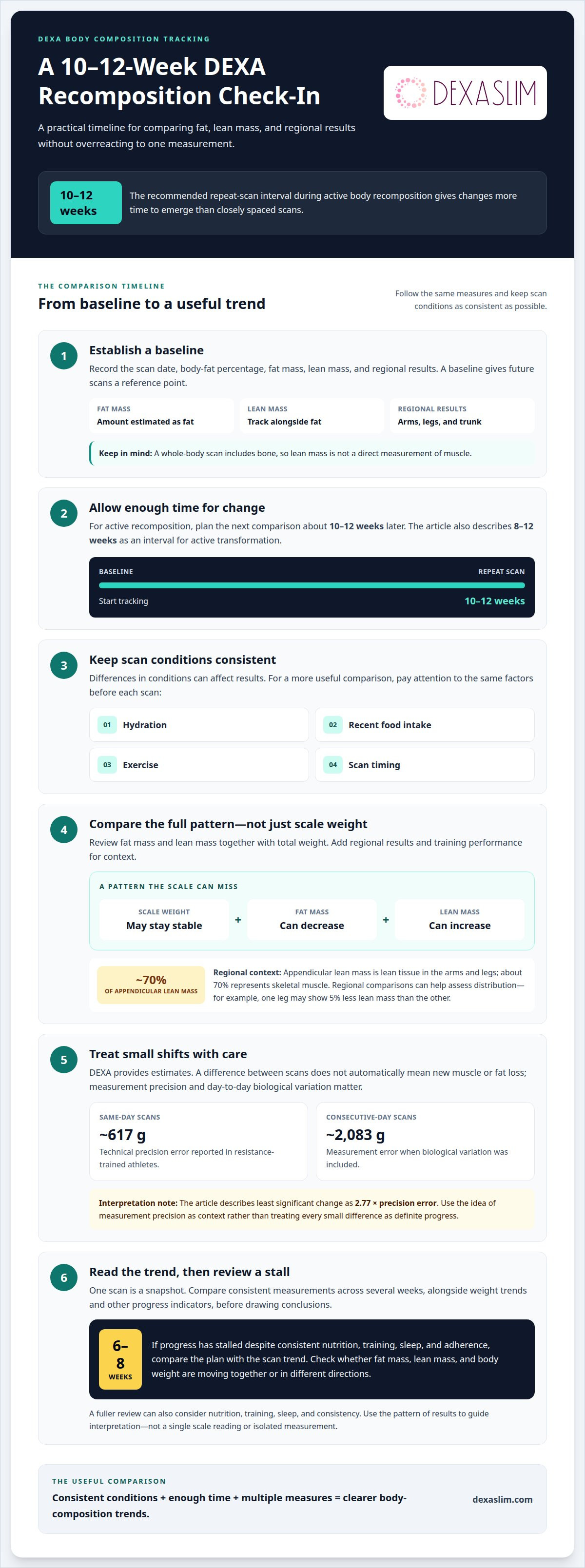
For active body recomposition, a repeat DEXA scan every 10-12 weeks gives tissue changes time to emerge. Consistent preparation makes comparisons more useful.
Standardizing Repeat Scans
Standardizing repeat scans means matching preparation and timing as closely as possible. Hydration, food intake, exercise, and scan timing can affect results, so different conditions may make comparisons less clear.
Use the same routine before each appointment. Keep hydration and meal timing similar, and avoid strenuous exercise for 24 hours before scanning. A hard workout can shift fluid and glycogen, affecting measured lean mass even when muscle tissue hasn’t changed.
Fasting is not a universal requirement for body-composition DEXA scans. Consistency matters: if one scan follows a meal and another follows a long fast, the results may be less comparable. Record the conditions for each scan so the professional reviewing your results can account for differences.
Schedule scans at a similar time of day when practical to limit variation from daily routines. The goal is not perfect conditions, but measurements that are as comparable as possible.
Recommended Scan Frequency
For body recomposition, repeat scans every 10-12 weeks to assess progress. Scanning more often than every 4 weeks is discouraged because lean-mass changes may not yet be statistically significant.
During rapid fat loss, a 6-8 week interval is another suggested schedule. Choose an interval that fits the pace of change and the question being tracked. For general health and maintenance, body-composition scans every 6-12 months may be more appropriate than frequent monitoring.
Don’t interpret a short-term difference as proof of muscle gain or loss. A five-pound weight change can include fat, lean tissue, water, or a combination. Compare the scan with the broader trend and the conditions surrounding each measurement.
Repeated DEXA scans use X-rays, so exposure is low but not zero. According to the Centers for Disease Control and Prevention, DEXA scans use 0.5 to 1.0 mREM of x-ray energy, compared with 20-30 mREM for a chest x-ray.
A DEXA scan itself typically takes 10-15 minutes; an appointment commonly takes 20-30 minutes. The professional positions you for the scan, then the machine captures measurements while you remain still. Plan repeat scans at intervals that allow meaningful comparison, rather than treating each appointment as a weekly progress check.
Tracking body composition changes over time
Track body composition across four to twelve weeks, rather than relying on one weigh-in. Comparing progress across scans is central to tracking body recomposition with DEXA. Weekly trends, measurements, and consistent fitness records can help explain what happens between scans.
Use a small set of repeatable markers. Review weight trends weekly and record circumference measurements every two to four weeks. Take progress photos every four weeks in consistent clothing, location, and lighting. Each marker offers a different perspective, so compare the direction of change rather than expecting every measure to move together.
Weight
weekly trends help distinguish a sustained shift from ordinary two- to five-pound fluctuations.
Circumference
measurements every two to four weeks can show changes that scale weight misses.
Photos
repeat them every four weeks under similar conditions to compare visible changes.
DEXA
repeat body-composition scans at planned intervals to assess fat, lean tissue, and visceral adipose tissue.
A clinical provider can help track progress between scans by reviewing these markers alongside your DEXA results. They can assess whether weight, circumference, and reported training performance support the same trend, then help identify useful questions for your next scan review.
Keep the context consistent, too. Changes in nutrition, exercise, sleep, or training can affect how you interpret progress. For example, stable weight with a smaller waist measurement may tell a different story from stable weight with unchanged measurements. Record relevant changes as they happen so the next comparison has context.
For metabolic tracking, a Resting Metabolic Rate (RMR) Test can help calibrate daily caloric needs and fitness regimens. Consider the result alongside your DEXA findings, intake, and activity patterns. It adds an energy-use measure to the body-composition picture, rather than replacing scan results or serving as a stand-alone progress measure. Tracking body recomposition with DEXA alongside metabolic information can put scan trends in context.
For people monitoring age-related muscle changes, annual ALMI tracking offers a longer-view marker. If metabolic health is the focus, visceral adipose tissue can be monitored with DEXA every 8 to 12 weeks. Match the interval to the outcome you’re tracking, and avoid treating a short-term change as a complete picture.
Explore a Resting Metabolic Rate (RMR) Test to add metabolic context to your tracking plan.
One case study illustrates the value of looking beyond a single weigh-in: after three months, the man's body fat fell to 12.5%, while his visceral fat was reduced by 20%. These results describe changes over the full period, not what any one reading could establish. They are an example to interpret alongside repeat measurements, rather than a target that every person should expect to match.
Keep the comparison window consistent and note whether weight, circumference, and scan findings point in a similar direction. This can help you avoid mistaking ordinary two- to five-pound fluctuations for evidence of body-fat change.
Dexaslim
Dexaslim helps turn body-composition questions into measurable data through a 1 Session Dexa Scan. It’s a natural next step when you need a baseline, want to compare progress, or need clearer context for changes in fat and lean mass.
For a broader view, VO2 Max Performance Testing assesses aerobic performance, while a Resting Metabolic Rate (RMR) Test provides information to help calibrate daily caloric needs. A Longevity Panel can add further health data. Choose the measures that match your goals, then interpret them alongside your training, nutrition, and scan history.
Contact Dexaslim to discuss which measurements fit your body-composition goals.
Turn Your Next Measurement Into a Clear Decision
Choose the outcome you want to understand next: body composition, fitness performance, or metabolic needs. A disciplined approach to tracking body recomposition with DEXA makes each measurement part of a longer view, not a verdict on your effort. Focus on meaningful trends and refine your goals as your priorities evolve.
The next step is to establish a measurement plan that fits your goals and gives future results useful context. Dexaslim offers DEXA body-composition scans, metabolic testing, and personalized health insights to help you understand your starting point and follow relevant measurements. Bring your questions and goals to Dexaslim to build a plan grounded in objective data.
Contact Dexaslim to discuss your scan and take the next step with confidence.
Frequently Asked Questions
Can I use DEXA to track my visceral fat reduction?
Yes, DEXA can estimate visceral fat and show how that measure changes across scans. Treat it as one part of your progress picture, not a stand-alone health assessment. Compare its direction with changes in total fat mass and your broader metabolic-health goals. Consistent scan conditions make comparisons more informative over time.
Do I need a doctor’s referral for regular tracking?
Referral requirements depend on the scan’s purpose and the facility’s process. Body-composition tracking and medical bone-density assessment are not interchangeable: one follows fat and lean tissue, while the other evaluates bone density. Be clear about which measurement you need. If a clinician is already monitoring a health concern, include that context when arranging or reviewing a scan.
How Much Change Is Meaningful?
A change is more meaningful when it exceeds measurement variability and fits a consistent trend. Review individual results, such as fat mass and lean mass, rather than focusing only on a percentage. If one result shifts while related measures and broader progress remain unchanged, don’t treat that difference as definitive. Scan precision matters when interpreting results.
How accurate is DEXA testing?
DEXA provides a detailed estimate of body composition, but it doesn’t directly photograph muscle tissue. Results can be affected by hydration, food intake, exercise, and timing. For a practical comparison, keep those conditions similar across scans and review changes by region as well as across the whole body. Treat the measurements as estimates, not exact counts of muscle cells.
How long does the appointment take?
A DEXA appointment typically takes about 20-30 minutes from start to finish, while the scan itself usually takes about 10-15 minutes. Allow time for positioning and the scan process, and follow the preparation guidance provided for your appointment. Arriving ready to begin helps keep the visit focused on obtaining a consistent measurement rather than rushing through setup.
How often should I get scanned?
For general health and maintenance, body-composition DEXA scans every 6-12 months may be appropriate. The right interval depends on what you’re monitoring and how quickly you expect your composition to change. Frequent scans can make small measurement shifts look more important than they are. Set a schedule that supports comparison over time instead of reacting to every short-term fluctuation.
Is it safe to have multiple DEXA scans a year?
Each DEXA scan uses a low dose of X-ray energy, so repeated scans involve repeated exposure. Consider whether the timing serves a clear tracking purpose, and share relevant health circumstances with the professional overseeing your scan. Avoid scheduling scans solely for frequent reassurance: body-composition changes take time to develop, and measurements are most useful when compared under similar conditions.
How often should you get a DEXA scan to track body recomposition?
For active body recomposition, a repeat scan every 10-12 weeks is a practical interval. It allows time for changes in fat and lean mass to become clearer between measurements. Keep preparation conditions consistent, then review the results alongside your training and progress indicators. If your goal or pace of change shifts, use that context to reassess the interval.