

Symptoms can point toward low testosterone, but they can also have other causes. Low energy, changes in sexual health, or reduced physical performance may result from different factors, so symptoms alone can’t establish whether testosterone replacement therapy is appropriate. The decision depends on a clinical evaluation that considers your symptoms, health history, and hormone test results together.
Conflicting claims online can make it harder to know what to do next. TRT isn’t a quick vitality fix or a decision based on one number. It’s a clinical program for people who meet the criteria for treatment, with ongoing monitoring to guide care.
This guide explains what an evaluation may involve, what to discuss with a clinician, and how treatment options can differ. You’ll also learn why follow-up hormone monitoring matters and why results aren’t guaranteed. At Dexaslim, TRT programs are tailored to clinically eligible individuals and include ongoing hormone-level monitoring. Start with a discussion about your symptoms, measurements, and treatment fit, rather than assuming TRT is the answer.
Key Takeaways
• Learn how clinicians consider symptoms, health context, and lab results when assessing low testosterone.
• Compare common TRT delivery formats by routine and practical considerations, and identify useful questions for a clinical discussion.
• Understand why testosterone replacement therapy calls for an individualized risk-benefit assessment and ongoing follow-up.
• See how Dexaslim tailors TRT programs to clinically eligible individuals and monitors hormone levels during ongoing care.
• Use the evaluation process to clarify a medically supervised next step without assuming treatment is appropriate for everyone.
Testosterone Replacement Therapy: What It Treats, and What It Does Not
Low energy, changes in sexual health, and shifts in body composition can affect confidence and daily life. They can also have causes unrelated to testosterone. Online, these symptoms are sometimes presented as a clear reason to start testosterone replacement therapy, while the clinical context is left out. A sound decision starts by clarifying what treatment is for, what needs evaluation, and why a possible signal is not the same as a confirmed diagnosis.
Testosterone replacement therapy (TRT) is clinician-directed treatment intended to restore testosterone in someone with an established deficiency when treatment is clinically appropriate. It isn’t a diagnosis, a general wellness supplement, or a guaranteed route to greater vitality. Symptoms and laboratory findings need to be interpreted alongside health history and individual circumstances. The Testosterone Replacement Therapy Overview describes common medical uses and administration methods, but an overview can’t determine whether treatment is right for a particular person.
Which symptoms can prompt a testosterone evaluation?
Possible signs include reduced sexual desire, erectile changes, persistent fatigue, lower mood, reduced muscle strength, or changes in body composition. These symptoms can be a reason to discuss an evaluation, not a diagnosis. Sleep disruption, stress, medication effects, nutrition, activity patterns, and other health conditions can contribute to similar changes.
Consider the pattern: When did the symptoms begin? Have they persisted or changed? Do several occur together, and how much do they affect daily life? Note relevant health conditions, medications, sleep changes, and shifts in training or weight. This context helps a clinician interpret test results instead of treating one symptom or isolated measurement as a diagnosis.
Symptoms can prompt an evaluation; diagnosis requires clinical evidence interpreted in context.
Why TRT is not a general vitality or performance shortcut
Promotional claims can make TRT sound like a direct path to more energy, improved body composition, or peak performance. That framing skips the central questions: Is there a clinically established deficiency, and is treatment appropriate for this individual? Treating a diagnosed condition is different from pursuing testosterone simply to optimize a number or counter the effects of aging.
TRT may be considered for clinically eligible individuals, but suitability and potential benefits and risks vary. A treatment decision should account for health history, goals, laboratory evidence, and the need for ongoing follow-up. Age alone, a single symptom, or a desire for a performance edge doesn’t establish a need for treatment.
Use symptoms as a reason to gather better information, not to self-diagnose. A measured evaluation can clarify whether low testosterone is a plausible explanation, whether other factors deserve attention, and what a medically supervised next step could be.
How Clinicians Evaluate Low Testosterone Before Recommending TRT
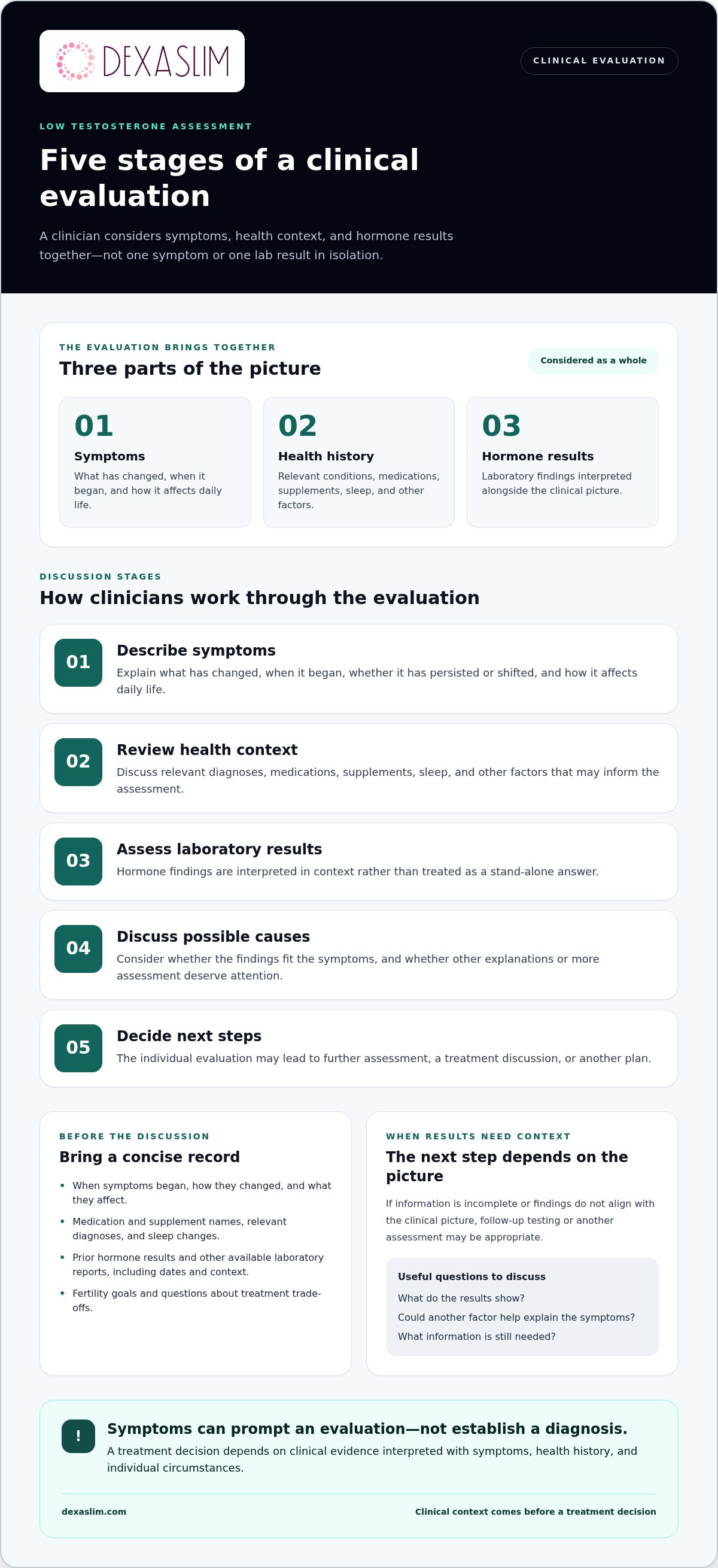
A useful evaluation brings your concerns into a structured clinical picture. The clinician considers what you’re experiencing alongside your health history and hormone results, then determines whether more assessment is needed. The goal isn’t to match one symptom to one number. It’s to understand the full pattern and make a decision in context.
Expect the discussion to cover these steps:
Describe symptoms.
Explain what has changed, when it began, and how it affects daily life.
Review health context.
Discuss relevant diagnoses, medications, supplements, sleep, and other factors that may inform the evaluation.
Assess laboratory results.
A clinician interprets hormone findings in context rather than treating a single result as a stand-alone answer.
Discuss possible causes.
Consider whether the findings fit the symptoms and whether other explanations or additional assessment deserve attention.
Decide next steps.
Depending on the individual evaluation, that may mean further assessment, a treatment discussion, or another plan.
What to prepare before a clinical evaluation
Bring a concise record, not a perfect medical timeline. Note when symptoms began, whether they’ve changed, and what they affect, such as sleep, relationships, work, or exercise. Gather medication and supplement names, relevant diagnoses, prior hormone results, and other available laboratory reports. If you have older test results, include their dates and any context that may help the clinician interpret them.
Write down fertility goals and questions about treatment trade-offs. These details can shape the conversation and help keep the plan aligned with what matters to you.
How testing and clinical context work together
Hormone results don’t interpret themselves. A clinician considers them alongside symptoms, medical history, and the circumstances of testing. If information is incomplete or findings don’t align with the clinical picture, follow-up testing or another assessment may be appropriate. The next step depends on the individual evaluation, not a fixed sequence that applies to everyone.
Bring your questions, too: What do the results show? Could another factor help explain the symptoms? What information is still needed before discussing testosterone replacement therapy? Dexaslim’s comprehensive longevity panel is a separate blood-diagnostics resource, not a required step or substitute for a clinician’s TRT evaluation. To discuss treatment fit and individualized care, explore Dexaslim’s clinical TRT program.
TRT Treatment Options: Compare Delivery, Routine, and Trade-Offs
When treatment is being considered, the delivery format becomes one practical part of the clinical decision. Testosterone products include injections, topical gels or creams, oral capsules, nasal gels, and subdermal pellets. Availability and appropriate use depend on current approvals, clinical judgment, and individual suitability. No format is automatically the best choice for every patient.
Use this comparison to organize a discussion, not to select or start a product on your own. Instructions depend on the prescribed formulation.
| Format | Routine | Practical consideration | Discuss with your clinician |
|---|---|---|---|
| Topical gel or cream | Applied to the skin according to product instructions. | Application becomes part of a regular routine. Some topical products can transfer through skin contact before the application area is managed as directed. | Ask about application steps, preventing transfer to others, and what to do if you miss an application. |
| Injection | Administered on the schedule prescribed for the specific product and patient. | Consider comfort with injections, administration instructions, and how the routine fits your schedule. | Clarify how administration is handled and what support or instruction is part of your plan. |
| Oral capsule | Taken according to its product-specific directions. | Daily medication habits and the exact instructions may influence whether this fits your routine. | Review how to take the prescribed product and whether other medications or health factors matter. |
| Nasal gel | Used as directed for the specific product. | Consider whether the application routine is workable and comfortable for you. | Ask about correct application and how to manage missed doses. |
| Subdermal pellet | Placed beneath the skin by a clinician. | The placement procedure and follow-up differ from self-applied formats. | Discuss procedure-related considerations, expected follow-up, and how the option fits your care plan. |
Make the choice fit your life and care plan
Start with practical questions. Can you follow the routine consistently? Are you comfortable applying a product or receiving an injection? Could skin contact with other people affect your choice of topical treatment? Would a clinician-administered option fit your preferences? Be direct about these details. A format that seems convenient on paper may not suit your habits or circumstances.
The treating clinician weighs your preferences against medical suitability and monitoring needs. The plan may also change if follow-up findings or circumstances call for reassessment. Don’t compare formats by convenience alone; consider how each can be used safely and consistently under clinical guidance.
Dexaslim’s testosterone replacement therapy program is tailored to clinically eligible individuals and includes ongoing hormone-level monitoring. Discuss the delivery method as part of an individualized evaluation rather than assuming a particular format. Use your consultation to clarify whether treatment is appropriate and what routine best aligns with your clinical needs.
TRT Safety and Monitoring: Address the Risks Before You Decide
Safety is a core part of the decision, not a footnote after treatment begins. Testosterone replacement therapy calls for an individualized risk-benefit assessment based on your health history, treatment choice, goals, and follow-up findings. A study result or reassuring headline can inform the discussion, but it can’t guarantee how treatment will affect you personally.
The TRAVERSE trial studied more than 5,200 men and found no significant increase in major cardiovascular events with testosterone therapy compared with placebo. The trial also reported higher rates of atrial fibrillation, pulmonary embolism, and acute kidney injury in the testosterone group. These findings add useful context, but they don’t establish that every patient or formulation has the same risk profile.
Risks and precautions to discuss with a clinician
Include your full health context in the risk review. Relevant considerations can include cardiovascular history, prostate-related concerns, blood health, other diagnoses, and the specific formulation under consideration. Risks and precautions vary, so a general online list can’t serve as a personal assessment.
Fertility
Testosterone therapy can affect sperm production. The Endocrine Society’s clinical practice guideline advises against starting testosterone therapy in men planning fertility in the near term. Tell the clinician about current or future fertility goals before discussing treatment.
Prostate and blood health
Share relevant history and ask which clinical checks apply to you. These checks can identify concerns that may change the treatment decision or follow-up plan.
Heart and overall health
Discuss existing conditions and how the evidence applies to your circumstances. No single trial can provide a personal safety guarantee.
What ongoing monitoring is designed to assess
Follow-up gives the clinician a way to review your response, check hormone levels, and assess potential safety concerns. The checks and timing should be tailored to your health and treatment, rather than assumed from a generic online schedule.
Monitoring also helps guide decisions. If results, symptoms, or new health information raise concerns, the clinician may adjust the plan, investigate further, or reconsider treatment. Raise changes and questions rather than waiting for a routine review to mention them.
Before deciding, ask what the proposed monitoring is intended to track, which results could affect your plan, and how your personal risks will be revisited over time. Dexaslim tailors clinical TRT programs to eligible individuals and monitors hormone levels during ongoing care. Explore the testosterone replacement therapy program to discuss evaluation and fit, without assuming eligibility or a particular outcome.
Starting a Testosterone Replacement Therapy Program With Dexaslim
Considering treatment doesn’t mean you’ve decided to begin. The next step is a clinical discussion that brings your symptoms, health context, goals, and available test results into focus. Evaluation helps determine whether testosterone replacement therapy is appropriate for you. A symptom or interest in treatment alone doesn’t establish eligibility, and there’s no automatic prescription or guaranteed outcome.
What to expect from an individualized program
Dexaslim provides clinical TRT programs tailored to individuals assessed as eligible. Ongoing hormone-level monitoring is part of care, keeping treatment decisions connected to clinical information over time. The evaluation informs whether treatment is a suitable next step; it doesn’t promise a particular treatment choice or result. Your circumstances guide the discussion.
Think of the process as a decision, not a commitment. Use the conversation to understand how your goals and health history relate to treatment, what options may be appropriate, and how ongoing monitoring fits into care. If TRT isn’t the right next step, that is useful information too.
Your next steps before discussing TRT
A little preparation can make the conversation more focused. Bring a concise summary rather than trying to reconstruct every detail from memory. Include:
• Symptoms, when they began, and how they affect everyday life.
• Your goals and priorities, including fertility considerations where relevant.
• Medical history, current diagnoses, medications, and supplements.
• Existing laboratory results and any notes about when they were collected.
• Questions about suitability, treatment options, potential risks, and monitoring.
Be clear about what matters most to you. For example, explain whether your main concern is a change in sexual health, energy, or physical function, and what you want to understand before making a decision. Mention anything that could affect your ability to follow a treatment routine or attend follow-up. Specific questions help turn general information into a discussion grounded in your circumstances.
You don’t need to arrive with a self-diagnosis or a preferred treatment format. Bring the information you have, identify what remains uncertain, and let clinical assessment guide the next step. Dexaslim’s program is designed for eligible individuals, with care tailored to the person and hormone levels monitored during ongoing treatment. Suitability and outcomes vary.
Ready to move from online claims to a clinically informed discussion? Explore Dexaslim’s testosterone therapy program to discuss whether TRT may fit your goals and health context.
Make Your Next Step a Measured One
You don’t need to settle the question of TRT on your own. Turn uncertainty into a focused clinical discussion: identify what you want to change, share the information you have, and stay open to what the evaluation shows. The right next step may be treatment, further assessment, or a different direction. A clear decision is more valuable than a rushed one.
For eligible individuals, Dexaslim provides tailored clinical testosterone replacement therapy programs with ongoing hormone-level monitoring. This keeps care connected to clinical findings rather than assumptions about what treatment should deliver.
Bring your questions and priorities to the conversation. Ask what the evaluation means for you, how treatment decisions are made, and what ongoing care involves. Then decide with evidence, context, and your personal goals in view.
Explore Dexaslim’s testosterone replacement therapy program to take the next step toward an informed discussion. You can move forward with clarity, one decision at a time.
Frequently Asked Questions
What is testosterone replacement therapy?
Testosterone replacement therapy is clinician-directed treatment for testosterone deficiency when evaluation indicates it may be appropriate. It isn’t a general-purpose energy or performance treatment. Before discussing options, a clinician considers your symptoms, hormone results, health history, and possible causes. For example, persistent fatigue alongside other changes calls for a fuller review than a decision based on fatigue alone. Treatment choices and follow-up are individualized.
How do clinicians determine whether someone is eligible for TRT?
Eligibility depends on the overall clinical picture, not a symptom or lab value considered alone. A clinician reviews your symptoms and health history, interprets available test results, and considers other possible explanations. Bring prior reports with their collection dates and any context you remember, such as illness or medication changes. Current clinical guidance and personal circumstances inform whether treatment, further evaluation, or another approach makes sense.
Can testosterone replacement therapy affect fertility?
Yes, testosterone treatment may affect fertility, so raise current or future plans for biological children before starting. Don’t assume fertility will remain unchanged or that any effects will be reversible. A clinician can discuss how treatment relates to your priorities and what medically appropriate options may be relevant. If fertility matters to you, make it a central part of the decision, not a question saved for after treatment begins.
How long does it take to notice a response to TRT?
There’s no single response timeline that applies to everyone. The cause of symptoms, treatment approach, health context, and how progress is assessed can all matter. Some changes may take time, and symptoms with other causes may not improve with TRT. Before treatment, agree with your clinician on specific goals, such as tracking a particular symptom or daily function. Review progress during follow-up rather than relying on promised results.
What happens if I stop testosterone replacement therapy?
What happens after stopping varies with the reason for treatment, how long it was used, and individual physiology. Hormone levels and symptoms may change, but the timing and pattern can’t be predicted for everyone. If you’re considering stopping, discuss the reasons and a plan with your treating clinician first. Don’t change or discontinue prescribed therapy on your own, especially if new symptoms or health concerns prompted the decision.
Is testosterone replacement therapy only for older men?
No. Age alone doesn’t establish whether TRT is appropriate. A younger adult with concerning symptoms still needs an individualized evaluation, just as aging by itself doesn’t prove testosterone deficiency. Keep a record of changes and relevant health information instead of relying on age-based assumptions or online checklists to self-diagnose. A clinician can interpret findings in light of your history and current guidance, then explain whether treatment or a different next step is appropriate.
Does TRT automatically improve energy, muscle, or libido?
No. Improvement in energy, muscle, libido, or any other specific outcome isn’t guaranteed. Before treatment, identify which change matters most to you and how you’ll assess it with your clinician. For instance, describe the activity or daily task affected rather than setting a vague goal to “feel better.” This gives follow-up a practical focus and helps distinguish a treatment response from symptoms that may have another cause.