

A measured baseline is more useful than a generic calorie estimate. An RMR test to determine caloric needs measures the energy your body uses at rest, typically through a breathing test that tracks oxygen consumption and carbon dioxide output. Combine the result with your activity level to estimate your total daily calorie needs.
Online calculators can provide a starting point, but they estimate from general inputs rather than measuring your resting energy use. That difference matters when you want a more personalized basis for nutrition or weight-management decisions. An RMR result is useful data, not a complete calorie prescription: daily needs also reflect movement and other energy demands.
Learn what the test measures, how its results can inform calorie estimates, and who may benefit from a measured baseline. You’ll also learn where RMR testing has limits and how to prepare so the result can guide your next steps.
Key Takeaways
• An RMR test measures the energy your body uses at rest and can provide a more individualized starting point than a general calorie estimate.
• Use the result alongside your activity level to build a fuller estimate of daily calorie needs.
• RMR data can inform nutrition and weight-management decisions, but it doesn't explain every factor that affects progress.
• Preparation matters: follow the testing instructions, including the recommended fasting period, to support a useful result.
• A measured baseline can help you decide when to reassess your calorie plan as your training or nutrition changes.
Resting Metabolic Rate Test: Who Needs It and What Does It Show?
An RMR test can help people who want a measured baseline for calorie planning, especially when estimates from general formulas don’t match their experience. It measures resting energy use, then informs, rather than dictates, calorie decisions. If you’re adjusting nutrition after a change in training, the result offers a practical reference to interpret alongside daily activity and weight trends.
In the United States, the price depends on the case and is provided after a quote request; factors include the testing setup and what the assessment includes. Insurance coverage depends on the plan’s terms and applicable medical-necessity criteria. For a nearby test, look for a clinic or performance-testing facility that offers RMR testing, such as a metabolic testing center.
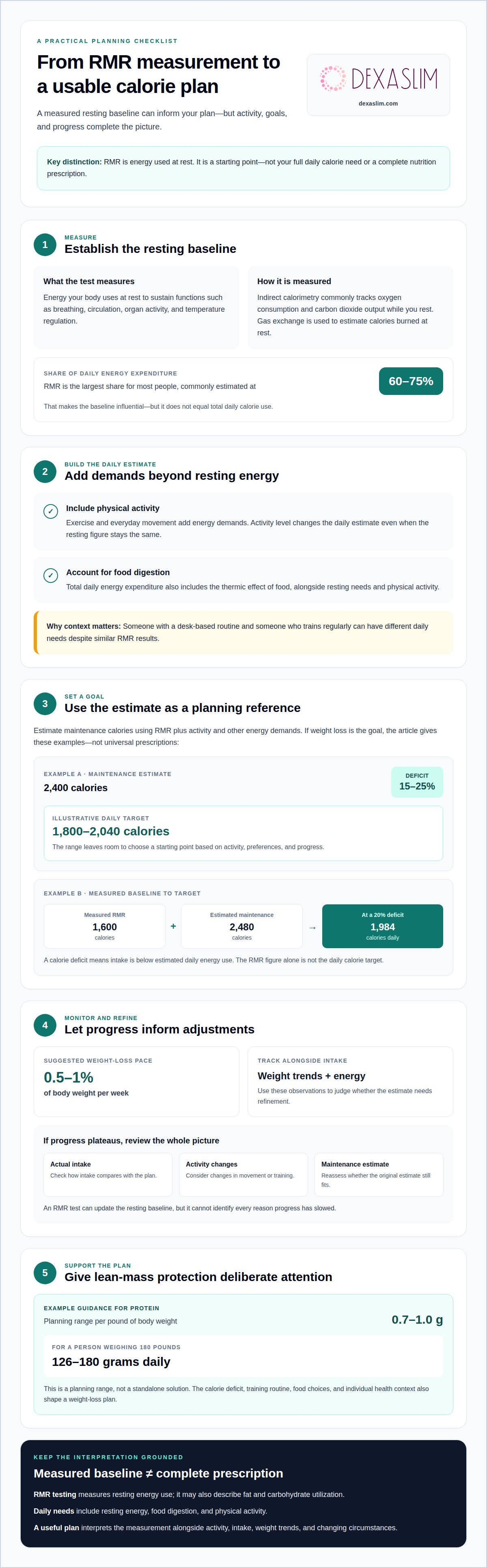
Use the measured result to help estimate maintenance calories, then set intake according to the goal. For example, a maintenance estimate of 2,400 calories produces a target of 1,800 to 2,040 calories with a 15 to 25% deficit. That range gives room to choose a starting point based on activity, preferences, and progress. It is a planning example, not a universal prescription.
For another illustration, a measured RMR of 1,600 calories combined with estimated maintenance calories of 2,480 gives a target of approximately 1,984 calories daily at a 20% deficit. A calorie deficit means intake is below estimated daily energy use. Track weight trends and energy alongside intake; adjust the plan when results show the estimate needs refinement. The RMR figure alone isn’t the daily calorie target.
Set a sustainable pace. A suggested weight-loss rate is 0.5 to 1% of body weight per week. A plateau is a reason to review the full picture, including actual intake, activity changes, and whether the original maintenance estimate still fits. An RMR test can update the resting baseline, but it cannot identify every reason progress has slowed.
Protect lean mass while losing weight by giving protein intake deliberate attention. The recommended range in the example guidance is 0.7 to 1.0 grams per pound of body weight. For a person weighing 180 pounds, that equals 126 to 180 grams daily. Treat this as a planning range, not a standalone solution: the calorie deficit, training routine, food choices, and individual health context also shape a weight-loss plan. A metabolic rate test provides data to guide decisions, not a complete nutrition prescription.
What resting metabolic rate measures
Resting metabolic rate, or RMR, measures the energy your body uses at rest. It provides a baseline, not the full calorie cost of daily movement, meals, or exercise.
Resting Calorie Expenditure
Resting calorie expenditure is the energy your body uses at rest to sustain essential functions. Breathing, circulation, organ activity, and temperature regulation continue around the clock, even when you’re still. That baseline gives calorie planning a measured starting point rather than relying only on an estimate based on age, height, and weight.
An RMR test commonly uses indirect calorimetry. You rest quietly while equipment collects breathing-related data, including oxygen consumption and carbon dioxide output. The test uses this gas exchange to estimate the calories your body burns at rest. You don’t exercise during the measurement, because activity would change the energy being assessed.
Oxygen use also provides information about fuel utilization. UC Davis Health states that an RMR test can measure fat and carbohydrate utilization. This helps describe which fuels your metabolism uses at rest, alongside the energy estimate. It isn’t a complete picture of body composition or a diagnosis of every medical factor affecting weight or energy.
Baseline Energy Needs
Baseline energy needs are the calories required for resting functions before adding food digestion or movement. Resting metabolic rate represents the largest share of daily energy expenditure for most people, commonly estimated at 60 to 75% of caloric needs. That share makes the resting baseline influential, but it doesn’t equal total daily calorie use.
Total daily energy expenditure includes resting needs, the thermic effect of food, and physical activity. Exercise, everyday movement, and digestion add energy demands beyond the resting measurement. Someone with a desk-based routine and someone who trains regularly can have different daily needs despite similar RMR results.
To turn an RMR result into a daily estimate, account for activity and other energy demands. The measured value anchors the calculation, while activity level changes the result. For example, exercising more often can raise daily expenditure without changing the resting figure itself. Treat the number as a baseline to interpret, not a fixed calorie prescription.
This distinction also clarifies what testing can and can’t answer. An RMR measurement provides direct information about resting energy use, while online formulas estimate from general personal inputs. Neither resting metabolism nor a single test explains every change in weight. Use the result as one data point alongside intake, activity, and changing body composition. A Resting Metabolic Rate (RMR) Test can establish that measured baseline.
RMR's contribution to daily energy expenditure
RMR is a starting point for estimating daily energy expenditure, not the complete total. Account for activity and other energy demands when estimating daily calorie needs.
From RMR to Daily Calorie Needs
RMR becomes a daily calorie estimate when it’s combined with an activity multiplier. This gives you a foundation for planning intake that reflects movement, rather than treating resting energy use as your full-day requirement. For example, a measured RMR of 1,600 calories multiplied by the moderately active factor of 1.55 gives estimated maintenance calories of approximately 2,480.
Calculating Total Daily Energy Expenditure
Total daily energy expenditure includes resting needs, the thermic effect of food, and energy spent on physical activity. Estimating this total matters because a calorie target based only on RMR leaves out exercise and other movement. An activity multiplier offers a practical estimate, but actual energy use also reflects your routine and how well its activity category fits.
Physical activity multipliers offer different estimates for different routines: 1.2 for sedentary, 1.375 for light activity, 1.55 for moderate activity, 1.725 for very active, and 1.9 for extremely active. Multiply the measured RMR by the factor that best represents your usual activity. A factor that overstates movement can inflate estimated maintenance calories; one that understates it can lower the estimate.
For a measured RMR of 1,600 calories, the sedentary multiplier of 1.2 gives an estimated 1,920 calories. The light-activity multiplier of 1.375 gives 2,200. At 1.55, the estimate is 2,480. These are calculated estimates, not separate measurements of oxygen consumption during exercise or every daily task.
Use the total as a working baseline, then compare it with actual patterns in intake, activity, and weight. If you exercise regularly, choose a multiplier that reflects your routine, not an unusually active day. Muscle-focused training also contributes to activity, but the multiplier still simplifies complex energy expenditure into one estimate.
RMR testing measures resting energy use; it doesn’t directly capture the calories spent during a workout. This helps explain why two people with similar RMR results may need different daily estimates. Their activity multipliers can differ, and the resulting totals can guide calorie planning more usefully than resting calories alone.
Keep the calculation transparent: measured RMR multiplied by an activity factor produces estimated maintenance calories. For example, 1,600 multiplied by 1.55 equals approximately 2,480. Interpret that figure as a starting estimate, then consider whether the activity factor reflects your usual schedule. The calculation connects a measured baseline to a broader daily energy estimate.
Limitations of RMR testing
An RMR result is useful data, not a complete explanation of weight, health, or progress. Keep its limits in mind when turning a resting measurement into a daily calorie estimate.
An RMR test measures resting energy use, but estimating daily calorie needs still requires accounting for activity and other energy demands. No single measurement identifies every cause of slow progress.
Age and weight are inputs in common online calorie formulas. Illness and medications also provide important context when interpreting a metabolic result, since health circumstances can affect energy needs and the meaning of a calorie plan.
Test Accuracy and Result Factors
Test accuracy describes how well a resting measurement represents energy use during the test, not how precisely it predicts total needs every day. This distinction matters because a daily estimate adds assumptions about activity and lifestyle to the measured baseline. The test directly measures resting energy use, while the final calorie figure remains an estimate.
Breathing data, including oxygen consumption, supports the resting calculation. Age and body weight appear in common formula-based estimates, while illness or medication context can matter when interpreting results. Assess a calorie deficit based on the estimate alongside real-world intake, activity, and weight trends, rather than treating it as a medical diagnosis.
Testing Compared With Online Calculators
RMR testing measures an individual’s resting energy use; an online calculator estimates it from general inputs such as age, weight, and height. This difference matters when a formula-based number doesn’t align with your experience. A measured result replaces the formula’s resting estimate, but it doesn’t measure all activity or determine a complete daily target by itself.
Consider someone whose calculator estimate seems inconsistent with a sustained change in weight. A measured baseline can refine the starting point, while activity and intake still shape the next estimate. RMR testing is most useful if you want a baseline or are reassessing after major training or nutrition changes. It won’t explain every plateau or replace medical evaluation when health concerns are involved.
RMR itself isn’t a direct predictor of lifespan. Research continues into possible links between metabolic efficiency and longevity, but a resting result alone can’t establish an individual’s long-term health outlook. Use it to inform energy planning, not as a longevity score or stand-alone measure of overall health.
Preparation before an RMR test
Preparation helps make the measurement more useful. Before an RMR test, fast for at least 8 to 12 hours, as recommended in the test guidance.
That fasting window gives the test a consistent starting condition. Eating changes the body’s immediate energy demands as it digests and processes food. Because the test aims to measure resting energy use, follow the stated fasting period rather than arriving after a meal. Don’t extend the fast beyond the instructions without guidance.
Plan the appointment around the fasting window. If the test is scheduled in the morning, count backward from the appointment to establish when your fast begins. An early appointment, for example, may mean having your evening meal earlier. The exact schedule depends on the test time and the fasting instructions you’ve received.
Keep the purpose clear: an RMR test measures calories your body burns at rest, not the energy cost of exercise. Training immediately before a measurement may make it harder to interpret the result as a resting baseline. Follow the test instructions about activity beforehand, and share relevant context about recent training and nutrition during the assessment.
Prepare to rest quietly while breathing-related data is collected. Indirect calorimetry uses oxygen consumption and carbon dioxide output to estimate resting energy expenditure. Movement or conversation during the measurement can disrupt a calm testing routine. Follow the testing team’s directions so the recorded breathing data reflects the intended resting condition.
Keep your usual nutrition and training context in mind when reviewing the result. A single measurement describes resting energy use during the test; it doesn’t capture every factor affecting daily calorie needs. Mention any recent changes in your routine, such as a shift in exercise or eating patterns. This context can help explain how the measured baseline relates to your current lifestyle.
Use the result as a foundation, then combine it with activity and nutrition information. Preparation can’t make an estimate a complete daily prescription, but consistent testing conditions give the measurement a clearer purpose. If you’re ready to establish a measured resting baseline, schedule an RMR test.
Dexaslim: VO2 Max Performance Testing
Dexaslim offers VO2 Max Performance Testing to assess aerobic endurance, peak oxygen consumption, and cardiovascular efficiency. Consider it when your next goal extends beyond estimating resting calories and includes understanding how your body performs during exercise. Pairing performance data with a resting metabolic baseline can give you distinct measures to inform training and nutrition decisions.
For calorie planning, Dexaslim also offers a Resting Metabolic Rate (RMR) Test. VO2 Max Performance Testing answers a different question: how effectively your body uses oxygen during physical effort. Together, these assessments can help clarify resting energy needs and aerobic performance without treating one measurement as a substitute for the other.
Contact Dexaslim to discuss which assessment best fits your goals.
Turn Your Baseline Into a Clear Next Step
Use your measured baseline as a decision tool, not a rule that dictates every meal or workout. An RMR test to determine caloric needs can move you from broad assumptions toward a plan informed by your own resting energy use. Next, apply that information to your routine and adjust as your activity, nutrition, or goals change.
Keep the process practical. Choose a calorie approach you can follow, observe how it fits your everyday life, and reassess when your routine changes meaningfully. The value of testing comes from using the data to support decisions over time, not treating one result as the final word.
Dexaslim can help you take that next step with RMR testing. Contact Dexaslim to discuss RMR testing and move forward with a measured foundation for your calorie planning. Make your next decision with purpose.
Frequently Asked Questions
How Is an RMR Test Different From Guessing Calorie Needs?
An RMR test measures your resting energy use, while a guess or online estimate relies on general information. For an RMR test to determine caloric needs, the measured result gives you a personal starting point instead of relying only on formulas based on age, height, and weight. You still need to account for activity when estimating full-day needs. Use this distinction to see whether your current plan rests on measurement or assumptions.
What Is RMR Testing?
RMR testing assesses how much energy your body uses while resting. During the assessment, you rest quietly as breathing-related information is collected and analyzed. The result describes your resting energy needs, rather than measuring every movement or meal across a day. This distinction is useful when reviewing calorie estimates and identifying which part of daily energy use the test evaluates.
How can RMR help create a diet plan for weight loss?
RMR can provide a measured baseline for setting and reviewing a calorie plan. Use it with your activity level to estimate daily needs, then compare the plan with actual intake and weight trends over time. For example, if your routine shifts from mostly desk-based work to regular training, reassess your activity assumptions instead of changing calories based on one weigh-in.
How often should RMR be tested?
Use an RMR test as a baseline, then consider reassessment after a major change in training or nutrition. The timing depends on whether your routine or goals have shifted enough to make the old measurement less relevant. A test isn’t a daily progress tracker. Between assessments, note meaningful changes in activity and eating patterns so you can interpret the next result in context.
Is my metabolism fast or slow?
A single RMR result doesn’t label your metabolism as simply fast or slow. Interpret the measurement in context, including age, weight, height, and sex, rather than comparing it casually with someone else’s result. Differences in body size and routine affect energy needs. If progress differs from expectations, review activity and intake alongside the resting measurement instead of treating a label as an explanation.
What Can You Do With the Results?
Use the results to refine a calorie estimate, discuss nutrition choices, and decide whether your activity assumptions fit your routine. An RMR report can also provide information about fat and carbohydrate use at rest. Keep the findings in context: they describe resting energy use, not every factor behind a change in weight or exercise performance. Apply the data to a specific planning question rather than treating it as a score.
What is an RMR test and how does it measure resting metabolic rate?
An RMR test uses indirect calorimetry to estimate resting energy expenditure from breathing data. While you rest, the assessment evaluates oxygen consumption and carbon dioxide output. These measurements help estimate how much energy your body uses at rest. The result describes that resting measurement; it doesn’t directly capture energy used during exercise, digestion, or other daily activity.
How is an RMR test performed, and how should I prepare?
You rest quietly while the test collects breathing data. Prepare by fasting for at least eight to 12 hours before the assessment, following the specific instructions provided for your appointment. Plan eating around the scheduled test time, and share relevant changes in training or nutrition when discussing the result. Arrive ready to remain still and follow the testing team’s directions throughout the measurement.