

Metabolic testing turns breathing into measurable data. Personalized metabolic testing can use indirect calorimetry to measure oxygen consumption and exhaled carbon dioxide at rest, helping determine resting metabolic rate (RMR) and estimate how the body uses fuel. During exercise, breathing and heart-rate measurements show how oxygen use, calorie expenditure, and fuel use change as intensity rises.
If calorie targets or workout plans feel like guesswork, objective measurements can provide a clearer starting point. Resting metabolic rate shows how much energy your body uses at rest, while the respiratory exchange ratio indicates the balance of fat and carbohydrate use for energy.
This guide explains how RMR testing works, what blood panels can measure, and what results can and cannot tell you about metabolism. You’ll learn how resting measurements differ from exercise testing, how hormones and nutrient markers add context, and how these findings can inform more individualized nutrition and movement decisions.
Key Takeaways
• Indirect calorimetry measures oxygen use and exhaled carbon dioxide to estimate resting energy needs.
• Blood panels can add context by measuring markers such as glucose and endocrine hormones alongside metabolic results.
• Exercise testing tracks how oxygen use, calorie expenditure, and fuel selection shift as intensity rises.
• Age, diet, exercise, genetics, gut health, and the balance of lean muscle and fat all influence metabolism.
• Dexaslim offers Resting Metabolic Rate testing, VO2 Max Performance Testing, and a Longevity Panel to help build a more individualized picture.
Combining RMR measurements with hormone and nutrient panels
Resting metabolic rate (RMR) measures energy use at rest; blood panels add biological context. Together, these data can inform nutrition and activity recommendations tailored to individual metabolic health.
Integrating RMR, Hormone, and Nutrient Results
RMR shows resting energy needs, while a comprehensive metabolic blood panel can measure glucose and endocrine hormones. Read together, these results help distinguish energy-use patterns from markers that may signal metabolic or nutritional imbalances. For example, glucose results add context to an RMR measurement, but neither result alone explains every influence on metabolism or defines a complete nutrition plan.
Metabolomic testing adds another layer by analyzing samples such as urine, plasma, serum, saliva, or tissue. Techniques including nuclear magnetic resonance spectroscopy and mass spectrometry measure compounds linked to biological processes. This profile can help characterize nutritional status alongside RMR and blood markers, giving practitioners more context for personalized nutrition recommendations.
Personalizing Nutrition and Activity Plans
Personalized nutrition uses measured energy needs and relevant lab findings to guide food choices and activity. For example, a lower or higher RMR reading can help calibrate daily calorie targets instead of relying only on general estimates. Blood markers and nutrient patterns add context, allowing recommendations to reflect more than a calorie number.
Translate results into focused changes. A practitioner can prioritize two to three nutrition recommendations based on major nutrient imbalances, goals, and preferences. Activity can also be tailored to the person’s measured needs and routine. Review the plan as circumstances change, and use follow-up measurements to assess whether the recommendations still fit the person’s metabolic health journey.
Comparing Metabolic Tests With Other Data
Metabolic testing measures energy use at rest or during activity; standard blood tests measure markers such as glucose and endocrine hormones. Genetic testing describes inherited variants, while wearable data tracks patterns such as movement and heart rate. Each captures a different part of the picture, so combining relevant results can provide more context than treating a single measurement as a complete assessment.
When choosing a testing provider or laboratory, look for clear explanations of what each test measures, how results are interpreted, and how findings connect to practical recommendations. Ask how personal data is stored and shared, and review the laboratory’s privacy terms before providing a sample.
Keep the limits in mind: a test result is one piece of health information, not a stand-alone diagnosis. Recent activity, diet, and underlying health conditions can affect results, so interpretation should account for context. Health data is sensitive; understand who can access it and how it may be used.
How does metabolic testing work behind the scenes?
In the United States, metabolic testing can include resting metabolic rate (RMR) testing with indirect calorimetry, exercise testing, blood panels, and metabolomic analysis. These tests measure different things, so their usefulness depends on the question being assessed.
Indirect calorimetry measures oxygen consumption and exhaled carbon dioxide. It is an established method used in hospitals and research for decades; the results are measurements, while calorie needs calculated from them remain estimates.
Measuring Resting Metabolic Rate
Indirect calorimetry assesses RMR by measuring oxygen consumption and carbon dioxide production while you rest. A metabolic cart uses these gas measurements to estimate how much energy your body burns at rest. The test is non-invasive, and an RMR test typically takes about 10-15 minutes. That baseline helps replace a generic calorie estimate with a measurement tied to your resting physiology.
Preparation affects the conditions being measured. For an RMR test, fast for at least 4 hours; overnight fasting is ideal. Avoid exercise for 12 hours and caffeine, nicotine, and stimulants for at least 4 hours beforehand. Stay hydrated with water, and continue prescribed medications unless a healthcare provider directs otherwise. These steps help reduce temporary influences on the reading.
Results describe resting energy use, not every calorie burned throughout the day. Daily expenditure also reflects activity and other energy demands. For weight-loss planning, RMR can inform a starting estimate of intake, but it does not prescribe a specific diet or predict an individual outcome on its own.
Connecting Metabolic Rate With Calorie Expenditure
RMR is the energy your body uses at rest, while total daily calorie expenditure also includes energy spent moving and exercising. For most people, RMR accounts for 60-75% of total daily calorie expenditure. That share explains why a resting measurement can meaningfully inform calorie planning, even though it doesn’t capture every activity across the day.
Use the result as a baseline, then consider routine movement and training demands. Someone with a mostly seated day and someone who exercises regularly may have different total energy needs despite similar RMR readings. Compare estimated intake with the measured resting baseline and activity pattern; don’t treat the RMR figure as a complete daily calorie target.
The scientific value of metabolic testing depends on matching the method to the question. RMR testing directly measures gas exchange at rest, while exercise testing tracks oxygen and fuel use as effort increases. Blood panels measure markers such as glucose and endocrine hormones. Wearables track activity patterns, not resting gas exchange.
For a measured resting baseline, resting metabolic rate testing can help anchor calorie planning in observed energy use rather than a generic estimate.
Fat- and carbohydrate-burning intensity
Exercise metabolic testing tracks breathing and heart rate as effort rises. Oxygen consumption, calorie expenditure, and fuel use show how your body shifts between fats and carbohydrates during activity.
How Exercise Testing Tracks Fuel Use
A test may use a treadmill or bike while equipment measures breathing and heart rate. As workload increases, oxygen consumption and calorie expenditure change. The respiratory exchange ratio, or RER, indicates the proportion of energy coming from carbohydrates and fats. Together, these measurements reveal how fuel use responds to different exercise intensities.
For example, a comfortable pace may produce a different fuel-use pattern than a harder effort. Testing maps that change against workload instead of assuming one intensity works for everyone. The resulting levels can help shape training around a specific goal, such as building endurance or managing weight. They describe fuel use during the test, not a universal prescription for daily exercise.
Interpreting Intensity and Training Thresholds
Exercise data can identify intensities at which the body uses fat or carbohydrates efficiently. The optimal training level depends on the goal: a steady endurance session and a high-intensity workout place different demands on the body. A measured profile helps distinguish those demands and provides a more precise basis for adjusting pace or resistance.
The anaerobic threshold marks the point where lactic acid accumulates faster than the body can clear it. This helps explain why an effort that feels controlled can become difficult as intensity rises. Repeatedly training beyond a manageable level can hinder progress and increase injury risk. Use the threshold as one data point when structuring activity, not as a reason to push through fatigue.
Interpret results in the context of the activity being tested. A treadmill profile reflects effort on a treadmill; a bike assessment reflects cycling demands. Weight, conditioning, and the test protocol also shape how results apply to exercise outside the session. Ask what the measured levels mean for your chosen activity, then align training intensity with that goal.
Preparing for an Exercise Metabolic Test
Preparation affects the conditions captured during testing. Avoid eating for at least 2-4 hours beforehand, and avoid strenuous exercise for 24 hours. Skip caffeine, nicotine, and stimulants for at least 4 hours before the assessment. Wear comfortable exercise clothing and athletic shoes, and arrive well-hydrated.
Continue prescribed medications unless a healthcare provider directs otherwise. These steps help keep the test focused on your response to rising effort. Breathing, heart rate, oxygen consumption, and RER then provide a clearer view of how your body uses fuel across exercise levels.
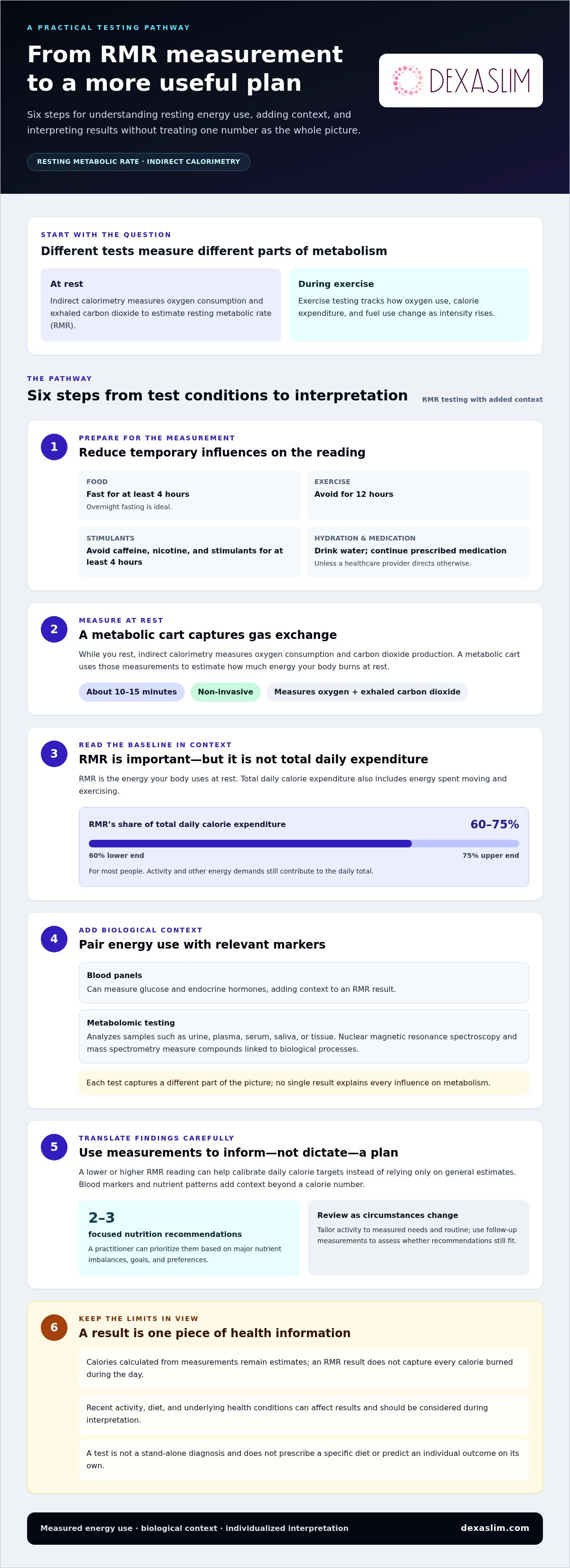
How resting metabolic rate testing works
An RMR test estimates energy use by measuring oxygen consumption while you rest. The measurement provides a clinical baseline for calorie planning, not a diagnosis of disease or cardiovascular health. Understanding the steps can help you prepare consistently and interpret what the result reveals about your body’s energy processes.
Before testing, follow preparation instructions that protect the resting measurement. For an RMR test, fast for at least 4 hours; overnight fasting is ideal. Avoid exercise for 12 hours, and avoid caffeine, nicotine, and stimulants for at least 4 hours. Stay hydrated with water, and continue prescribed medications unless a healthcare provider directs otherwise. Morning testing can also help limit daily calorie fluctuations.
During the test, you rest while a metabolic cart measures oxygen consumption and carbon dioxide production. The equipment analyzes those gases to estimate the calories your body burns at rest. The test is non-invasive and painless, and the breathing analysis typically takes about 10-15 minutes. A supervised clinical metabolic test may take 30 to 60 minutes overall, including preparation and other assessment steps.
Keep the setting steady. Recent strenuous exercise can temporarily raise energy expenditure, while food, stimulants, and movement can shift the body away from a resting state. For example, arriving straight from a workout can make the measurement less representative of your usual resting conditions. Follow the preparation protocol and remain still during the reading so the equipment captures resting gas exchange rather than activity-related changes.
The result estimates resting calorie use, helping set a more informed starting point for daily intake. It does not measure every calorie burned through work, walking, or training. A measured resting baseline still needs activity context before it can guide food intake or weight-loss planning. RMR also cannot identify the cause of an unusual result; interpretation depends on health context and other available measurements.
Use the result as a baseline, then compare it with changes in activity, nutrition, and body composition over time. If a calorie plan produces different results than expected, the gap may reflect activity or other metabolic processes, not simply a “slow” or “fast” metabolism. Pairing a resting measurement with a clear activity record helps distinguish resting energy needs from daily expenditure and keeps adjustments grounded in actual patterns.
Factors influencing metabolism
Metabolism reflects interacting processes, not a single fixed rate. Nutritional status, diet, exercise, genetics, toxic-substance exposure, gut health, age, and underlying disease can all influence how the body uses energy. An RMR measurement captures resting energy use under test conditions, while these factors help explain why people with similar measurements may have different needs over time.
Body composition is one important distinction. Two people at the same body weight can have different metabolic efficiency because their proportions of lean muscle and fat differ. Weight alone therefore cannot describe how much energy each person uses at rest or during activity. Pairing weight with body-composition information gives more useful context for interpreting a metabolic measurement.
Dietary patterns also shape how the body processes fuel. Some people metabolize carbohydrates more efficiently, while others may need more protein to support energy and satiety. These differences don’t mean one food pattern fits everyone. They show why nutrition recommendations should account for a person’s goals, food preferences, and measured metabolic information instead of relying only on a standard calorie target.
Nutrition and nutrient status
Food choices and nutritional status contribute to metabolic processes.
Movement
Exercise changes energy demands and the body’s use of fuel.
Age and genetics
Both influence individual metabolic patterns.
Gut health and exposure
Gut health and toxic-substance exposure are among the factors affecting metabolism.
Underlying disease
Health conditions can affect how the body processes energy.
Use these factors to interpret results, not to diagnose yourself. For example, a measured resting rate and a dietary record answer different questions: one estimates energy use at rest, while the other describes intake. Consider activity patterns and relevant health context before adjusting a nutrition or exercise plan. This distinguishes a measured baseline from the real-world influences that shape daily energy needs.
A practical review can start with three steps. First, record the goal, such as changing weight or improving exercise performance. Next, consider the RMR result alongside body composition, dietary habits, activity, and relevant health history. Then choose focused nutrition or activity adjustments that fit those findings. This turns metabolic data into a usable wellness plan instead of treating one number as the whole picture.
Track the same factors consistently when reviewing progress. If activity increases or dietary intake changes, energy needs may shift even when body weight stays similar. Reassess the plan against the original goal and your current routine. Personalized metabolic testing is most useful as part of this broader evaluation, where measurements, daily habits, and health context inform decisions together.
Dexaslim: 1 Session Dexa Scan
Dexaslim is a natural next step when you want objective measurements to complement metabolic testing. A 1 Session Dexa Scan uses medical-grade DEXA technology to assess body composition and bone density, adding information that a resting energy measurement alone cannot provide.
Choose the measurement that matches your question. A Resting Metabolic Rate (RMR) Test measures energy use at rest. VO2 Max Performance Testing evaluates aerobic endurance, peak oxygen consumption, and cardiovascular efficiency. A Longevity Panel offers a broader set of metabolic health insights. These services can help you build a more complete baseline for refining nutrition, activity, or performance goals.
Contact Dexaslim to discuss which measurement best fits your goals.
Turn Your Data Into a Clear Next Step
Use personalized metabolic testing as a starting point for decisions, not a score to chase. The most useful next step is the one that answers your current question: understanding resting energy needs, assessing exercise performance, or measuring body composition. Choose a clear goal first, then build a baseline to inform future adjustments.
Dexaslim offers a Resting Metabolic Rate (RMR) Test, VO2 Max Performance Testing, and a 1 Session Dexa Scan. Each can provide a different measurement to support your broader health and performance picture. Select the assessment that aligns with the information you want to act on.
Contact Dexaslim to discuss testing and identify a useful starting point. Take the next step with a clear question and a commitment to decisions grounded in measurable data.
Frequently Asked Questions
Does metabolic testing effectively support weight loss efforts?
Metabolic testing can make weight-loss planning more informed by adding measured energy-use data to decisions about food intake and activity. For example, someone whose progress has stalled can compare their routine and intake with a measured resting baseline, rather than relying only on a generic calorie estimate. The test doesn’t cause weight loss; its value is helping shape and refine a plan using relevant personal measurements.
How should an individual prepare for a professional metabolic test?
Follow the test’s preparation instructions, because exercise and stimulants can affect measurements. For an RMR test, fast for at least 4 hours, avoid exercise for 12 hours, and avoid caffeine, nicotine, and stimulants for at least 4 hours. Drink water and continue prescribed medications unless a healthcare provider directs otherwise. For exercise testing, wear comfortable athletic clothing and shoes, arrive hydrated, and avoid strenuous exercise beforehand.
What are considered the key markers for overall metabolic health?
Key indicators can include blood glucose, triglycerides, blood pressure, waist circumference, and body composition. Fasting glucose under 100 mg/dL, triglycerides below 150 mg/dL, and blood pressure at or below 120/80 mmHg are clinical benchmarks. A waist circumference of 35 inches or less for women is an indicator of lower visceral fat and reduced cardiovascular risk. These measures describe different aspects of health, so consider them together.
What benefits can you expect when your plan aligns with your metabolism?
A plan built around measured energy use and personal routines can make calorie targets and activity choices more relevant. For example, someone with a demanding exercise schedule may need a different intake strategy from someone with mostly sedentary days. Tracking how energy, hunger, and exercise performance respond helps identify whether a plan is workable. The practical benefit is a clearer basis for adjusting habits, not a promised outcome.
Who May Benefit from This Test?
People seeking a clearer baseline for nutrition, activity, or performance may find testing useful. It can be especially relevant when standard calorie estimates don’t reflect someone’s experience or when they are refining a fitness routine. Someone preparing to adjust food intake, for instance, can use resting energy data as one planning input. The right test depends on the question, such as resting needs or exercise response.
Who might benefit from metabolic assessment?
Metabolic assessment can help people seeking objective information about energy use, fuel selection, or markers related to metabolic health. An endurance athlete may want to understand how fuel use changes during exercise, while someone reviewing nutrition may want relevant blood markers. People managing a known health condition should interpret assessment information within their existing care context. Testing can inform decisions, but it doesn’t replace diagnosis or treatment.
Why does a customized plan matter for long-term results?
A customized plan accounts for differences in body composition, dietary preferences, goals, and activity. Two people at the same body weight can have different proportions of lean muscle and fat, which may shape energy needs. A plan that reflects those differences is easier to evaluate and adjust than a generic template. Review measurements and routines together, then make focused changes that remain practical as your schedule or goals evolve.
What is personalized metabolic testing, and what does it measure?
Personalized metabolic testing combines measurements selected to answer questions about an individual’s energy use and metabolic health. Resting tests assess energy use at rest; exercise assessments track oxygen consumption and fuel use as effort rises. Blood panels can measure markers such as glucose and endocrine hormones, while metabolomic analysis examines compounds in biological samples. Each method measures something different, so test selection should match the information a person wants to understand.