.svg)


Can peptide therapy for body composition help reduce fat without unwanted loss of lean mass? The answer depends on which peptide is being discussed, what it’s approved to treat, and how treatment is monitored. “Peptide therapy” covers very different medicines and claims, so a compelling social-media story isn’t the same as clinical evidence.
It’s reasonable to look beyond scale weight. Weight alone can’t show whether a change reflects fat, lean tissue, or both, and preserving muscle matters when body composition is the goal. A peptide should be considered a targeted clinical tool, not a stand-alone plan.
This article separates evidence-backed uses from emerging claims, explains why peptide type and clinical oversight matter, and outlines questions to raise about safety and monitoring. It also shows how objective measures, including DEXA scans that assess lean mass and fat distribution, can add context to changes over time. Use evidence, your health profile, and measurable progress to guide the conversation, not marketing promises.
Key Takeaways
• Peptide therapy for body composition refers to distinct treatments, not one universal approach. The peptide, its intended use, and your health context all matter.
• Separate evidence-backed medicines and clinical uses from emerging claims. A peptide’s popularity doesn’t establish its safety or effectiveness.
• Look beyond scale weight by establishing a baseline and tracking measures that distinguish fat mass from lean mass.
• Interpret measurements consistently over time; each tool offers different information and has limitations.
• Bring your goals, health history, current medicines, and monitoring plan into a clinical discussion. Treatment suitability is individual, and results aren’t guaranteed.
What Does Peptide Therapy for Body Composition Mean?
Peptide therapy for body composition is not one universal treatment. It describes distinct interventions involving specific peptides, each with its own biological action, intended use, evidence base, and regulatory status. The phrase may appear in wellness marketing, but that doesn’t make different peptides interchangeable or establish that a treatment is appropriate for a particular goal.
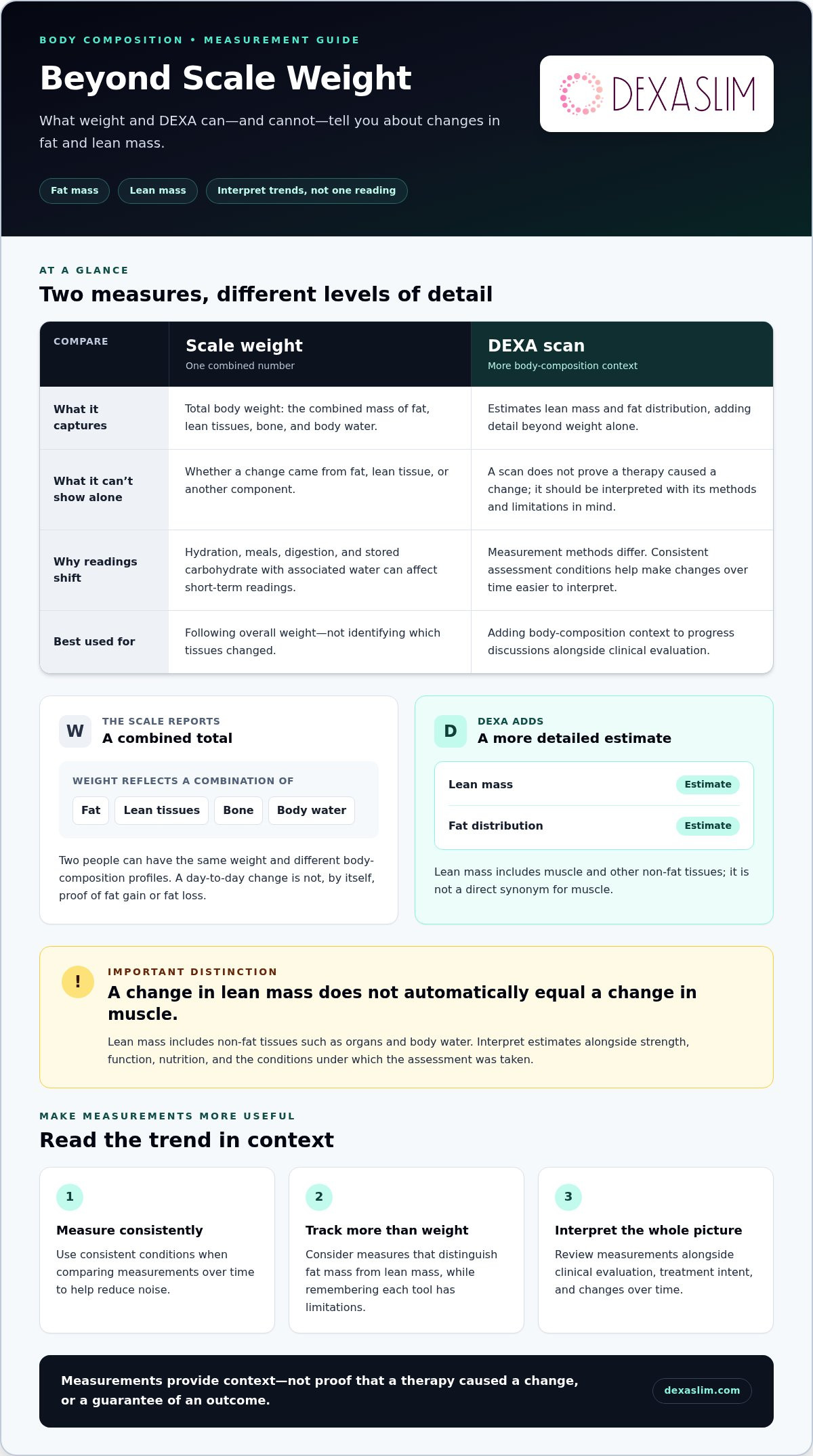
Body composition describes the proportions of fat mass and lean mass in the body. Scale weight combines these and other factors into one number, so it can’t show by itself what changed or whether a shift reflects fat, muscle, or fluid.
For context on broader discussions of hormones and performance, watch this video from Peter Attia, MD:
What are peptides, and why are they discussed in body-composition care?
Peptides are short chains of amino acids, the same basic building blocks used to make proteins. Some act as signals in the body, interacting with receptors or other pathways involved in processes such as appetite regulation or hormone release. Their effects depend on the specific substance and how it is used.
That distinction matters. A peptide studied for one medical condition isn’t automatically supported for fat loss or lean-mass retention. Evidence can range from well-studied, approved medicines used for defined indications to early research or claims with limited human evidence. Formulation and regulatory status can differ, too. The word “peptide” alone tells you little about expected benefit or risk.
Why scale weight does not tell the whole story
Fat mass is stored body fat. Lean mass includes muscle, but also other non-fat tissues; it isn’t a direct synonym for muscle. Total body weight reflects the combined mass of fat, lean tissues, bone, and body water. Two people at the same weight can therefore have different body-composition profiles, and a weight change can’t identify which tissue changed.
Short-term scale readings also shift with hydration, meals, digestion, and changes in stored carbohydrate and its associated water. A day-to-day increase doesn’t necessarily mean fat gain, just as a lower reading doesn’t prove fat loss. Consistent measurement conditions help reduce noise, but no single measure tells the full story.
Use body-composition measures as context, not proof that a therapy caused a change. A DEXA scan can estimate fat distribution and lean mass, offering more detail than weight alone, while still having its own methods and limitations. A measurable body-composition goal is something you can track; it is not a guaranteed treatment outcome. Interpret results alongside clinical evaluation, the treatment’s intended use, and changes over time.
How Can Peptides Influence Fat Mass, Appetite, and Lean Tissue?
A peptide’s effect depends on the specific agent, its intended medical use, dose, and the person receiving it. Some medicines affect appetite-related signaling; other peptides act through different pathways and have different evidence and clinical uses. The label “peptide” doesn’t predict a shared effect on fat or muscle.
Body-composition effects cannot be assumed across all peptides. A change in body weight during treatment also doesn’t, by itself, show which tissues changed or prove that the medicine caused the change.
GLP-1 medicines and appetite-related changes
GLP-1 is an incretin, a hormone signal involved in regulating blood glucose and appetite. Medicines that act on the GLP-1 pathway can influence appetite and feelings of fullness, which may affect how much a person eats. This is one possible route to weight change, not a direct muscle-building mechanism. Not every peptide is a GLP-1 medicine, and not every GLP-1 medicine has the same approved uses or prescribing considerations.
If appetite and food intake decrease, a person may consume less energy than they use. That shift can contribute to weight loss, but the amount and composition of any change vary. Health status, treatment dose, nutrition, activity, and individual response all matter. A qualified clinician should evaluate whether a particular medicine is appropriate, review potential risks and current medications, and monitor progress. Don’t treat a mechanism described in a study or advertisement as a prediction of your personal result.
Fat loss, lean mass, and the limits of mechanism claims
Lean mass is broader than skeletal muscle. It includes non-fat tissues such as organs and body water, so a change in a lean-mass estimate doesn’t necessarily mean an equivalent change in muscle. Measurement methods also differ. Interpret the measure alongside strength, function, nutrition, and the conditions under which the assessment was taken.
When energy intake falls, weight loss may involve both fat and lean tissue. The balance can be influenced by the size and pace of the energy deficit, adequate nutrition, resistance training, health conditions, and other individual factors. These are practical parts of a body-composition plan, not proof that a peptide preserves muscle. A proposed biological mechanism alone cannot establish that a treatment builds or protects skeletal muscle in people.
Track treatment alongside the factors that shape results: changes in eating, training, symptoms, and repeat body-composition measurements taken consistently. Dexaslim’s DEXA scans measure lean mass and fat distribution, giving clinical discussions more context than scale weight alone. A DEXA body-composition scan can help document a trend, while clinical evaluation helps interpret what that trend means. Measurement adds information; it doesn’t isolate the effect of a medicine from every other influence.
What Does the Evidence Say About Peptide Therapy and Body Composition?
Evidence depends on what was studied and what researchers measured. A clinical trial showing lower body weight doesn’t automatically establish how much fat or lean mass changed, whether strength was maintained, or whether the result applies to a different peptide or population.
The examples below distinguish human evidence on weight outcomes from evidence about specific clinical uses. Trial results describe group averages, not personalized predictions.
| Evidence category | Studied outcome | Population | Key limitation |
|---|---|---|---|
| Semaglutide for chronic weight management, STEP 1, 68 weeks | Average body-weight reduction of 14.9% from baseline | Adults with overweight or obesity without diabetes | Weight loss is not the same as a direct measure of fat mass, lean mass, or muscle function. |
| Tirzepatide for chronic weight management, SURMOUNT-1, 72 weeks | Average body-weight reduction of 20.9% at the highest studied dose | Adults with obesity or overweight and a weight-related condition, without diabetes | The result reflects a specific trial population, dose, and duration. It doesn’t predict an individual response or establish muscle retention. |
| Tesamorelin for its established clinical use | Reduction of excess abdominal fat in adults with HIV-associated lipodystrophy | Adults with HIV and lipodystrophy | This specific use doesn’t establish effectiveness for general weight loss or body-composition goals in other populations. |
| Retatrutide, an investigational peptide | Early human trials reported weight-loss findings, including up to 24% after 48 weeks | Participants in clinical trials, not a general-use population | Investigational results are not proof of approval, long-term safety, or lean-mass preservation. |
How to read claims about fat loss and muscle retention
Check the endpoint first. Was the outcome body weight alone, or did researchers directly assess fat mass, lean mass, strength, or physical function? Then consider study duration, participant characteristics, comparison group, and whether the change matters clinically. Animal research, small samples, and short follow-up can inform questions, but they can’t establish reliable human treatment effects.
Established uses versus emerging peptide claims
Regulatory status applies to a specific drug formulation and indication, not to every product described as the same peptide. Approved medicines, investigational compounds, compounded formulations, and online “research” products are not interchangeable categories. Verify current FDA information for a named drug and use. Preliminary findings and personal anecdotes aren’t substitutes for clinical evidence.
For peptide therapy for body composition, the key distinction is between evidence for a defined use and claims of broad fat loss or muscle gain. Read the advanced peptide protocols guide for more on matching goals with evidence and safety considerations. Even strong trial findings can’t guarantee a particular body-composition result.
How Can You Track Body-Composition Changes During Treatment?
Build a measurement plan before treatment begins. A clear baseline makes it easier to distinguish a sustained trend from normal fluctuation and gives a clinician information to interpret alongside symptoms, relevant health markers, and treatment response. No single number explains the whole picture.
Define a baseline.
Record agreed starting measures before interpreting change. These may include body weight, waist measurement, a body-composition assessment, relevant health markers, and context such as recent changes in nutrition, activity, or health. Note the measurement date and method.
Choose measures that answer your question.
Scale weight tracks total weight, not its components. Waist measurements can provide a simple measure of body size, while DEXA estimates fat distribution and lean mass. Strength and daily function add a different perspective. Each measure has limitations, so select them with your clinician based on your goals.
Repeat consistently.
Use the same method under similar conditions and follow a clinician-guided schedule. For weigh-ins, keep timing and routine consistent. For body-composition testing, use comparable preparation and assessment conditions where possible. Avoid interpreting a single reading or a short-term fluctuation as a treatment result.
Interpret the trend in context.
Review measurements alongside symptoms, relevant clinical markers, nutrition, activity, and functional changes. Discuss unexpected shifts with the clinician overseeing treatment rather than changing a medication or plan based on one result.
Build a meaningful baseline beyond body weight
A baseline is more useful when it captures more than a starting number. Agree on which measures matter, record the method used, and note relevant context that could affect interpretation. DEXA can estimate fat distribution and lean mass, but no single scan is universally definitive. For a closer look at what this assessment can and cannot show, explore the DEXA body-composition scan guide.
Use repeat measurements to interpret trends
Repeat the same assessment consistently. A change across comparable readings is more informative than comparing results from different tools or conditions, but it still can’t isolate the effect of treatment from other influences. Repeatable measurement improves interpretation; it doesn’t prove causation. Clinical review helps connect the trend to treatment response, symptoms, and relevant health information.
For peptide therapy for body composition, objective tracking can make decisions more informed without turning a measurement into a promise. Establish a clearer baseline with a DEXA body-composition scan from Dexaslim.
When Is a Clinical Conversation About Peptide Therapy Appropriate?
A clinical discussion makes sense when you’re weighing a specific treatment against a clearly defined health or body-composition goal. It should cover more than a target weight. Bring your priorities, health history, current medications, concerns, and questions about evidence and safety. The aim is to determine whether a particular option fits your circumstances, not to assume every peptide is suitable.
Questions that clarify goals, suitability, and monitoring
Start by naming the outcome you care about most. Is it a change in weight, fat distribution, physical function, or another measurable target? Clear priorities help guide which outcomes to monitor and prevent a scale reading from becoming the only measure of progress.
Share relevant medical history and all current medications, including supplements. Discuss potential risks, possible side effects, the treatment’s intended use, and what is known about its evidence and regulatory status. Ask how follow-up will work, which symptoms should be reported, and what would prompt a reassessment. These details help make clinical oversight specific to the treatment and to you.
Agree on how success will be evaluated before starting. That could include a combination of body weight, body-composition measures, symptoms, relevant health markers, or functional outcomes, depending on the clinical context. Establish when the plan will be reviewed and what findings might lead to continuing, adjusting, or stopping treatment. Suitability is individualized, and no therapy guarantees a specific change in fat mass, lean mass, or overall weight.
How Dexaslim connects clinical care with objective data
At Dexaslim, medically supervised GLP-1 peptide therapy and advanced peptide treatments are considered within a clinical context. These are distinct treatment categories, not interchangeable solutions. Clinical evaluation and ongoing monitoring matter, and an option’s relevance depends on individual health factors, treatment purpose, and the evidence for that specific approach.
Objective measurement can add useful context to follow-up. Dexaslim’s DEXA scans measure lean mass and fat distribution, helping assess changes beyond total scale weight. A scan is one piece of information, not a stand-alone verdict. Discuss results alongside symptoms, health markers, and the broader treatment plan to understand what the measurements may indicate.
Use clinical evaluation to connect your goal, the treatment rationale, and the measures that will track your response. That framework supports a more informed discussion without turning an early result or marketing claim into a prediction.
If you’re considering a medically supervised treatment discussion or want objective context for body-composition tracking, explore Dexaslim’s clinical services.
Make Your Next Step Evidence-Led
The most useful next step isn’t choosing a peptide based on a promised outcome. Define what you want to measure, which trade-offs matter to you, and what clinical information should guide the decision. Treat peptide therapy for body composition as a question for individualized evaluation, not a shortcut or a guarantee.
Dexaslim offers medically supervised GLP-1 peptide therapy and advanced peptide treatments. DEXA scans, which measure lean mass and fat distribution, and metabolic testing can add objective context to clinical follow-up. The goal is a thoughtful plan grounded in your health context and trackable measures, with room to reassess as new information emerges.
Explore Dexaslim’s clinical services to learn about care and diagnostic options. Clear goals and good data can help you move forward with greater confidence, one informed decision at a time.
Frequently Asked Questions
Is peptide therapy proven to improve body composition?
Some peptide medicines have evidence for specific medical uses, but that doesn’t prove that peptide therapy for body composition reliably improves fat mass, lean mass, or physical function for everyone. Check what a study actually measured and whether its participants and treatment match the claim being made. A result for weight change alone can’t establish muscle gain or preservation. A clinician can help assess how relevant the evidence is to your health and goals.
Can peptide therapy cause loss of lean mass?
Lean mass can decrease during weight loss, but the amount varies and isn’t determined by the peptide alone. Changes in nutrition, activity, illness, hydration, and measurement conditions can affect interpretation. If you notice reduced strength, difficulty completing usual activities, or persistent appetite suppression that limits adequate intake, raise it with the clinician overseeing treatment. Track function and nutrition concerns alongside body-composition results rather than relying on scale weight alone.
Are all peptides FDA-approved for weight or body-composition treatment?
No. FDA approval applies to a particular drug, formulation, and indication, not to peptides as a whole or every product using a similar name. Some peptide medicines are approved for specific conditions, while other compounds promoted online may be investigational or lack FDA approval. Compounded products are also distinct from FDA-approved drugs. Before use, review the exact substance and intended purpose with a qualified clinician and consult current FDA information.
How is body composition measured during peptide therapy?
Measurement depends on the question. A DEXA scan estimates fat distribution and lean mass; waist measurements track body size, while weight records total mass. Strength tests or functional measures can show how someone performs, not just what a scan estimates. For useful comparisons, keep the method and preparation consistent, and record results with dates. Ask the clinician to interpret a change in light of your health and treatment plan.
Do you need resistance training while using peptide therapy?
Resistance training can help maintain strength and support muscle function during changes in body weight, but the right approach depends on your health, experience, and physical capacity. Start with a routine you can perform safely and progress gradually. If you have an injury, chronic condition, or new symptoms, discuss appropriate activity with a qualified clinician before increasing intensity. Training supports a broader plan; it doesn’t guarantee a particular scan result.
Can peptide therapy replace nutrition and lifestyle changes?
No. Medication doesn’t replace adequate nutrition, physical activity, sleep, or other health practices that support long-term wellbeing. If treatment changes appetite, review whether your eating pattern still provides enough nourishment to meet your needs. A clinician can help you consider treatment alongside daily habits and relevant health factors. Avoid extreme restriction or relying on a peptide alone to achieve or maintain a body-composition goal.
How long does it take to see body-composition changes with peptide therapy?
There’s no universal timeline. The pace and type of change depend on the specific treatment, dose, health context, nutrition, activity, and the measure being used. Scale weight may shift before a repeat body-composition assessment can show a meaningful trend. Agree with your clinician on when to reassess, and avoid drawing conclusions from isolated readings. Contact the clinical team sooner if you develop concerning symptoms or unexpected changes.