.svg)


A credible advanced peptide protocol starts with a clear health goal, not a compelling claim. Peptide benefits can sound convincing, but evidence varies by compound and intended use. A protocol’s label alone can’t tell you whether it fits your circumstances, what risks matter, or how progress should be assessed.
It’s reasonable to want straight answers before considering treatment. This guide explains how clinicians can evaluate a protocol in light of a defined goal, individual health factors, available evidence, and appropriate follow-up. You’ll also learn what to discuss about regulatory status, product quality, potential risks, and monitoring, without assuming a particular outcome.
At Dexaslim, advanced peptide treatment is clinically supervised and planned around an individual evaluation rather than generalized claims. When relevant, diagnostic information such as longevity blood panels or DEXA body-composition scans can provide context for clinical assessment and follow-up. The sections ahead explain how to weigh evidence, ask focused questions, and identify a responsible next step with a clinician.
Key Takeaways
• An advanced peptide protocol should address a defined health goal, not be judged by how sophisticated its name sounds.
• A clinician should consider your health history, relevant data, potential benefits, and evidence gaps before discussing treatment options.
• Compare protocols by intended goal, evidence quality, personal fit, clinical oversight, and how progress will be assessed.
• Discuss treatment-specific risks, eligibility, and follow-up with a clinician rather than assuming one protocol suits everyone.
• Diagnostic context, including longevity blood panels or DEXA body-composition scans, can support a more informed clinical discussion.
What Is an Advanced Peptide Protocol and Its Purpose?
An advanced peptide protocol is a clinician-guided plan that considers peptide-based treatment for a defined health objective. It should connect the proposed treatment to the person’s health history, available evidence, and a plan for reviewing progress. The word “advanced” is not a clinical standard. It doesn’t establish that a treatment is effective, safe, or appropriate for a particular person.
Scientific language can make a broad promise sound like a proven result. Claims about cellular performance, recovery, or longevity need to be assessed in relation to the specific compound and proposed use. A plausible biological explanation may support further investigation, but it doesn’t establish that people will experience a meaningful benefit.
A credible protocol is defined by its clinical rationale, individual assessment, and planned follow-up, not by an impressive label or a promised result. Clarify what the treatment is intended to address, what is known and uncertain, and how the clinician will assess whether the plan remains appropriate.
This article covers advanced peptide protocols as a clinical-planning topic. For information about one specific treatment area, see the GLP-1 peptide therapy guide.
What does peptide therapy mean in a clinical context?
Peptides are short chains of amino acids, the same basic building blocks used to make proteins. Different peptides can have different biological roles, so the intended effect depends on the particular compound and how it is being considered for use. “Peptide therapy” is a broad label, not one treatment with a single established purpose. Biological plausibility alone doesn’t confirm clinical benefit; evidence must be assessed for the specific compound and use.
Why do people consider advanced peptide protocols?
People may discuss goals such as recovery or metabolic function with a clinician. These are topics for assessment, not guaranteed outcomes. Define the objective first. A specific goal makes it easier to determine whether a proposed approach is relevant, what evidence applies, and what progress could reasonably be evaluated. General wellness claims don’t offer the same clarity.
Suitability can’t be determined from an online template or another person’s experience. A clinician needs to assess personal circumstances and health history before considering whether a treatment approach is appropriate. Bring a clear description of your goal and questions about the rationale, evidence, uncertainty, and follow-up. That provides a more useful starting point than choosing a protocol by name.
How a Clinician Builds an Individualized Peptide Protocol
A thoughtful plan takes shape through assessment, not guesswork. The clinician clarifies the concern, reviews personal context and available information, then discusses whether a treatment option has a sound rationale. This sequence helps distinguish what may be relevant to the individual from what a generalized protocol claims to do.
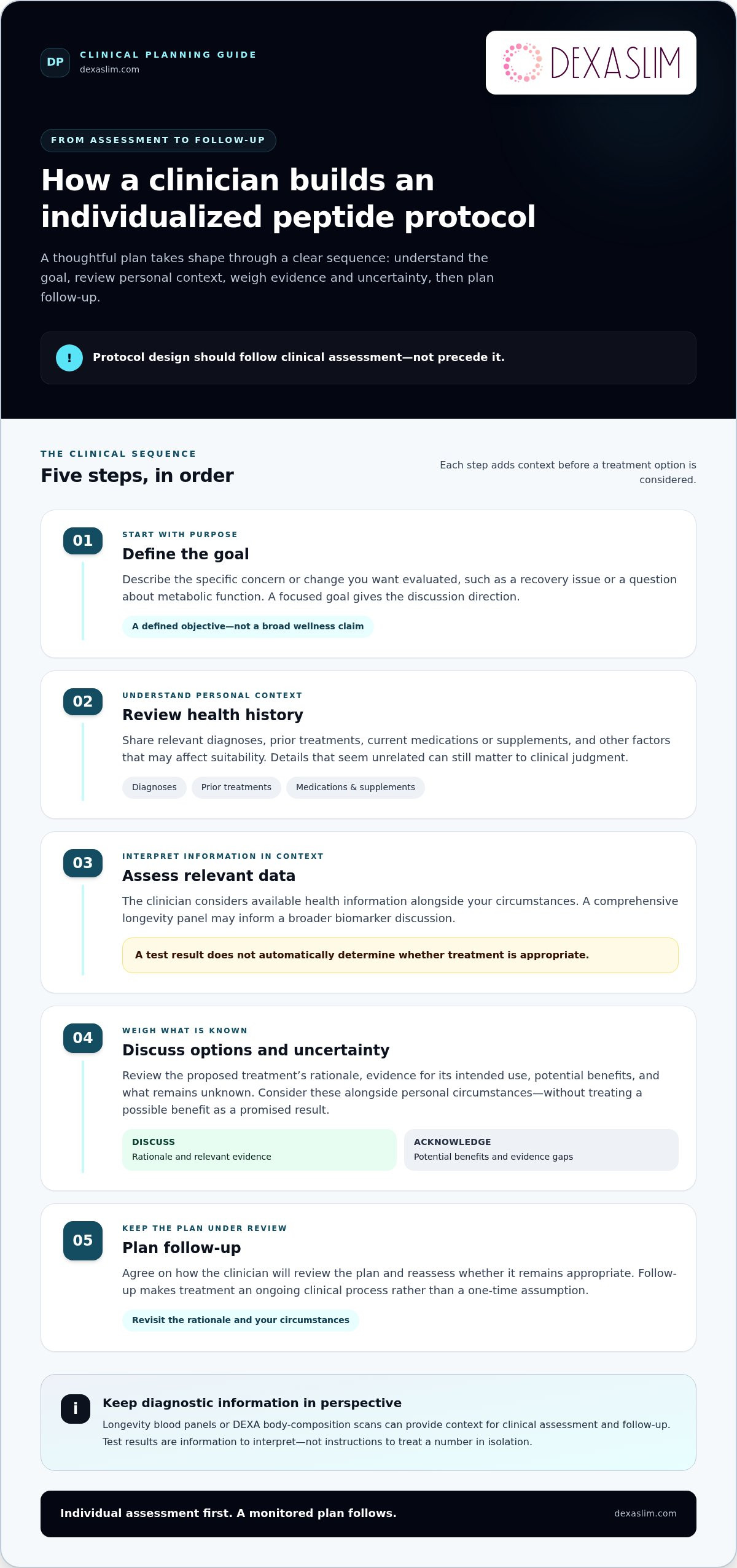
Protocol design should follow clinical assessment, not precede it. A useful conversation moves through a clear sequence:
Define the goal.
Describe the specific concern or change you want evaluated, such as a recovery issue or a question about metabolic function. A focused goal gives the discussion direction.
Review health history.
Share relevant diagnoses, prior treatments, current medications or supplements, and other factors that may affect suitability. Details that seem unrelated can still matter to clinical judgment.
Assess relevant data.
The clinician considers available health information in context. A comprehensive longevity panel may inform a broader biomarker discussion, but no single result automatically determines whether treatment is appropriate.
Discuss options and uncertainty.
Review the proposed treatment’s rationale, evidence for its intended use, potential benefits, and what remains unknown. Weigh these points alongside personal circumstances instead of treating a possible benefit as a promised result.
Plan follow-up.
Agree on how the clinician will review the plan and reassess whether it remains appropriate. Follow-up makes treatment an ongoing clinical process rather than a one-time assumption.
Start with the goal and a clinical baseline
Prepare a concise account of what you want assessed, when the concern began, and how it affects daily life. Bring an up-to-date list of current treatments and relevant health history. A clinician can use that context, together with appropriate diagnostic information, to frame questions and identify considerations. Test results provide evidence to interpret; they aren’t instructions to treat a number in isolation.
Turn assessment into a monitored plan
Before proceeding, understand why the specific option is being considered, how it relates to your goal, and where evidence is limited. Informed consent means having the opportunity to discuss uncertainties and alternatives, not simply accepting a confident-sounding claim. Follow-up allows the clinician to revisit the rationale and your circumstances. There’s no universal protocol template that fits every person or objective.
Dexaslim provides clinically supervised advanced peptide treatment centered on individualized clinical evaluation. Learn about Dexaslim’s advanced peptide treatment and the clinical approach behind it.
How to Compare Advanced Peptide Protocols Without Falling for Broad Claims
A sophisticated-sounding protocol is not proof of meaningful benefit. Compare the clinical rationale, not the branding, complexity, or number of proposed components. Evidence can differ by compound, intended use, population studied, and research quality. Findings for one use don’t automatically support a different use of the same compound.
Protocol quality depends on evidence for the specific use, not on the word “advanced.” Use these criteria to make the comparison concrete:
Intended goal: Is the proposed treatment linked to a specific concern, or does the explanation rely on broad language such as “optimization” without defining what is being addressed?
Evidence quality: What human evidence supports this compound for this particular use? Does the claim rely on clinical outcomes in people, or on early research that suggests a possible biological effect?
Individual fit: Does the rationale account for your health history, current treatments, and circumstances, or is the same plan presented as suitable for everyone?
Clinical oversight: Is a clinician involved in assessing suitability and explaining uncertainty, alternatives, and possible risks as part of informed consent?
Measurable follow-up: Is there a clear way to review whether the plan remains appropriate, rather than relying only on a general impression or a promised result?
Treatment status matters, too. Some peptide-based medicines have established clinical uses for specific conditions, while other compounds or proposed uses may remain investigational or uncertain. Don’t assume evidence or authorization for one indication applies to another. Regulatory details and evidence can change, so verify the current status of the specific compound and use being discussed before making a decision.
Which questions reveal the strength of a protocol's rationale?
Ask direct questions: What exact goal is this treatment intended to address? What human evidence supports this compound for that use, and what does the evidence not show? How will the clinician explain uncertainty, alternatives, and possible risks before you decide? Clear answers should connect the proposed treatment to your circumstances without overstating what research can establish.
How can readers recognize overconfident claims?
Pause when you hear guaranteed outcomes, sweeping promises about longevity, or claims that one plan works for everyone. Testimonials may describe an individual’s experience, but they can’t establish that a treatment caused the result or demonstrate safety and effectiveness for other people. An early research finding may offer a rationale for further study, not proof of a meaningful clinical outcome.
Use evidence, individual fit, oversight, and follow-up as your filter. If a claim is broad but the explanation can’t identify the intended use or limits of what’s known, confident presentation is no substitute for a sound clinical rationale.
Safety, Eligibility, and Follow-Up: What to Understand Before Treatment
Safety isn’t determined by the word “peptide” or by a reassuring lab result. Suitability depends on the specific treatment, your health history, current medications, and a clinician’s assessment. Evidence about potential side effects also varies by compound and intended use. Don’t apply a risk list from one treatment to another. Ask the clinician to explain what is known for the proposed use and identify important evidence gaps.
An advanced peptide protocol should include a plan for reassessment, not just an initial decision. Follow-up helps the clinician review your response and tolerability, revisit whether the original rationale still applies, and decide whether the plan remains appropriate. It doesn’t guarantee a desired outcome, but it creates a structured opportunity to respond to individual findings.
What should a responsible clinical discussion cover?
Before treatment, clarify the rationale, known treatment-specific risks, uncertainties, and relevant alternatives. Make sure you understand the information before giving informed consent. Share current medications and supplements, relevant health conditions, prior treatment experiences, and any changes in your health. These details help a clinician consider your circumstances rather than relying on a generic protocol.
Testing can add context, but no single lab panel can guarantee eligibility or safety. Results need to be interpreted alongside your history, symptoms, and the specific treatment under consideration. Ask how a result affects the clinical discussion, what it can’t tell you, and whether further assessment is relevant. If evidence about a risk or side effect is uncertain, that uncertainty should be explained rather than replaced with an unsupported assurance.
Why does monitoring matter after treatment begins?
Follow-up gives you and the clinician a chance to discuss changes, unwanted effects, and whether the treatment still fits the original goal. Keep track of relevant symptoms or concerns so the conversation is based on more than memory. The clinician may adjust or reconsider the plan in light of individual findings. The timing and type of review should reflect the treatment and your circumstances, not an assumed schedule for everyone.
Don’t wait for a routine follow-up if you develop severe or rapidly worsening symptoms. Seek urgent medical help. For other new or concerning symptoms, contact the clinician responsible for your care promptly and explain what changed. Don’t independently modify a treatment plan based on online advice.
Dexaslim provides clinically supervised advanced peptide treatment, with clinical evaluation taking priority over generalized claims. Read about Dexaslim’s advanced peptide treatment and the questions to consider in a clinician-led discussion.
How Dexaslim Connects Advanced Peptide Treatment With Measurable Health Data
Dexaslim provides clinically supervised advanced peptide treatment. The focus is on connecting an individual’s health goal with a considered clinical discussion, rather than assuming one protocol suits everyone. Relevant diagnostic information can add context, but it doesn’t determine treatment automatically or predict a specific result.
Start with the objective. For someone concerned about body composition, understanding current measurements may help make the broader conversation more specific. A DEXA body-composition assessment provides information about body composition. It doesn’t establish, by itself, whether peptide treatment is suitable or show that a peptide caused a change.
When can diagnostic context add value?
Objective measurements can make a health discussion more specific. DEXA findings may add context when body composition relates to a person’s goal. Blood-test information, including results from a longevity panel, may contribute to a broader review of health markers. A clinician interprets these results alongside the person’s history, current concerns, and the treatment being discussed. No scan or panel independently confirms eligibility, safety, or effectiveness.
Keep the measurement and treatment question distinct. A test may describe a baseline or reveal information worth discussing; it doesn’t prove that a proposed treatment will change that measure. A change in a measurement alone also doesn’t establish what caused it. An advanced peptide protocol should be considered within the limits of available evidence and the person’s clinical context, with realistic expectations about what assessment can and can’t show.
What is a practical next step?
Prepare for a clinical conversation with a concise description of your goal, relevant health history, current medications or supplements, and questions you want answered. Ask how the proposed treatment relates to that goal, what evidence supports the intended use, what remains uncertain, and how the clinician will review whether the plan continues to make sense. This keeps the discussion focused and informed.
In an initial discussion, expect to explore your objective and relevant health context, consider whether diagnostic information may help, and address questions about rationale and uncertainty. The purpose is to support an informed decision, not promise a particular outcome. Clinical assessment can clarify what deserves consideration, but it can’t guarantee a response.
To learn more about the clinical approach, read about advanced peptide treatment at Dexaslim.
Make Your Next Step Evidence-Led
Before acting on a claim, turn it into a focused clinical conversation. Write down the health goal you want evaluated, what you hope to understand, and what evidence or uncertainty you need clarified. This preparation helps keep the discussion grounded in your priorities rather than a protocol’s marketing language.
Dexaslim offers advanced peptide treatment alongside DEXA scans and longevity blood panels. These services give you options to discuss how relevant health data may inform clinical assessment. Measurements can add context, but they don’t promise a particular response. Let evidence, individual circumstances, and informed discussion guide the decision.
Ready to explore a clinically supervised next step? Explore advanced peptide treatment at Dexaslim and bring your questions, goals, and relevant health history to the conversation. Consider an advanced peptide protocol with clear expectations and an informed clinical discussion.
Frequently Asked Questions
What is an advanced peptide protocol?
An advanced peptide protocol is a clinician-guided treatment plan designed around a specific objective and an individual assessment. “Advanced” isn’t a standardized measure of effectiveness or safety. Ask what precise concern a proposed treatment is meant to address instead of relying on a broad label such as “cellular optimization.” A useful plan also identifies relevant uncertainties and how the clinician will revisit the decision.
Are advanced peptide protocols FDA-approved?
Approval depends on the specific product and its intended use, not on the phrase “advanced peptide protocol.” A product’s status for one use doesn’t establish approval or evidence for another. Ask the clinician to identify the specific treatment and explain its regulatory status and supporting evidence. Because details can change, verify current information through the FDA before relying on a claim about a particular peptide.
Can peptide therapy be combined with exercise or nutrition changes?
Exercise and nutrition may be part of a broader health plan, but whether changes make sense alongside a particular treatment depends on your circumstances and clinical advice. For example, share your training routine and any major recent changes in eating patterns during the assessment. Don’t assume a peptide replaces foundational habits or guarantees improved performance. Discuss relevant conditions and current treatments so advice reflects your full health picture.
What should I ask before starting a peptide protocol?
Ask what specific goal the treatment addresses and what evidence supports that exact use. Then clarify known risks, uncertainties, alternatives, and how your health history or current medications affect the decision. You can also ask what signs or information would prompt the clinician to reassess the plan. These questions help distinguish a reasoned recommendation from a generalized claim without requiring you to interpret technical research alone.
Can blood tests show whether a peptide protocol is working?
Blood tests can track selected biomarkers, but they can’t independently prove that a treatment is effective for every goal. A change in a marker may need interpretation alongside symptoms, health history, and other relevant assessments. Ask which measure relates to your intended outcome, why it matters, and what it can’t establish. The clinician should explain how test findings fit into the overall assessment rather than treating one result as a verdict.
How long does it take to see results from peptide therapy?
There’s no reliable universal timeline. The timeframe depends on the treatment, intended outcome, individual factors, and quality of evidence for that use. Be cautious of claims promising rapid or fixed results for everyone. Before treatment, ask what changes are meaningful to track, when reassessment makes sense, and how the clinician would respond if you notice no benefit or experience unwanted effects.
Are peptide protocols appropriate for everyone?
No. Suitability depends on the particular treatment, health history, current medications, goals, and clinician assessment. Someone taking medication for another condition, for example, should include that in the discussion rather than assuming a general online protocol applies. Some individuals may need further evaluation or have reasons to avoid a particular approach. Don’t use another person’s results or an online checklist as a substitute for individualized clinical judgment.