

What if your weight looks steady but still doesn’t tell you what’s happening beneath the surface? A scale captures total mass, while a single lab result captures one moment. A metabolic health assessment can build a broader picture by connecting measurements of body composition, metabolic function, and physical performance.
It’s reasonable to find the options confusing. DEXA scans, blood tests, resting metabolic rate testing, and VO₂ Max testing measure different things. No single result answers every question. Start by defining what you want to understand, then choose measurements that fit. Read each result in context instead of treating it as a verdict.
This article explains what these tests can reveal and how their roles differ. You’ll learn how body-composition data describes fat and lean mass, how metabolic testing measures energy use at rest, and how performance testing evaluates aerobic capacity. You’ll also find practical ways to choose a baseline, prepare for testing, and review your results with a qualified provider.
Key Takeaways
• Use a metabolic health assessment to establish a personal baseline around the questions and goals that matter to you.
• Match each test to its purpose: DEXA for body composition, RMR testing for resting energy use, and VO₂ Max testing for aerobic performance.
• Read results in context. An assessment organizes selected measurements, but it isn’t a diagnosis.
• Make testing more useful by defining your question, following the assigned provider’s preparation instructions, and reviewing the results with them.
• Dexaslim offers DEXA scans, RMR testing, VO₂ Max testing, and a Longevity Panel, each contributing distinct data to a baseline.
What a metabolic health assessment measures, and why one number is not enough
Body weight can show whether total mass has changed. By itself, it can’t show how much of that mass is fat or lean tissue, how much energy your body uses at rest, or how your aerobic system performs. A single lab value has limits, too: it answers a specific question, not every question about metabolic health.
A metabolic health assessment brings together selected measurements to describe body composition, energy use, or performance. It is not a single test or a diagnosis.
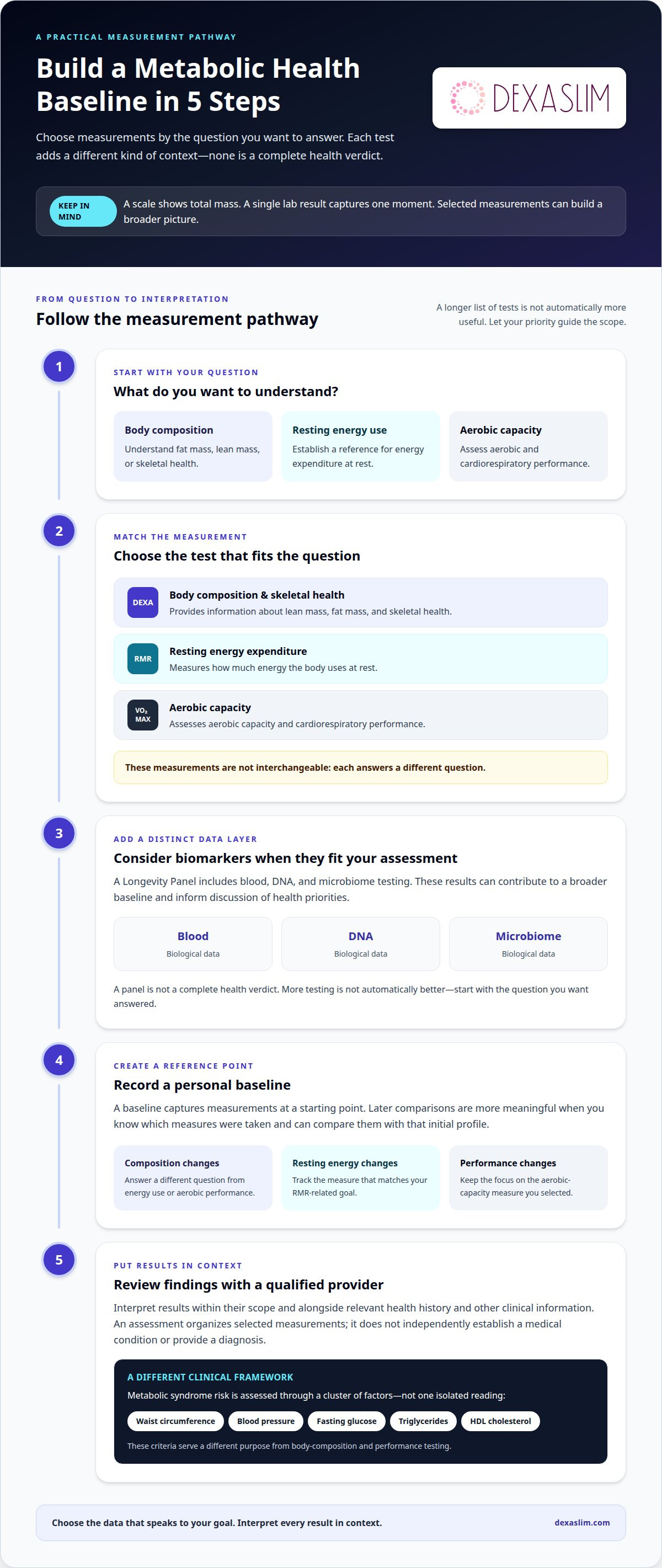
Each measurement has a distinct role. DEXA provides information about lean mass, fat mass, and skeletal health. Resting Metabolic Rate (RMR) testing measures energy use at rest. VO₂ Max testing evaluates aerobic capacity. These results add different kinds of context, but they are not interchangeable scores. Choose measurements based on what you want to understand, then interpret each within its scope.
Metabolic risk is assessed through a cluster of factors, not one isolated reading. The clinical criteria for metabolic syndrome, for example, include waist circumference, blood pressure, fasting glucose, triglycerides, and HDL cholesterol. Those criteria serve a different purpose from body-composition or performance tests, but they illustrate why one metric cannot represent an entire health profile.
Metabolic health assessment versus a routine checkup
A routine checkup addresses broad health needs. An assessment focuses on selected measurements and the specific insight each can provide. It can organize objective data around questions such as whether body composition, resting energy use, or aerobic fitness is your priority. The scope should fit the question. A longer list of tests isn’t automatically more useful.
Assessment results are contextual data. They don’t independently establish a medical condition, and a scan or performance result shouldn’t be treated as a diagnosis. Dexaslim provides specialist, supportive, consultative services rather than primary care. A qualified provider can interpret findings alongside relevant health history and other clinical information.
Why a personal baseline matters
A baseline records measurements at a starting point. Later comparisons are more meaningful when you know which measures were taken and can compare them with that initial profile. A change in body composition answers a different question from a change in resting energy use or aerobic performance. Track the measure that matches your goal.
Start with your own priority: understand body composition, establish an RMR reference, or assess aerobic capacity. Choose data that speaks to that goal rather than pursuing a number without a clear purpose. Interpretation depends on individual context and qualified provider guidance. A baseline doesn’t promise a particular result, but it gives you a reference for informed conversations and future decisions.
The core measurements in a metabolic health assessment
Build an assessment around questions, not a pile of scores. Do you want to understand how your body is composed, how much energy it uses at rest, or how effectively your cardiovascular and respiratory systems support exertion? Each measurement contributes a different piece of information. A broader profile may also include selected biomarkers, giving you complementary perspectives without turning them into one all-purpose verdict.
DEXA describes body composition and skeletal health, RMR testing measures resting energy expenditure, and VO₂ Max testing assesses aerobic capacity. These tools answer different questions. One cannot stand in for another.
Body composition, resting energy use, and aerobic capacity
DEXA analysis provides data on lean mass, fat mass, and skeletal health. This can help distinguish changes in body composition that a weight reading alone won’t show. RMR testing focuses on energy expenditure while the body is at rest. VO₂ Max testing assesses aerobic capacity and cardiorespiratory performance, offering a different view of physical function. Choose based on what you want the measurement to clarify.
Think of these measures as separate instruments, not competing scores. If your question concerns body composition, DEXA is relevant. If you want a measure of resting energy use, RMR testing fits that question. If you’re examining aerobic performance, VO₂ Max testing provides relevant data. For clinical context on metabolic risk factors, the NHLBI guidelines on metabolic health risk factors discuss factors used in evaluating metabolic syndrome. That clinical framework is distinct from body-composition and performance testing.
Biomarkers and broader longevity testing
Biomarkers add another layer. The Longevity Panel includes blood, DNA, and microbiome testing, bringing together several types of biological data. These results can inform a more detailed discussion of health priorities, but a panel isn’t a complete health verdict. Interpret its findings in context and consider them alongside relevant history and other measurements.
Keep the roles clear: a biomarker result, a DEXA finding, an RMR measurement, and a VO₂ Max result each have their own scope. Combining selected data can create a broader baseline, but more testing isn’t automatically better. Start with the question you want answered, then select measurements that address it. For a closer look at blood-test selection, Dexaslim’s guide, “Comprehensive Longevity Panel: A Data-Driven Guide to Choosing Blood Tests,” offers a focused next step.
Dexaslim’s assessment options offer distinct parts of a connected measurement pathway. Dexaslim’s body-composition, metabolic, and performance testing can help you align different measures with a personal question or goal.
Matching Assessment Methods to Your Questions
Choose a test by starting with the question you want answered. A body-composition measure won’t tell you your resting energy expenditure, and a performance measure won’t describe your fat and lean mass. Use the comparison below to match each measurement to its purpose and keep its limits in view.
| Question | Relevant measurement | What it cannot establish |
|---|---|---|
| What does my body composition look like? | DEXA, which provides lean-mass, fat-mass, and skeletal-health data | A complete picture of metabolic health or a diagnosis on its own |
| How much energy does my body use at rest? | Resting Metabolic Rate (RMR) testing | Aerobic capacity or body composition |
| What does my aerobic capacity look like? | VO₂ Max testing | Resting energy expenditure or a complete metabolic profile |
| Could selected biological markers add useful context? | Blood testing or a broader panel, such as the Longevity Panel | A complete health verdict or a substitute for clinical interpretation |
Which measurement fits a body-composition goal?
If your question is about lean mass, fat mass, or skeletal health, DEXA provides relevant data. It helps you look beyond total weight, but it doesn’t independently explain every aspect of metabolic function. For a closer look at the scan and its results, see “DEXA Body Composition Scan: The Clinical Gold Standard for Health and Longevity (2026).” That guide covers scan details and interpretation.
Which measurement fits an energy-use or performance question?
Choose RMR testing when you want to assess energy expenditure at rest. Choose VO₂ Max testing when your focus is aerobic capacity and cardiorespiratory performance. They measure different functions, so neither replaces the other. The guide “Resting Metabolic Rate Test: What It Measures and How to Choose One” explores RMR testing in more detail.
Biomarkers may add context when your question involves selected blood measurements or broader biological data. For example, basic metabolic panel testing covers measurements such as blood glucose and other components relevant to metabolism and fluid balance. A broader panel isn’t automatically necessary; useful scope depends on the question and provider guidance.
A metabolic health assessment isn’t one score that summarizes every system. Select the measure that directly addresses your goal, then interpret it within its scope. Dexaslim brings body-composition, resting-metabolism, and performance testing into a specialist assessment pathway. Dexaslim’s assessment options include measures for different priorities.
How to prepare for testing and make assessment results useful
Useful results start before the test. Define what you want to learn, choose measurements that address that question, follow the preparation instructions for each test, and review the findings in clinical context. This sequence keeps a metabolic health assessment focused and makes the data easier to use.
Set a clear assessment question before testing
Decide which information would help clarify your priorities. Are you focused on body composition, resting energy use, aerobic performance, or broader biological markers? You don’t need every available measure. Choose tests that answer your question, not simply because they generate more data.
Define the question.
Write down what you want to understand, such as your body-composition profile or resting energy expenditure.
Select relevant measures.
Match the question to an appropriate test. Keep the scope targeted instead of assuming one package fits everyone.
Follow test-specific instructions.
Preparation can differ by assessment. Follow the assigned provider’s instructions for timing, activity, food, or other preparation details. Don’t substitute general advice for directions specific to your test.
Review the results.
Discuss what each measurement shows, what it does not establish, and how it relates to your goals and relevant health context.
Preparation supports a more meaningful measurement. If you’re completing more than one test, keep track of which instructions apply to each. If preparation instructions are unclear, resolve that with your assigned provider before testing rather than guessing. For future comparisons, record the assessment date and measures collected. This helps distinguish a change in a result from a difference in what was tested.
Review results with appropriate clinical context
Don’t treat a result as an isolated target or a complete health verdict. A measurement describes a specific feature under particular testing conditions. Its meaning depends on factors such as your health history, the purpose of the assessment, and other information available to the qualified provider reviewing it. Clarify what the finding supports, what remains unknown, and whether it addresses your original question.
A measured baseline is a reference point for understanding your data, not a promise of a particular outcome. Findings can inform discussion and planning, but they don’t guarantee that a future measurement or health status will change. Focus on informed interpretation and relevant next steps, not on treating a number as a prediction.
Dexaslim provides specialist, supportive, consultative services, not primary care or emergency services. If you encounter a medical emergency, call 911 or go to the nearest emergency department. The practice does not admit patients to the hospital, treat hospitalized patients, or provide immediate on-call services.
Once you’ve identified the question you want your measurements to answer, review Dexaslim’s assessment options to see which tests align with that priority.
Build a personalized metabolic health assessment with Dexaslim
A useful assessment starts with your question, not a preset stack of tests. Dexaslim offers distinct measurements that can be selected around your goals, from body-composition data to resting energy use, aerobic performance, and broader biological information. Each option adds a different perspective. Selected results can help establish a personal baseline for informed discussion with a qualified provider.
Choose measurements around your goals
Match the test to the information you want. Dexaslim’s assessment options include:
DEXA Body-Composition Scan
AI-powered DEXA analysis provides lean-mass, fat-mass, and skeletal-health data. Choose this measurement when your focus is body composition.
DEXA Bone Density Scan
A distinct option for questions focused on bone density and skeletal health.
Resting Metabolic Rate (RMR) Testing
Choose this when you want to measure resting energy expenditure.
VO₂ Max Test
This test addresses questions about aerobic capacity and cardiorespiratory performance.
Longevity Panel
This includes blood, DNA, and microbiome testing, providing selected biological data for discussion.
These measurements have different scopes. A DEXA scan doesn’t measure resting energy expenditure, and an RMR test doesn’t describe aerobic capacity. The Longevity Panel adds a broader biological perspective, but it isn’t a complete health verdict. You don’t need every option by default. Select measures that directly relate to your priorities, then review what each result can and cannot tell you.
Take the next step with expert-led assessment
Dexaslim’s expert-led, concierge approach connects assessment choices with personalized health insights. A focused starting point might be one measurement tied to a specific question. If your goals span body composition and performance, more than one type of assessment may be relevant. Let your priorities guide the scope, and interpret each result within its intended role and your personal context.
Assessment data can support a conversation and help organize future planning, but it can’t promise a particular change or outcome. It also doesn’t replace primary care. Dexaslim provides specialist, supportive, consultative services rather than primary-care services, and it isn’t an emergency service.
The Practice is cash-pay only and does NOT submit claims or bills for reimbursement by insurance or Medicare. No promises or expectations have been made about the results of any treatments or services.
Build a clearer baseline by choosing tests that answer your specific questions. Explore Dexaslim’s metabolic assessment services.
Turn your next question into a clearer starting point
Your next step doesn’t have to be a long list of tests. Choose the question you want to answer, then establish a baseline that gives you useful information to discuss with a qualified provider. A focused metabolic health assessment can bring structure to that conversation without treating one result as the whole story.
Dexaslim displays more than 80 five-star reviews on its site. Consider those alongside the assessment details as you decide whether its expert-led approach fits your goals. Dexaslim’s metabolic assessment services provide a way to explore options for building a more informed personal baseline.
Frequently Asked Questions
Can a metabolic health assessment diagnose a medical condition?
No. An assessment can provide measurements that inform a clinical discussion, but the results alone don’t diagnose a condition. An unexpected measurement may prompt a qualified provider to consider your health history, symptoms, and other relevant findings. Use the data as a starting point for interpretation, not as a reason to self-diagnose or make treatment changes without professional guidance.
Is metabolic health assessment the same as metabolic rate testing?
No. Metabolic rate testing is one specific type of measurement. Resting Metabolic Rate testing estimates energy expenditure at rest, while a metabolic health assessment can include selected measures that address other questions, such as body composition or aerobic capacity. If you want to understand resting energy use, RMR testing is relevant, but it doesn’t provide all the information that may be useful in a broader assessment.
Can a metabolic health assessment help track changes over time?
Yes. A baseline can provide a reference for later comparisons, especially when you repeat the same type of measurement under comparable testing conditions. For example, compare DEXA body-composition data with later DEXA data, rather than with a scale reading. Record the test date and method, and review apparent changes with a qualified provider before drawing conclusions.
What happens if my assessment results are outside a reference range?
An out-of-range result needs context, not an immediate conclusion. Reference ranges can vary by test and laboratory, and a result’s meaning depends on factors such as your history and other findings. Review the result with a qualified provider, including the units and range printed on the report. Don’t diagnose yourself or change prescribed treatment based on a number alone.
Do I need DEXA, RMR, and VO₂ Max testing together?
No. You don’t automatically need all three. Choose according to the question you want answered: DEXA for body-composition information, RMR testing for resting energy expenditure, or VO₂ Max testing for aerobic capacity. Someone focused on aerobic fitness may not need a body-composition measurement to answer that specific question. A qualified provider can help you decide whether combining tests adds useful context for your goals.
Does Dexaslim accept insurance or Medicare for metabolic assessments?
No. The Practice is cash-pay only and does NOT submit claims or bills for reimbursement by insurance or Medicare. Keep this in mind when planning for an assessment and selecting measurements that fit your goals.