.svg)

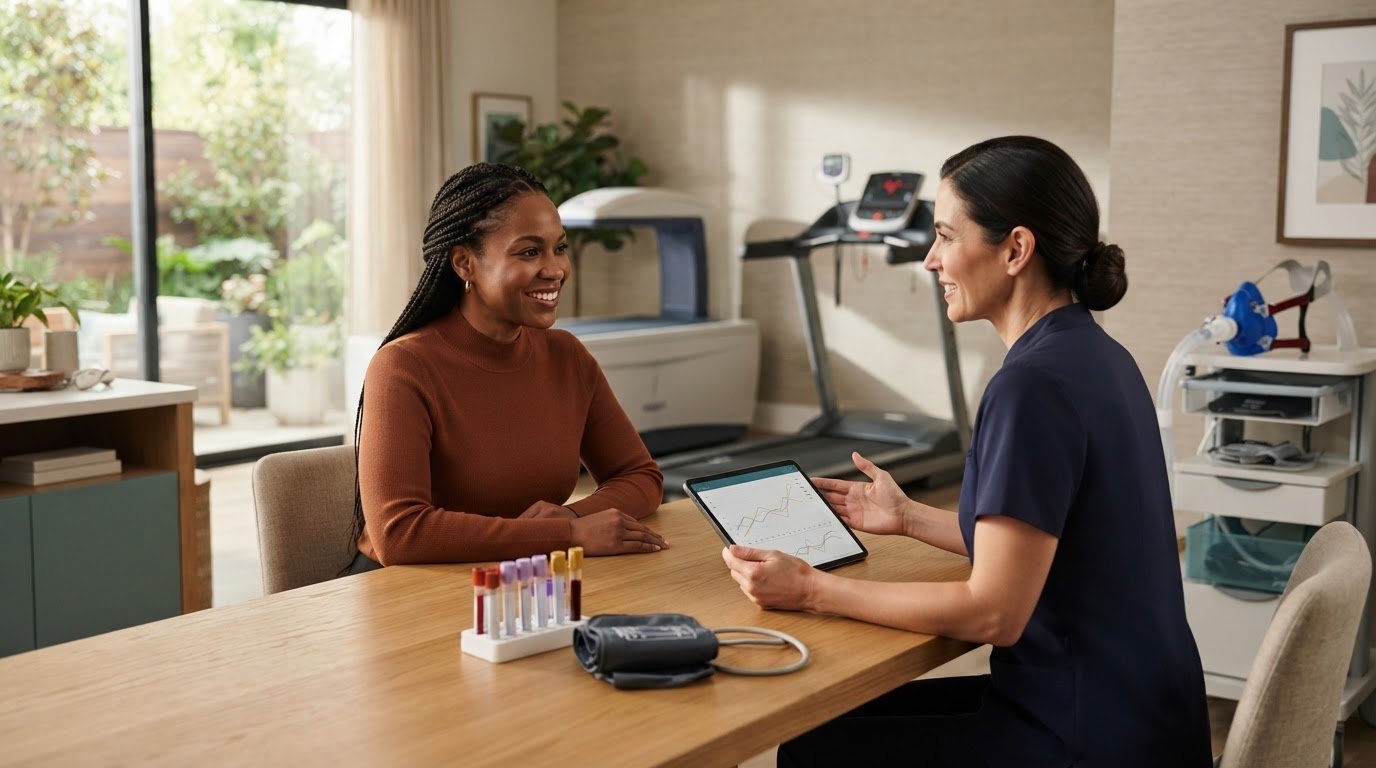
More tests don’t automatically produce better longevity decisions. The right measurements depend on age, menstrual status, menopause, personal history, and what you can act on. That’s why longevity testing for women should start with a focused baseline, not an oversized panel built around one-size-fits-all recommendations.
It makes sense to want clear answers. Online advice can make every biomarker sound urgent, while a result without context can create more questions than direction. A number is useful when it’s interpreted alongside symptoms, life stage, prior results, and established clinical guidance. Testing can inform a conversation, but it doesn’t replace screening, diagnosis, or care from a qualified clinician.
This practical 2026 checklist will help you connect health questions to measurements, understand how menstrual changes and menopause can shape interpretation, and identify realistic next steps. It covers blood panels, DEXA measurements of body composition and bone density, VO₂ Max, and resting metabolic rate testing. Use it to prepare a concise, personalized discussion, then focus on trends and actions rather than chasing every available test.
Key Takeaways
• Choose tests according to the health question you want to explore, rather than treating a broad panel as a universal checklist.
• Account for age, menstrual status, and menopause when discussing what a result means and which measurements may be relevant.
• Compare blood panels, DEXA, VO₂ Max, and resting metabolic rate by the questions each can help explore.
• For longevity testing for women, prepare relevant health history and follow the instructions for each test instead of assuming every test requires fasting.
• Review results in context and agree on practical follow-up steps. A single measurement does not predict your future health.
Longevity testing for women: what a useful health baseline can, and cannot, tell you
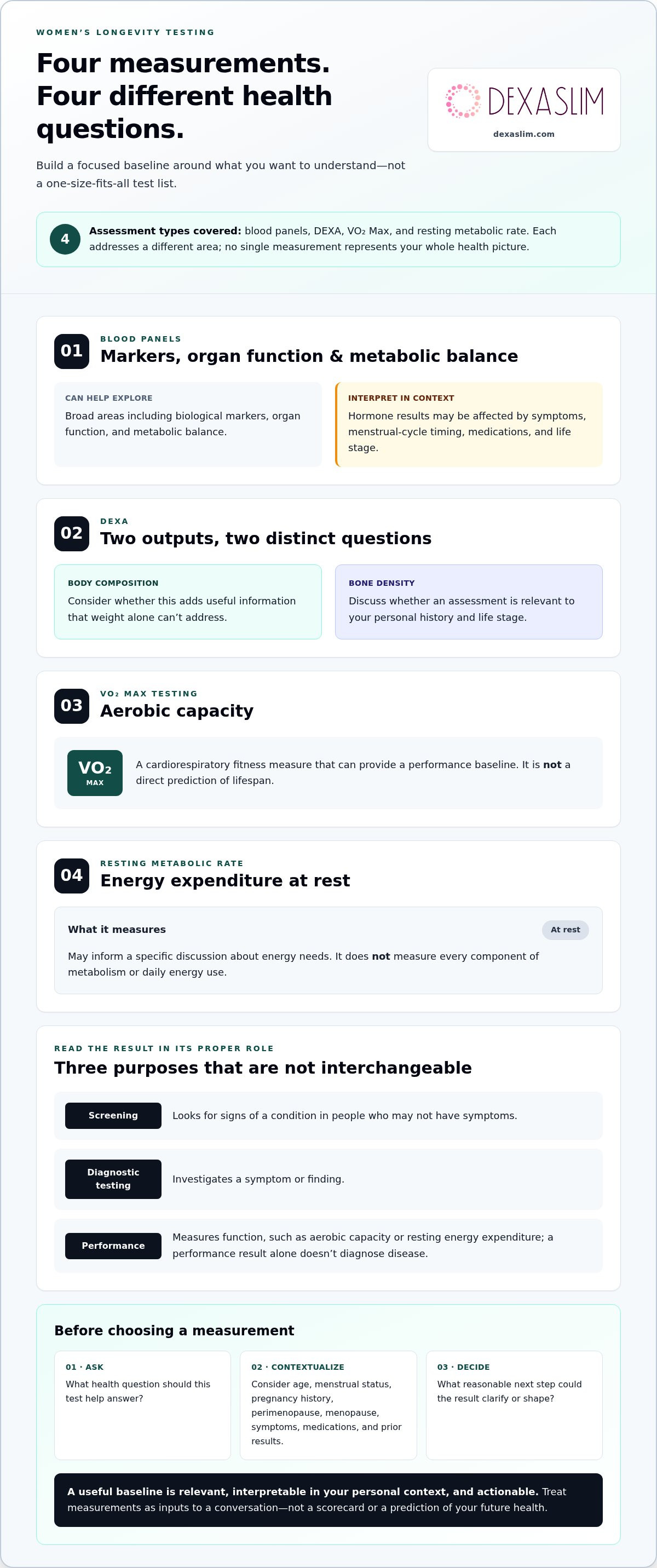
Longevity testing for women means choosing health measurements to inform proactive conversations about current health and future priorities. Options may include laboratory markers, body composition, bone density, or physical performance measures. Each answers a different question. A result is a snapshot shaped by the testing method, timing, health history, and life stage. It can’t guarantee a longer lifespan, prevent disease, or predict exactly what your future health will be.
Keep three purposes distinct. Screening looks for signs of a condition in people who may not have symptoms. Diagnostic testing investigates a symptom or finding. Performance assessment measures function, such as aerobic capacity or resting energy expenditure. These categories can inform one another, but they aren’t interchangeable. A performance result alone doesn’t diagnose disease.
A sit-to-stand measure can illustrate one aspect of physical function, but it isn’t a complete longevity assessment or a prediction of lifespan. The video below demonstrates this type of functional test.
A useful baseline is relevant to your health question, interpretable in your personal context, and actionable in a way that supports a clear next step. Biomarkers are measurable indicators of biological processes. The broader concept of biomarkers of aging is still distinct from a validated prediction of an individual’s lifespan. Treat measurements as inputs to discussion, not a scorecard of your future.
Why women’s age and life stage change the context
Age alone doesn’t tell the full story. Menstrual status, pregnancy history, perimenopause, and menopause may affect symptoms, physiology, and how results are interpreted. A result collected during one life stage may not provide a like-for-like comparison with one collected later. Share relevant context and medications with your clinician. Don’t assume one panel or testing schedule fits every woman.
Start with a question, not a shopping list of tests
Begin with a goal, symptom, risk factor, or baseline question. Are you reviewing a health concern, understanding body composition, or establishing a measure of aerobic fitness? Your personal and family history, symptoms, and clinician’s judgment help determine whether testing is appropriate and which results could change next steps. For a closer look at selecting blood measurements, read this comprehensive longevity panel guide. Choose tests for their purpose, not simply because they’re available.
Women’s longevity testing checklist: connect each health question to a measurement
Build the checklist around questions you want to explore, not a preset panel. Cardiovascular and metabolic health, bone health, body composition, aerobic capacity, and resting energy expenditure are distinct areas. A clinician can help prioritize them based on your history, symptoms, life stage, and existing preventive care. Before choosing a test, write down the question it should help answer and what you might do with the result. No single measurement represents your whole health picture.
Cardiovascular and metabolic context
Discuss relevant risk factors and whether blood-based measurements could add useful information. Keep routine screening and follow-up in view. HRSA outlines evidence-based preventive health services, which serve a different purpose from optional longevity measurements.
Bone health
Consider whether a bone density assessment is relevant to your personal history and life stage.
Body composition
Ask whether measuring body composition would help answer a specific question that weight alone can’t address.
Cardiorespiratory fitness
Consider whether assessing aerobic capacity would provide a meaningful performance baseline.
Resting energy expenditure
Decide whether a resting metabolic rate measurement could inform a specific discussion about energy needs.
This is a discussion guide, not a required test panel or diagnostic protocol. Select a measurement when its result could clarify a question or shape a reasonable next step.
Blood biomarkers: metabolic, organ-function, and hormone context
Dexaslim’s longevity blood panels assess broad areas including biological markers, organ function, and metabolic balance. That doesn’t make every marker relevant to every person. Hormone testing needs particular context: symptoms, menstrual-cycle timing, medications, and life stage can all affect interpretation. Avoid treating a hormone result as meaningful in isolation. For practical guidance on understanding blood results, see biomarker testing for longevity.
Beyond bloodwork: bone density, body composition, and fitness
DEXA can assess body composition and bone density, two separate outputs that address different questions. VO₂ Max testing assesses aerobic capacity. It isn’t a direct prediction of lifespan. A resting metabolic rate test measures energy expenditure at rest, not every component of metabolism or daily energy use. Keep the purpose clear for each measure. Dexaslim offers longevity panels, DEXA scans, VO₂ Max testing, and resting metabolic rate testing as distinct assessments that can inform a broader health discussion.
Which longevity tests for women fit your life stage and health priorities?
Match each measurement to a specific question. A blood panel can offer information about biological markers, organ function, and metabolic balance. DEXA, VO₂ Max, and resting metabolic rate testing assess different aspects of body composition, bone density, aerobic capacity, and energy use. None is automatically the best choice. Let your symptoms, health history, life stage, and the decision you hope to inform guide what you discuss.
| Health question | Measurement type | Context needed |
|---|---|---|
| Could blood measurements add useful information to a broader health discussion? | Longevity blood panel | Symptoms, health and family history, medications, and the specific question being explored |
| Would information about bone density or body composition help clarify a concern? | DEXA scan | Personal history, life stage, and whether the result could inform follow-up |
| Would an aerobic-capacity baseline help track physical performance? | VO₂ Max assessment | Current activity, relevant health context, and the purpose of tracking |
| Would a resting energy-use measurement help inform a specific discussion? | Resting metabolic rate test | Test conditions and how the result relates to the question being asked |
This comparison is a starting point, not a prescription. Routine preventive screening also matters: the Women's Preventive Services Guidelines address preventive care, while longevity measurements may offer other data for a health discussion. Keep those purposes distinct.
Perimenopause and menopause: interpret changes in context
During perimenopause and menopause, changing hormones and bone-health considerations may shape which questions deserve attention. Symptoms, menstrual changes, medications, and personal history help establish context. Don’t treat one hormone result as a diagnosis of menopause or hormonal deficiency. Age can inform a conversation, but it doesn’t replace life-stage details or individual clinical judgment. Use a checklist to organize relevant questions, not to impose a universal schedule.
Choose complementary measurements without duplicating the question
Blood biomarkers, DEXA measurements, and fitness assessments can add different perspectives. For example, blood data and body-composition data don’t answer the same question, while VO₂ Max and resting metabolic rate reflect different aspects of physiology. Add a measurement only when its result could inform a decision, follow-up, or useful comparison over time. For more detail on body composition, explore this DEXA body composition scan guide.
Use this framework for longevity testing for women as a focused discussion tool. The most useful plan is tailored to your priorities, not built by adding tests without a clear purpose.
Before and after testing: prepare, review results, and decide what comes next
Make each measurement earn its place. A clear question before testing makes preparation more relevant and results easier to discuss. Use this five-step checklist to move from curiosity to a considered follow-up plan.
Define the question.
Write down the goal, symptom, risk factor, or baseline you want to explore. Be specific about what you hope the result will help clarify.
Share relevant history.
Provide your clinician with relevant diagnoses, medications, supplements, symptoms, and recent health changes. Include menstrual-cycle timing or menopause status when relevant to hormone-related questions.
Complete testing as instructed.
Follow the preparation instructions for that specific assessment. Don’t assume every blood test requires fasting or that instructions for one measurement apply to another.
Review the result in context.
Discuss unexpected or abnormal findings with a qualified clinician before changing medication, treatment, or other care. Consider the test method, your health history, symptoms, and life stage.
Agree on follow-up.
Decide whether the next step is clinical evaluation, a change in your health plan, or simply recording a baseline. Retest only when a new result could guide a decision or help monitor a meaningful change.
What to bring and record before testing
Prepare a concise record of medications, supplements, relevant diagnoses, current symptoms, and recent changes in health or routine. For hormone-related questions, note cycle timing or menopause status if relevant. Bring your defined testing goal, too. These details give the results a clear reference point and help keep the discussion focused.
Results become useful when interpreted with your history, the right context, and a clear next step. A flagged result may call for clinical follow-up, while a performance measure may serve as a wellness baseline. These are different uses. Neither should prompt a major care change without appropriate review.
How to turn results into a measured follow-up plan
Ask what a finding means for your situation, whether it needs further evaluation, and what action, if any, is supported. Separate results that need clinical attention from measurements you’re tracking for wellness. For longevity testing for women, repeat testing should have a purpose, such as answering an unresolved question or assessing a change over time. Avoid retesting simply to collect more numbers.
For objective measurement options that can contribute data to a broader health discussion, explore Dexaslim’s testing options.
Build your women’s longevity testing plan with objective health data
A focused plan turns testing from a collection of numbers into a structured health conversation. Define the question first. Account for your symptoms, history, menstrual status, and menopause stage. Select measurements that fit those priorities, then review each result in context before deciding what to do next. This approach keeps longevity testing for women personal and purposeful, rather than driven by a universal panel or checklist.
When a longevity panel may be a useful starting point
A longevity blood panel can provide biomarker data for proactive discussion of biological markers, organ function, and metabolic balance. It may be a useful starting point when blood-based information aligns with a question you want to explore. The panel is one source of information, not a complete picture of health. It doesn’t replace clinical evaluation, guarantee future outcomes, or promise to prevent disease or identify every health risk.
Before testing, identify what you want the results to help clarify. Share relevant symptoms, health history, medications, and life-stage context during review. Ask how findings relate to your situation and whether any require clinical follow-up. A measurement is most useful when it leads to an informed discussion or a clear decision, not simply a longer list of results.
When to add a physical or performance assessment
Add an assessment when it addresses a distinct goal. DEXA can help explore body-composition or bone-density questions; it isn’t a general disease-screening test. VO₂ Max testing assesses aerobic capacity, while resting metabolic rate testing measures resting energy expenditure. These measures can complement blood data, but they answer different questions. Choose one when its result can inform a relevant discussion, baseline, or follow-up plan.
For example, a question about bone density points toward a different measurement than a goal of understanding aerobic capacity. A broad interest in health doesn’t automatically make every assessment useful. Match the test to your priorities, and interpret the result alongside your history and current health context.
Keep the plan simple: define the question, choose relevant measurements, and review what the results can and can’t tell you. Dexaslim’s longevity panel and separate DEXA, VO₂ Max, and resting metabolic rate assessments offer objective data for broader health discussions. Explore Dexaslim’s longevity testing options and use the information to support an informed conversation about your health.
Turn your health questions into a focused next step
Build a useful plan by starting with a question, accounting for your life stage, and choosing measurements that can help answer it. That’s the core of longevity testing for women: a focused, interpretable set of data, not a universal panel or a prediction of future health.
Dexaslim’s longevity panel assesses biological markers, organ function, and metabolic balance. DEXA, VO₂ Max, and resting metabolic rate assessments provide distinct types of health data, each suited to different questions. Select only measurements that align with your goals, then review the results in context with a qualified clinician before deciding what comes next.
Objective data can make a health conversation more specific. It works best when paired with your history, symptoms, and a clear follow-up plan. Explore Dexaslim’s longevity testing options and identify which measurements may support your next informed discussion. Start with one relevant question, then build from there with clarity and confidence.
Frequently Asked Questions
What tests should women consider for longevity?
Choose tests based on your health questions, personal history, life stage, and clinician guidance. Blood biomarkers can provide information about areas such as organ function and metabolic balance. Physical and performance assessments answer different questions: DEXA assesses body composition and bone density, VO₂ Max measures aerobic capacity, and resting metabolic rate estimates energy expenditure at rest. A focused plan selects relevant measurements rather than treating every available test as necessary.
Is longevity testing different for women after menopause?
Menopause can change the context for discussing hormone-related symptoms and bone health, but it doesn’t create one testing panel that applies to everyone. Interpretation depends on symptoms, health history, medications, and other relevant context, not menopause status alone. A single hormone result can’t independently diagnose menopause or a hormonal deficiency. Discuss the specific concern with a qualified clinician, who can help determine whether testing may inform a useful next step.
Can a blood test measure biological age accurately?
A blood test can measure biomarkers that contribute information to a health assessment, but no single blood test establishes your lifespan or provides a definitive measure of your biological age. Results reflect selected markers at a particular time and need interpretation alongside your health history and other relevant measurements. Treat biological-age estimates as limited information, not a precise forecast or a substitute for clinical evaluation.
How often should women repeat longevity testing?
There’s no universal interval for repeating longevity tests. Timing depends on the type of measurement, your health history, prior findings, and whether a new result could guide a decision or help monitor a change. Some results may need clinical follow-up; other measurements may be useful as a baseline. Discuss the purpose and timing of repeat testing with a qualified clinician rather than retesting simply to collect more data.
Do women need hormone testing for longevity?
Hormone testing isn’t automatically necessary for longevity planning. It’s most useful when connected to a specific question, such as symptoms or a concern that merits clinical assessment. Interpretation may depend on menstrual-cycle timing, medications, symptoms, and life stage, including perimenopause or menopause. Don’t draw conclusions from an isolated result. Discuss whether testing is appropriate and how findings would be interpreted before using them to guide care.
Can DEXA, VO₂ Max, and blood testing be used together?
Yes, these measurements can complement one another when each addresses a relevant question. Blood testing can provide biomarker data, DEXA can assess body composition and bone density, and VO₂ Max testing measures aerobic capacity. They don’t measure the same thing, and combining them doesn’t automatically create a complete health assessment. Select each test for a clear purpose, then interpret the findings in context with your history and goals.
What should I do if a longevity test result is abnormal?
Discuss an abnormal or unexpected result with a qualified clinician before changing medication, treatment, or other care. Ask what the finding means in light of your symptoms, health history, life stage, and the specific test used. Depending on the result, clinical follow-up or confirmation may be appropriate. Don’t assume one flagged measurement proves a diagnosis, and don’t ignore it. Use it to plan an informed next step.