.svg)


A steady scale reading doesn’t necessarily mean your training isn’t working. When you’re figuring out how to track muscle gain and fat loss, weight alone can’t show whether you’re losing fat while building muscle. Changes in hydration, food and drink, and other day-to-day factors can also obscure the longer-term trend.
It’s frustrating when the scale, smart scale, and mirror seem to tell different stories. Rather than chase every number, measure consistently, compare trends over time, and look at more than one signal before deciding whether your body composition is changing.
This guide explains how to choose practical tracking methods, standardize weigh-ins and measurements, and interpret progress photos, clothing fit, and workout performance without overreacting to short-term changes. You’ll also learn when a DEXA scan can provide a more detailed body-composition baseline, and how to use that snapshot alongside everyday tracking rather than treating it as the whole story.
Key Takeaways
• Learn how to track muscle gain and fat loss with measures that show more than scale weight alone.
• Compare scale trends, waist measurements, photos, strength, and DEXA by what each can show and where each falls short.
• Standardize when and how you measure, then use repeated readings to distinguish trends from day-to-day variation.
• Choose a manageable tracking routine and consider how different indicators fit together before changing your approach.
• Consider a DEXA scan for a more detailed body-composition baseline, while keeping consistent at-home tracking in context.
How to Track Muscle Gain and Fat Loss Without Relying on the Scale
Body weight measures your total mass. It doesn’t show how much comes from fat, muscle, water, or other tissues, so a stable number can hide changes in your physique. To understand how to track muscle gain and fat loss, separate the question “What do I weigh?” from “How is my body composition changing?”
That distinction matters because progress doesn’t always show up as a noticeable drop on the scale. A useful tracking system looks for patterns across several measures, rather than relying on a single reading. For foundational context, explore the different models used to describe body composition.
For a practical overview of at-home measurement, watch this video from Live Lean TV:
What does body recomposition mean?
Body recomposition means changing the balance of fat and lean tissue over time. Fat loss and muscle gain are separate processes. They may happen together, but not necessarily at the same pace or to the same degree for everyone. Because scale weight combines all body mass into one number, it can’t identify which tissue has changed. Tracking multiple indicators gives you a more useful picture.
Why can weight stay stable while your body changes?
If fat mass decreases while lean mass increases, the changes may offset each other on the scale. For example, someone might lose some fat and gain a similar amount of lean tissue over time. Their total weight could change very little even as their body composition shifts. This is a hypothetical pattern, not a guaranteed outcome.
Short-term readings can also move for other reasons. Hydration, food and drink in your digestive system, and normal day-to-day variation all affect scale weight. One higher reading doesn’t establish fat gain, just as one lower reading doesn’t confirm fat loss. Weigh under similar conditions and compare repeated readings over time to separate a broader trend from temporary fluctuations.
No at-home measure can independently confirm both muscle gain and fat loss. A scale tracks total weight, a tape measure tracks circumference, photos show visible changes, and workout records show performance. Each provides a different signal and has its own limits. Look for several indicators moving in a consistent direction before drawing conclusions, and avoid changing your plan because of one isolated measurement.
Which Body Composition Tracking Methods Reveal Muscle and Fat Changes?
Each tracking method answers a different question. Combine a few consistent measures to add context instead of expecting one tool to confirm every change. The Obesity Action Coalition explains the value of assessing body composition beyond body weight alone.
| Method | What it measures | Practical value | Limitations |
|---|---|---|---|
| Scale trends | Total body weight | Shows whether weight is broadly moving over time. | Can’t distinguish fat from lean tissue; short-term readings fluctuate. |
| Tape measurements | Circumference at specific sites, such as the waist | Can help reveal changes in body size that weight alone misses. | Placement, tape tension, and posture can affect readings; it doesn’t identify the tissue change. |
| Progress photos | Visible changes in shape and definition | Offers a visual comparison across longer intervals. | Lighting, pose, clothing, and camera distance can distort comparisons. |
| Strength and workout records | Exercise performance, such as load or repetitions | Adds useful context about training progress. | Performance can improve for reasons other than muscle gain, so it doesn’t directly measure muscle mass. |
| DEXA | Body-composition data, including lean mass and fat distribution | Provides a more detailed baseline than scale weight alone. | It’s a snapshot, not proof of a long-term trend; results need context and consistent comparisons. |
What can at-home measurements tell you?
At-home measures are most useful when you can repeat them in the same way. Weigh under similar conditions, use the same waist location each time, and take photos with consistent lighting, clothing, pose, and camera distance. Clothing fit can offer an indirect signal, but it isn’t a direct body-composition assessment. Strength records show what’s happening in training, not how much muscle you have.
Choose a small set of measures you’ll maintain. For more detail on what a scan can show, read this DEXA body composition scan guide.
When can a DEXA scan add useful detail?
A DEXA scan can assess lean mass and fat distribution, giving you a more detailed reference point than body weight alone. It may be useful if you want a clinical baseline to compare with everyday trends. One result, however, can’t establish how your body is changing over time. Interpret it alongside consistent measurements and your goals. If a clinical baseline fits your needs, explore medical-grade DEXA body-composition scans as an optional assessment.
How to Compare Muscle Gain and Fat Loss Data Without Misreading It
Interpret trends, not isolated readings. Record measurements under similar conditions, then compare repeated observations over time. For example, weigh at a consistent time, use the same tape placement and tension, and take photos with similar lighting, posture, and camera distance. Note what you observe before deciding what it might mean. A single result can’t diagnose a change in body composition.
Different methods measure different things, so they won’t always agree. Use this table to understand possible patterns, not as a diagnostic tool:
| Observed pattern | What it may suggest | What to check next |
|---|---|---|
| Weight trends down; waist measurement also trends down | Overall weight and waist size are both decreasing. | Confirm the pattern with repeat measurements and consistent technique. |
| Weight stays similar; waist trends down; photos show a visible change | Several indicators point to a change in shape, despite little scale movement. | Keep tracking; these measures don’t identify exactly which tissues changed. |
| Weight rises; strength improves; waist and photos look similar | Training performance is improving, but the other indicators don’t yet show a clear body-composition pattern. | Review more data before attributing the change to muscle gain. |
| One reading changes sharply; other measures stay steady | The result may reflect measurement variation or a short-term fluctuation. | Repeat the measurement under comparable conditions before interpreting it. |
What if the scale and measurements disagree?
Start by checking your process. Confirm that you used the same scale, measurement location, posture, timing, and method. Repeat the measure and compare it with the surrounding trend. Don’t treat one tool as definitive just because it matches your expectations. Look for agreement across independent signals, while remembering that waist size, photos, and performance each have limitations. If a result raises a health concern, discuss it with a qualified professional.
How should you interpret lean mass and fat measurements?
Read the report terminology carefully. Lean mass is not synonymous with skeletal muscle alone. Depending on the method and report, lean mass can include other non-fat tissues, such as body water and organs. Measurement methods may define or estimate these components differently, so values from different tools shouldn’t be compared as if they were interchangeable. When comparing scans, review the same types of measurements and consider the conditions in which each was taken.
For more detail on what the term means and how it’s measured, see this lean muscle mass measurement guide. A measured change is data; its meaning depends on the method, consistency, and wider pattern. That distinction is central to how to track muscle gain and fat loss without overreading one number.
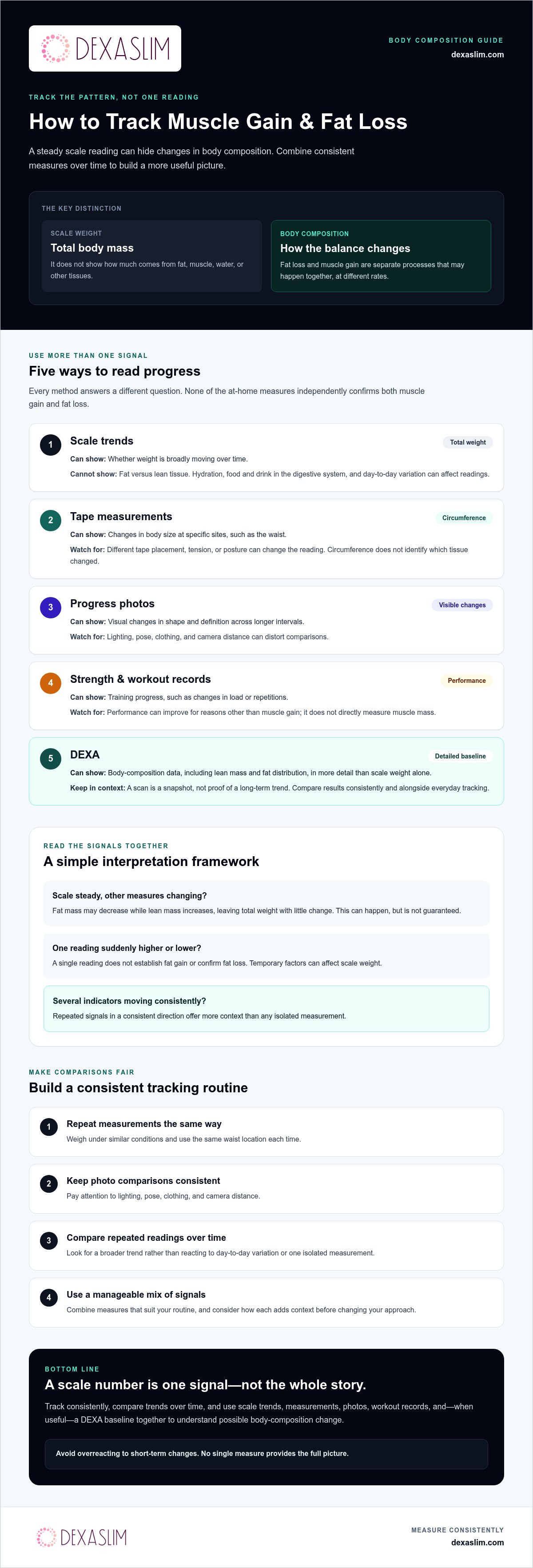
How to Build a Consistent Body Recomposition Tracking Routine
A useful routine should be simple enough to repeat and broad enough to show more than one side of progress. Choose a few measures that fit your goals, then keep the process consistent. This is how to track muscle gain and fat loss without turning every daily reading into a verdict.
Choose your measures.
Start with a weight trend, one or two circumference measurements, and a training log. Add progress photos if visual comparisons help you. You don’t need to track every available metric.
Establish a baseline.
Record your starting measurements, the date, and how you collected them. Note the scale or tape location, photo setup, and any relevant conditions so future comparisons have context.
Record consistently.
Use a calendar, notebook, or app. Log each measure using the same method, and add brief notes when your routine or training changes.
Review the pattern.
Compare repeated readings at planned check-ins. Consider the measures together, and avoid adjusting your approach in response to one unexpected result.
How often should you measure progress?
Match the frequency to the measure and to what you can sustain. If daily weighing feels useful, record it under consistent conditions and review the weekly trend rather than reacting to each number. If daily checks create stress, choose a less frequent schedule. Tape measurements may work well weekly or every few weeks, while photos are often more useful when spaced farther apart. There’s no single schedule that suits everyone.
What should you record alongside body measurements?
Context can help explain why a number changed, or why it didn’t. Keep your notes brief and practical:
Measurement details
date, time, and consistent setup or technique.
Training context
workout consistency and relevant performance changes, such as the load or repetitions you completed.
Routine changes
meaningful shifts in your usual activity or schedule that may affect comparisons.
Review your log periodically, such as during a regular weekly or monthly check-in that fits your routine. Ask whether multiple measures show a consistent direction, whether your collection method stayed steady, and what you want to monitor next. Use the data to guide reflection, not to diagnose a condition or prescribe a diet or treatment.
If you want a more detailed body-composition baseline to complement your ongoing tracking, explore medical-grade DEXA body-composition scans.
When to Use a DEXA Scan for Muscle Gain and Fat Loss Tracking
A DEXA scan is an optional tool for people who want more detail than body weight and circumference measurements provide. It can assess lean mass and fat distribution, offering a more informative body-composition baseline than a scale alone. It doesn’t replace regular tracking, and one scan can’t show a long-term trend or prove that a specific change has occurred.
Think of the scan as one data point in a wider system. Continue tracking measures you can repeat at home, such as weight trends, waist circumference, and workout performance. Compare results in context with your goals and the conditions under which each measurement was taken. This is a more grounded approach to how to track muscle gain and fat loss than relying on a single result.
Who may benefit from a more detailed body-composition baseline?
A scan may be useful if you’re already taking consistent measurements but want more insight into lean mass and fat distribution. It can provide a reference point to consider alongside ongoing training and at-home trends. Whether that added detail suits your goals depends on your individual circumstances. Discuss questions about your measurements or health with an appropriate qualified professional.
Keep expectations precise. A scan describes the measurement at that point in time. It doesn’t independently determine fitness, overall health, or whether you need a particular treatment. Before comparing results, make sure you understand what the report measures and consider whether the assessments are comparable. Interpret the findings alongside your routine and other indicators, not in isolation.
How can Dexaslim support data-led tracking?
Dexaslim provides medical-grade DEXA body-composition scans that assess lean mass and fat distribution. These measures can add detail to your baseline, while consistent at-home tracking helps you observe patterns over time. Ask about the specific measures included in a report and how to interpret them. Report details can vary, so don’t assume every scan presents the same information.
A clear tracking plan keeps the data useful: establish a baseline, record repeatable at-home measures, and use any scan result as supporting context rather than a verdict. If a more detailed baseline fits your goals, you can explore Dexaslim’s DEXA scan as one optional part of your tracking approach.
Turn Your Progress Data Into a Clearer Plan
Effective tracking isn’t about collecting every number. Choose a few measures you can repeat, record them under consistent conditions, and review patterns instead of reacting to isolated readings. Scale trends, measurements, photos, and workout performance each offer different context. Together, they help you make more informed sense of change.
That’s the foundation of how to track muscle gain and fat loss: keep your routine manageable, interpret each measure within its limits, and use the results to guide reflection rather than make snap judgments. A DEXA scan can complement your at-home tracking if you want a more detailed baseline. Dexaslim’s medical-grade DEXA technology assesses lean mass and fat distribution, adding another data point without replacing your ongoing measurements.
Explore Dexaslim’s DEXA body-composition scans to see whether this assessment fits your goals. Build a consistent system, give trends time to emerge, and keep moving forward with greater clarity.
Frequently Asked Questions
How can I tell if I am gaining muscle and losing fat at the same time?
Look for several consistent indicators, not one reading. Stable weight alongside a shrinking waist, changes in progress photos, and improving workout performance may suggest your body is changing, but none of these measures alone confirms simultaneous muscle gain and fat loss. Record measurements using consistent methods and compare trends over time. For more detailed context, a body-composition assessment can add information about lean mass and fat distribution.
Can you gain muscle and lose fat without changing your weight?
Yes. If fat mass decreases while lean mass increases, the changes can offset each other on the scale. Your total weight may stay similar even as your body composition changes. The rate and extent of these changes vary, so a stable reading doesn’t prove recomposition. Compare weight trends with repeatable measures such as waist circumference, photos, and workout records to build a more complete picture.
What is the most accurate way to track muscle gain and fat loss?
No single method answers every part of the question. A DEXA scan can provide detailed body-composition information, including lean mass and fat distribution, while consistent at-home measures help you monitor ongoing trends. Scales, tape measurements, photos, and performance logs all have limitations. For a practical system, combine a few repeatable indicators and compare them under similar conditions rather than treating any one result as definitive.
How often should I measure body composition progress?
Choose a schedule you can follow consistently, since there isn’t one interval that suits everyone. If you weigh daily, focus on the broader trend rather than each reading. You might take tape measurements weekly or every few weeks, and space progress photos farther apart for clearer visual comparison. Keep the timing and method consistent. Adjust the frequency if measuring more often creates stress or makes it harder to maintain your routine.
Can a DEXA scan show muscle gain and fat loss?
A DEXA scan can assess lean mass and fat distribution, offering more detail than body weight alone. Comparing results may help you evaluate body-composition changes, but a single scan is only a snapshot. Lean mass is not identical to skeletal muscle, and results should be interpreted in context. Use scan information alongside consistent at-home tracking and, if you have questions about your results, discuss them with a qualified professional.
Why is my weight changing but my body measurements are not?
Scale readings can shift with hydration, food and drink in your digestive system, and normal daily variation, while tape measurements may remain similar. Technique matters too: tape placement, tension, and posture can affect circumference readings. Check that you’re measuring the same location under comparable conditions, then compare repeated results rather than isolated numbers. If the difference persists or concerns you, a qualified professional can help interpret the information in context.
Should I use progress photos, measurements, or a scale to track body recomposition?
Use a manageable combination because each tool shows something different. A scale tracks total weight, tape measurements track circumference, and photos provide visual comparisons. Workout records add performance context, but they don’t directly measure muscle mass. Standardize the conditions for each measure, such as photo lighting and tape location, then review the patterns together. A clinical body-composition assessment is optional if you want more detailed information about lean mass and fat distribution.