

What if the first step in learning how to fix a slow metabolism isn’t trying to speed it up, but measuring what’s actually happening? Weight changes can feel confusing, especially when familiar habits no longer produce familiar results. But metabolism isn’t a hidden switch that needs a quick fix, and weight alone can’t show how your body uses energy.
You can’t control every influence on daily energy use, including age, sex, and genetics. You can build muscle, move more, eat in a way that supports your needs, and protect your recovery. This article explains what metabolism can and can’t tell you, then outlines practical habits to track and adjust without relying on “metabolism-boosting” shortcuts.
You’ll also learn when objective data may help. A Resting Metabolic Rate test offers an individualized estimate of energy use at rest and can inform a broader discussion about your needs. It isn’t a diagnosis or a complete metabolic assessment, but it can replace guesswork with a useful starting point. Start with the evidence, then refine your approach.
Key Takeaways
• Metabolism includes more than resting energy use; digestion and everyday movement also contribute to how much energy you use.
• Body size and composition influence energy needs, so a perceived slow metabolism isn’t the default explanation for weight changes or plateaus.
• Learn how to fix a slow metabolism by focusing on sustainable habits, including resistance exercise, regular movement, adequate nourishment, and recovery.
• Be cautious of quick-fix “metabolism boosters” and crash diets. Prioritize changes you can maintain and assess over time.
• An RMR test can provide an individualized estimate of resting energy use, but it can’t diagnose every cause of weight change.
What Does “Slow Metabolism” Mean, and Can You Actually Fix It?
“My metabolism is slow” can feel like a clear explanation when weight changes or energy dips. But that impression isn’t a measurement. Metabolism is the set of chemical processes that convert energy and sustain essential body functions, including building and breaking down the substances your body needs. For a broader overview of these processes, see What is Metabolism?
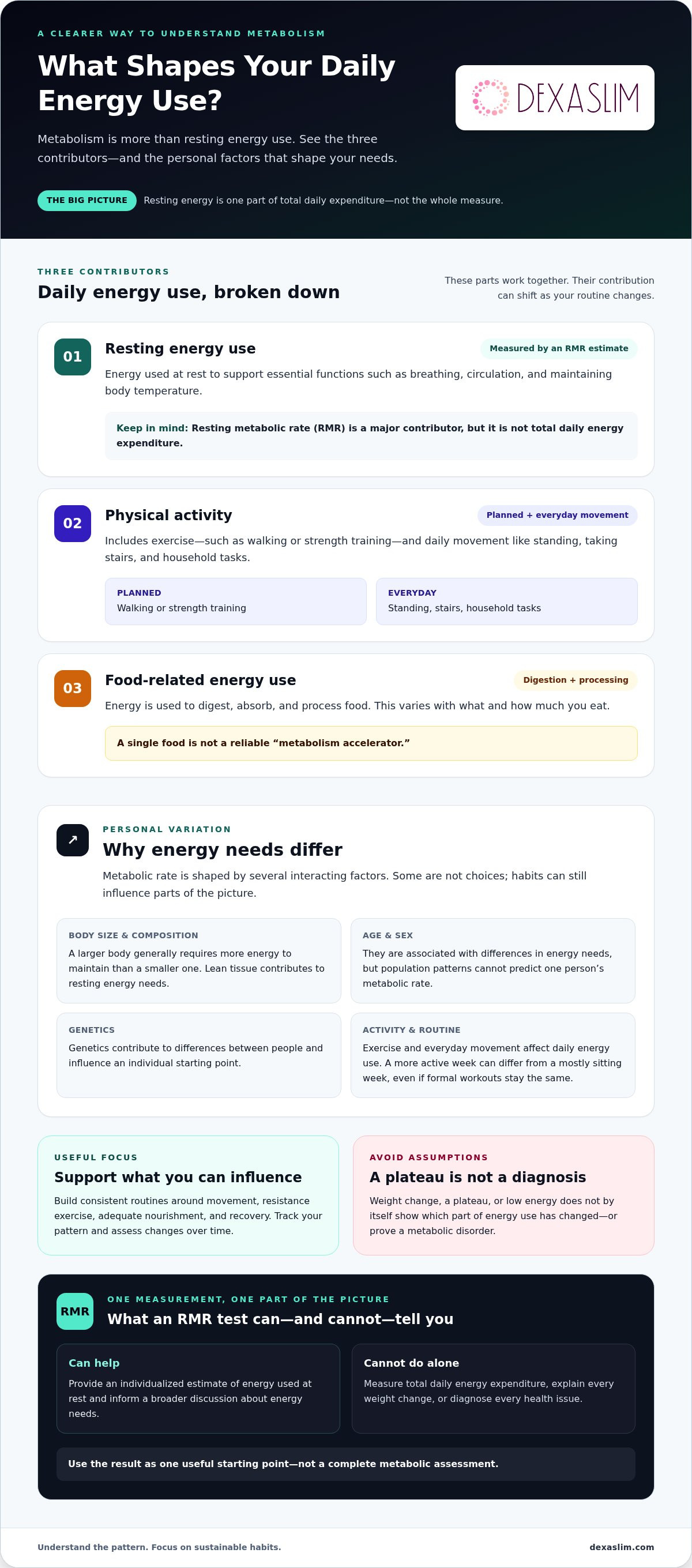
Metabolism is the body’s energy-processing activity, not a measure of how quickly you lose weight. Daily energy use has several parts: energy used at rest to maintain basic functions, energy used to digest and process food, and energy used for movement. Resting energy expenditure is only one part of the total. A plateau or a low-energy day can’t tell you which part has changed or whether your resting rate is unusual.
To add another perspective, watch this video on metabolism and weight-management advice:
What do people mean when they say their metabolism is slow?
Often, they’re describing an outcome: weight is changing, progress has stalled, or they feel tired. Those experiences matter, but none directly measures metabolic rate. Weight can shift with changes in food intake, movement, body composition, or other factors. Low energy can also have multiple explanations. Neither symptom nor body size alone proves a metabolic disorder.
A measured resting energy expenditure is different from a personal impression. It estimates energy used at rest under defined testing conditions. Even that result describes only one component of energy use. It doesn’t explain every weight change or identify every health issue. Treat “slow metabolism” as a question to investigate, not a diagnosis to assume.
Which parts of metabolism can change, and which cannot?
Age, genetics, body size and composition, and activity all influence energy needs. Some factors aren’t choices. Habits can still shape the picture: activity affects daily energy use, while changes in body composition can influence resting needs. These effects vary between people, so a generic promise to “reset” metabolism isn’t a sound plan.
So, how to fix a slow metabolism? Reframe “fix” as supporting health and refining habits, not forcing a dramatic or guaranteed metabolic shift. Build consistent routines around movement, nourishment, and recovery, then assess what changes over time. If weight changes or low energy persist or concern you, discuss them with a qualified health professional. The goal is a clearer understanding of your own pattern, not a quick boost based on guesswork.
What Determines Your Metabolic Rate? The Main Factors Explained
Your daily energy needs come from several interacting sources. Knowing which ones contribute helps replace vague “metabolism” claims with a clearer picture of what can be measured and what can be influenced. The Mayo Clinic’s overview of metabolism and weight loss also explains why resting needs are only one part of energy balance.
Resting energy use, movement, and digestion: how they differ
Resting metabolic rate (RMR) is the energy your body uses at rest to support essential functions such as breathing, circulation, and maintaining body temperature. It’s a major contributor to daily energy use, but it isn’t the whole picture. Resting metabolic rate is an estimate of energy used at rest, not a measure of total daily energy expenditure.
Total daily expenditure also includes:
Physical activity
Planned exercise, such as walking or strength training, plus everyday movement like standing, taking stairs, and doing household tasks.
Food-related energy use
The energy required to digest, absorb, and process food. This varies with what and how much you eat, but it doesn’t make any single food a reliable metabolism accelerator.
These components shift with your routine. A week with more walking or active chores may involve more movement-related energy use than a week spent mostly sitting, even if your formal workouts are unchanged. Compare your daily routines as well as your workouts when reviewing changes in activity.
How muscle, age, and individual variation affect energy needs
Body size and composition matter. A larger body generally requires more energy to maintain than a smaller one, while lean tissue contributes to resting energy needs. That doesn’t mean muscle alone determines RMR or that adding muscle produces a dramatic increase in daily calorie use. It does mean resistance exercise and adequate nourishment can help support muscle, especially during changes in weight or activity.
Age is associated with changes in energy needs, but the pattern isn’t identical for everyone. Shifts in body composition and activity can be part of the picture; age alone can’t predict an individual’s metabolic rate. Sex is another factor used in population-level estimates, partly because average body size and composition differ, but those averages aren’t a personal measurement.
Genetics also contribute to differences between people. They influence your starting point, not every outcome. Focus on factors you can track: body composition, daily movement, exercise, and recovery. If you’re refining how to fix a slow metabolism, start by understanding your own energy-use pattern rather than comparing it with someone else’s.
A Resting Metabolic Rate test can provide an individualized estimate of energy used at rest and help inform an energy-needs discussion. Use that data as one input, not a complete explanation of daily expenditure or a diagnosis.
Is a Slow Metabolism Really to Blame for Weight Gain or a Plateau?
A perceived slow metabolism isn’t the default explanation for weight gain or a plateau. Body weight reflects several interacting factors, including energy intake, daily movement, body composition, and changes in health or medication. A plateau is a signal to review the pattern, not proof that your metabolism is broken.
Start with variables that can shift over time. Portions, snacks, drinks, and meal routines may change without being obvious. Everyday activity can also drop when work, sleep, stress, or schedules change. As body weight and composition change, energy needs can shift too. These are possibilities to investigate, not assumptions about what caused your experience.
The scale also captures more than changes in body tissue. Fluid balance and ordinary measurement variation can move the number up or down over short periods. A single weigh-in can’t distinguish these shifts from a longer-term trend. Compare measurements taken under consistent conditions and look at the pattern over time, alongside changes in your routines and activity.
Why weight plateaus do not prove your metabolism is broken
As body weight changes, the energy required to maintain that body can change as well. A plan that once produced a change may no longer create the same energy balance. That doesn’t establish metabolic dysfunction. Intake estimates can also be imprecise, and small shifts in walking, standing, or planned exercise may affect overall activity.
Review your longer-term record before making a drastic adjustment. Note your weight trend, eating routine, movement, and any changes in medication or health. If you track weight, use a consistent method rather than reacting to an isolated reading. The goal is to identify useful context, not to judge yourself or pursue increasingly restrictive changes based on a few days of data.
When should you consider a medical conversation?
Arrange a conversation with a qualified clinician if weight changes persist without a clear explanation, or if you develop significant new symptoms. Medical conditions and medication effects can influence weight and energy, but their relevance depends on your individual history. A clinician can review that context and decide whether further assessment is appropriate.
Don’t stop or change a prescribed medication on your own, and don’t use symptoms as a self-diagnosis. Instead, bring a clear timeline: when the change began, how it has progressed, what has shifted in your routine, and any new concerns. That information gives a clinical discussion a stronger starting point than the label “slow metabolism.”
So, how to fix a slow metabolism isn’t the first question to answer when weight changes or progress stalls. First, separate short-term scale noise from a lasting trend, then review changes in intake, movement, body composition, medication, and health. Use clinical evaluation when the pattern is persistent or concerning. That sequence replaces guesswork with a more useful next step.
How to Support a Healthy Metabolism: A Sustainable Step-by-Step Plan
Lasting progress comes from repeatable habits, not a dramatic “reset.” The practical answer to how to fix a slow metabolism is to support the systems that influence daily energy use while paying attention to your own baseline. Build steadily, track a few useful signals, and adjust one habit at a time.
The safest general approach is to support muscle, movement, nutrition, and recovery.
Build a foundation with food, movement, and muscle
Start with the basics you can sustain. Avoid universal calorie targets and severe restrictions; nutritional needs vary, and crash diets can make it harder to maintain nourishing routines and lean mass. If weight management is your goal, focus on a balanced eating pattern that gives you enough nourishment to function and stay active.
Use this sequence to make the plan practical:
Establish your baseline.
For a short period, note your usual meals, daily movement, strength sessions, and recovery. Look for realistic opportunities, not reasons to blame yourself.
Choose one nutrition habit.
For example, plan regular meals or include a nourishing protein source in meals. Keep the change manageable rather than cutting out whole food groups without guidance.
Increase movement in a way you can repeat.
Add a walk, take the stairs when appropriate, or break up long periods of sitting. Everyday movement counts alongside planned exercise.
Include resistance exercise suited to your ability.
Strength training can help build or preserve muscle. Protecting lean mass can be especially relevant during weight-management efforts, but exercise should match your experience, health, and physical capacity.
Make the routine sustainable.
Keep the habits that fit your life and build from there. Don’t rely on supplements marketed as quick metabolism boosters; claims of dramatic results aren’t a substitute for consistent health behaviors.
Track recovery and adjust one habit at a time
Sleep and stress matter to overall health and can affect how manageable your routines feel. They aren’t metabolic switches. Aim for a recovery routine you can maintain, and notice whether poor sleep or high stress makes it harder to eat regularly, stay active, or complete planned exercise.
Measure behaviors and trends, not every detail. Track whether you’re moving consistently, whether strength exercises feel more manageable over time, and how body trends change across a longer period. Daily scale readings and calorie logs can be useful for some people, but they aren’t mandatory measures of success. Avoid letting short-term variation dictate a sudden restriction or punishing workout.
Change one variable, then give yourself time to see whether it fits before adding another. If you have a medical condition, take medications that affect eating or exercise, or are considering a major dietary or training change, get qualified guidance first. For an individualized estimate of energy use at rest, explore Resting Metabolic Rate testing as one source of context for an energy-needs discussion.
When an RMR Test Can Help You Personalize Your Next Step
General equations can estimate resting energy needs from factors such as body size, age, and sex. They offer a useful starting point, but they can’t capture every individual difference. A Resting Metabolic Rate (RMR) test provides another option: it measures resting energy expenditure under specified testing conditions, giving you an individualized data point instead of relying only on a population-based estimate.
What can a resting metabolic rate test tell you?
An RMR result estimates how much energy your body uses at rest. That information can support a more tailored discussion about energy needs, especially if a generic estimate feels like a poor fit. It’s one piece of the picture, not a verdict on whether your metabolism is “slow.”
RMR is not the same as total daily energy expenditure. Movement, exercise, digestion, and other daily demands contribute to total energy use beyond what the test measures. Neither a measured RMR nor a general equation sets an exact daily intake or guarantees a particular weight outcome. Results also need to be interpreted in context, rather than treated as a standalone diagnosis or explanation for every weight change.
For more detail on what the test measures and considerations around testing, see this Resting Metabolic Rate Test guide. Body composition can add useful context because lean mass and fat distribution relate to energy needs in different ways. A DEXA body composition scan can provide information about those measures.
Turn personal data into a responsible next step
Use the result to ask better questions, not to chase a perfect number. A clinician or qualified professional may consider RMR alongside your activity, body composition, eating patterns, goals, and health history. If your measured result differs from a general estimate, that difference is context for the discussion. It doesn’t establish a medical condition or automatically call for a specific diet.
Dexaslim offers RMR testing for people seeking a measured baseline. If you’re exploring how to fix a slow metabolism, an RMR result may help make energy-needs conversations more individualized, but sustainable habits and appropriate clinical evaluation still matter. The test does not promise weight loss or identify every possible cause of weight change.
Use measurement to reduce guesswork, then interpret it alongside the rest of your health picture. Explore Dexaslim’s testing options to learn more about measured health data.
Make Your Next Step Measurable
Progress starts with a better question, not a harsher plan. Instead of asking whether your metabolism is “broken,” decide what information would help you make a thoughtful next move. You might track a routine you want to strengthen, discuss persistent changes with a qualified clinician, or seek a clearer baseline before adjusting your approach.
Dexaslim offers Resting Metabolic Rate testing, DEXA body composition scans, and VO2 Max testing. Each can provide a different kind of personal data, but no single measurement explains every aspect of health or guarantees a specific outcome. Use results as context for informed decisions, not as a verdict on your body.
If you’re still wondering how to fix a slow metabolism, focus on what you can assess and sustain. Explore Dexaslim’s metabolic testing options to consider whether objective measurements could help inform your next step. Keep your expectations realistic, your decisions grounded in evidence, and your progress personal. You can move forward with clarity, one deliberate choice at a time.
Frequently Asked Questions
Can you permanently damage your metabolism by dieting?
Dieting doesn’t usually cause permanent metabolic damage, but prolonged or substantial weight loss can change energy needs. A smaller body requires less energy to maintain, and the body may also adapt to lower intake. For example, a meal plan that once led to weight loss may later produce slower progress. Avoid extreme restriction, and discuss persistent concerns or repeated cycles of restrictive dieting with a qualified health professional.
Does eating more frequently speed up your metabolism?
No. Eating more often doesn’t reliably increase total daily energy use enough to drive meaningful weight change when overall intake is similar. Meal frequency is mainly a preference and routine choice. For instance, someone who feels better with breakfast and lunch can choose that pattern, while another person may prefer smaller meals. Focus on a nourishing pattern you can maintain, rather than adding snacks to chase a metabolic effect.
Can drinking cold water meaningfully increase metabolic rate?
No, cold water isn’t a meaningful metabolism-boosting strategy. Your body uses some energy to warm what you drink, but that effect is small and temporary, not a substitute for regular movement or adequate nourishment. Drink water to meet your hydration needs and support normal daily function. Choosing cold water is fine if you enjoy it, but don’t expect it to create a noticeable or lasting change in body weight.
Is resting metabolic rate the same as basal metabolic rate?
They’re closely related measures, but the terms aren’t strictly interchangeable. Basal metabolic rate is measured under more tightly controlled conditions, after rest and fasting, while resting metabolic rate testing generally uses less restrictive conditions. Both estimate energy used for essential functions at rest. If you’re comparing results, check which measure was taken and how the test was performed; labels alone may not make two readings directly comparable.
Can caffeine or “fat-burning” supplements fix a slow metabolism?
No supplement can reliably fix a slow metabolism. Caffeine may cause a small, temporary increase in energy expenditure, but that doesn’t amount to a lasting solution. The FDA doesn’t approve dietary supplements for safety or effectiveness before they’re marketed, so “fat-burning” claims aren’t proof of benefit. Check ingredients and potential interactions with a qualified health professional, especially if you take medication or have a health condition.
How accurate are online metabolism calculators?
Online calculators provide estimates, not direct measurements. Their results depend on the information entered, such as age, height, weight, and activity level, as well as the equation used. If activity is difficult to classify or body composition differs from the formula’s assumptions, the estimate may not closely match your needs. Use a calculator as a planning reference, not a precise calorie prescription or a reason to make drastic changes.
Can metabolism change after illness, medication changes, or major weight loss?
Yes. Illness or medication changes can affect appetite, activity, fluid balance, or other processes that influence body weight and energy needs. Major weight loss can also reduce the energy required to maintain a smaller body. The cause and significance vary by person. If a change is persistent, unexplained, or follows a medication adjustment, discuss the timeline and your concerns with a clinician. Don’t stop or alter prescribed medication on your own.