

Your heart rate zone depends on how hard your heart is working relative to its maximum. For a starting estimate, subtract your age from 220, then use that maximum to map effort across five zones. The American Heart Association defines moderate-intensity exercise as 50%-70% of maximum heart rate, a useful reference point for heart rate training for endurance.
An age-based estimate alone can’t capture individual differences. Resting heart rate, workout intensity, and recovery patterns add context, helping you interpret the numbers rather than follow them blindly.
Learn how to estimate your zones, recognize what each effort level means, and use resting and recovery heart-rate data to track your response to training. This guide also explains how VO2 Max testing can help personalize your training zones, so you can build an endurance routine around measurable information.
Key Takeaways
• Use your estimated maximum heart rate to map effort across five zones, but treat age-based ranges as a starting point rather than a personal measurement.
• Build endurance by keeping easy sessions controlled; the talk test can help you recognize a sustainable aerobic effort.
• Track resting and post-workout heart rates over time to spot patterns in recovery and training response.
• Read monitor data alongside workout intensity and how you feel. One isolated heart-rate reading offers less insight than a consistent trend.
• Use VO2 Max testing to gain more individualized information about aerobic fitness and training zones.
Five heart rate zones and their intensity ranges
Five-zone training connects workout intensity to a percentage of maximum heart rate. Use the zones to distinguish easy endurance work from tempo and interval efforts.
Heart Rate Zone Intensity Ranges
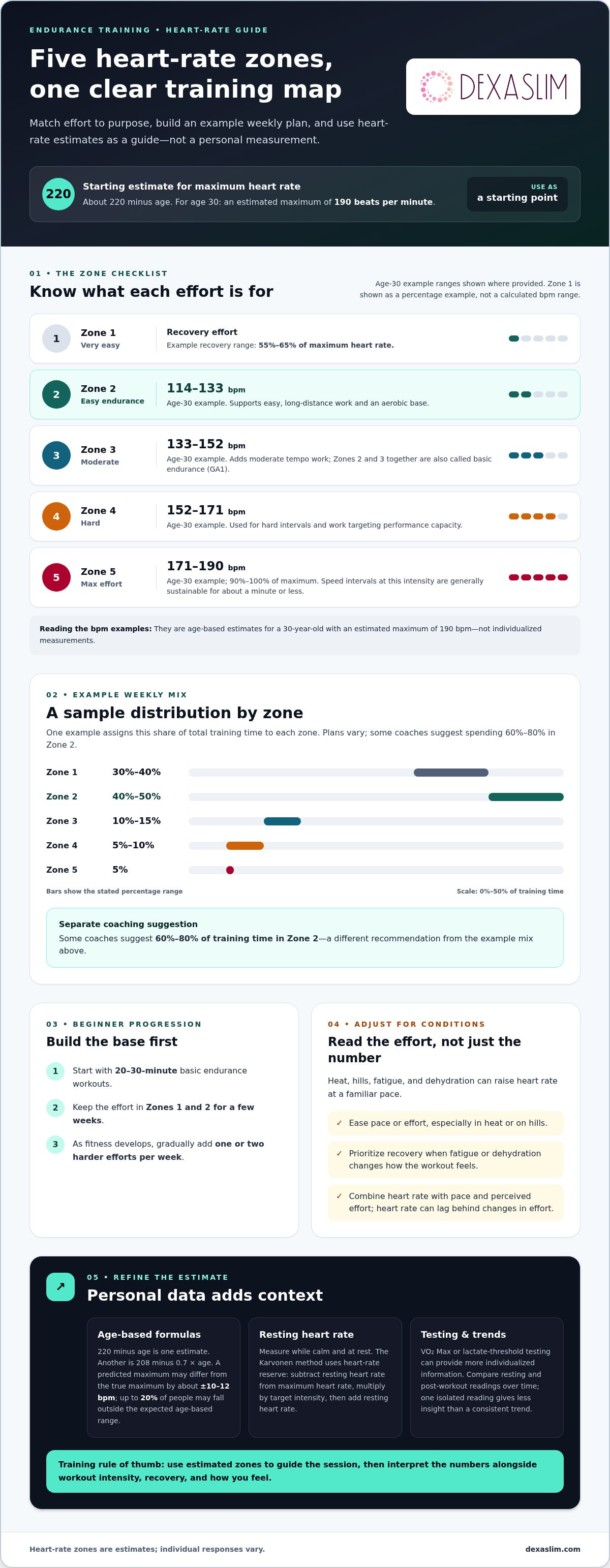
Heart rate zones classify effort, helping you match each workout to a fitness goal. In one age-based example, a 30-year-old with an estimated maximum of 190 beats per minute has a Zone 2 target of 114-133 beats per minute, Zone 3 of 133-152, Zone 4 of 152-171, and Zone 5 of 171-190.
Zone 2 supports easy, long-distance endurance; Zones 2 and 3 together are also called basic endurance training, or GA1. Zone 3 adds moderate tempo work, while Zone 4 supports hard intervals and Zone 5 max-effort speed work. Zone 1 is very easy recovery; an example recovery range is 55%-65% of maximum heart rate.
Calculating and Setting Personal Zones
Maximum-heart-rate calculations estimate your training bands, while testing can individualize them. According to the American Heart Association, maximum heart rate can be estimated as about 220 minus age; for a 30-year-old, that gives roughly 190 beats per minute. Multiply that estimate by each zone’s percentage to calculate a target range.
The Karvonen formula includes resting heart rate: subtract resting heart rate from maximum heart rate, multiply the result by the target intensity percentage, then add resting heart rate. For example, a 30-year-old with a resting heart rate of 45 has an example Zone 1 range of 118-132 beats per minute. VO2 Max testing can help tailor zones to individual performance.
How much weekly endurance training should be done in each heart rate zone? There’s no single distribution for every plan. One example assigns 30%-40% of training time to Zone 1, 40%-50% to Zone 2, 10%-15% to Zone 3, 5%-10% to Zone 4, and 5% to Zone 5; some coaches suggest 60%-80% in Zone 2.
How do I build an endurance heart rate training plan for beginners? Start with 20-30-minute basic endurance workouts, using Zones 1 and 2 for a few weeks. Then gradually add one or two harder efforts per week as fitness develops.
How should I adjust heart rate training for heat, hills, fatigue, and dehydration? These conditions can raise your heart rate at a familiar pace. Ease your pace or effort, especially on hills or in heat, and prioritize recovery when fatigue or dehydration affects how the workout feels.
Choose zones according to the goal: Zone 2 builds an aerobic base, Zone 3 develops moderate tempo fitness, and Zone 4 targets performance capacity. Age-based estimates are starting points; personal testing helps refine the target, particularly when your measured response differs from the predicted range.
How do I know what heart rate zone I'm in?
Compare your workout heart rate with an estimated maximum, then consider the result alongside your perceived effort. A formula offers a starting target, not a direct measurement of your personal threshold.
Estimating Maximum Heart Rate
Age-predicted maximum heart rate is an estimate used to calculate target zones. It matters because every zone range depends on that starting value. According to the American Heart Association, maximum heart rate can be estimated as about 220 minus age. The revised estimate, 208 minus 0.7 times age, offers another age-based calculation.
For a field estimate, one example test calls for running as fast as possible for 3 minutes, then resting for 3 minutes between hard runs. Stop if the effort feels unsafe. A lab VO2 Max test can help identify an individual maximum heart rate more accurately.
Limits of Heart Rate Zone Formulas
Heart rate formulas estimate intensity bands; they don’t directly measure your lactate threshold. An age-predicted maximum may differ from your true maximum by about ±10-12 beats per minute, and up to 20% of people may fall outside the expected age-based range. Because estimates can vary, calculated zones may not match your individual effort.
A lactate-threshold test can provide a more individualized reference for tempo and threshold work. Example training bands place tempo effort at 80%-85% of maximum heart rate and lactate-threshold work at 85%-88%. Treat formula-based targets as estimates, not precise personal thresholds.
How accurate are heart rate zone formulas compared with a lactate threshold test? Age-based formulas estimate zones and may miss your true maximum. A lactate-threshold test measures a more personalized effort marker, making it more useful for setting threshold-focused targets.
How do I estimate maximum heart rate and resting heart rate for training zones? Estimate maximum heart rate with the American Heart Association’s 220-minus-age method. Measure resting heart rate while calm and at rest, then use both values in a heart-rate-reserve calculation to set targets.
What are the risks of relying on heart rate alone during endurance training? Heart rate can lag behind changes in effort, so the reading may not reflect how demanding a hill or interval feels. Combine it with pace and perceived effort, and stop if you feel unwell.
Zone 5 targets 90%-100% of maximum heart rate and supports max-effort intervals for speed. This intensity is generally sustainable for about a minute or less before you need to slow down. Use personalized testing options to add measured aerobic data to your training targets.
Resting and recovery heart rate
Resting heart rate is your pulse while resting; recovery heart rate describes how it changes after exercise. Track both as separate signals. A resting rate commonly falls between 60 and 100 beats per minute, while endurance athletes can have rates in the 30s and 40s. Context matters: one reading can’t describe your full training response.
Measure your resting pulse under consistent conditions, such as after waking and before starting activity. Record the result with notes about sleep, stress, and the previous workout. Compare the pattern across days rather than reacting to a single reading. Endurance athletes often have resting rates below 50 beats per minute, but a low number alone doesn’t measure fitness or recovery.
Recovery heart rate offers another view of how your body responds after exercise. Note your pulse when you stop, then observe how it changes during recovery. Keep the activity and measurement conditions consistent: a hard interval session and an easy walk place different demands on your body. Look for trends alongside effort, not an isolated post-workout value.
Zone 1 is very easy active recovery, such as walking or slow jogging. Use it when the goal is gentle movement rather than another demanding workout. A 5-to-10-minute Zone 1 cooldown gives you a defined period to lower effort after harder activity. Keep the pace easy enough to maintain relaxed movement; don’t turn recovery into a hidden tempo session.
Recovery supports a sustainable training rhythm, but heart rate alone can’t identify an injury. Treat a change in your usual resting or recovery pattern as information to consider alongside workout intensity, fatigue, and how you feel. Pain or altered movement deserves attention even if your monitor looks normal. Heart rate measures performance, not injury.
Choose active recovery based on the demands of your previous session. After a demanding interval workout, opt for an easy walk or slow jog rather than repeating high-intensity effort. After light activity, your planned session may fit your routine. Use your heart rate zone to cap effort, then review your notes and recovery pattern before increasing training load. Consistent records make these decisions more objective.
For a practical log, record your resting pulse, workout type, perceived effort, and post-exercise response. Note stress or unusual daily demands for context. Compare similar sessions over time, not a hill workout with an easy walk. This helps distinguish everyday variation from a persistent shift and adjust activity before fatigue accumulates.
Aerobic base and endurance adaptations
Zone 2 training builds an aerobic base through sustained, controlled effort. Use heart rate, breathing, and workout duration together to keep the session aerobic. Heart rate training for endurance helps organize these signals around a clear purpose.
Building an Aerobic Base
Zone 2 is easy, long-duration exercise designed to develop endurance. The example aerobic training range is 65%-75% of maximum heart rate, but your personal target depends on your measured zones. During the session, you should be able to speak in short sentences without gasping.
Brisk walking faster than 2.5 miles per hour can count as Zone 2 cardio. Running, cycling, or walking can all fit if the effort stays controlled. Choose a pace you can sustain, then use your breathing and monitor reading to notice when hills or acceleration push intensity upward.
Build duration gradually. A weekly increase of 5%-10% in basic endurance workout time is described as realistic. Beginners can start with shorter sessions and extend them as the effort remains manageable. If your heart rate rises above your target at the same pace, slow down rather than forcing the planned speed.
Make consistency the priority. Many coaches suggest spending 60%-80% of training time in Zone 2 to build an endurance base. An example plan allocates 40%-50% to Zone 2, showing that schedules vary with training goals and structure. Use the distribution as a planning reference, not a fixed prescription.
Benefits of Aerobic Training
Aerobic training builds your ability to sustain movement at a controlled intensity. Over time, a lower resting heart rate or faster pace at the same heart rate can signal improved running fitness. Compare similar workouts and routes to make those changes meaningful.
Zone 2 also gives your weekly plan room for harder sessions by keeping easy days genuinely easy. For advanced endurance athletes, one long Zone 2 session per week can last an hour or more. Long, slow distance is a cornerstone workout because it extends time spent sustaining aerobic effort.
Keep the session’s purpose in mind. If conversation becomes difficult, reduce your pace, incline, or resistance until your breathing settles. Moderate effort should feel repeatable, not like a tempo test. Record duration, route, and heart rate to see whether the same effort produces a faster pace in later workouts.
Use heart rate zones to manage the balance between duration and intensity. Zone 2 supports steady aerobic work; adding speed every session changes the demand and can compromise the long-session goal. Heart rate training for endurance works best when you track pace at a familiar heart rate, then adjust future workouts gradually instead of chasing a single fast result.
Heart rate monitor data
A monitor creates a record you can compare across workouts. Read the number alongside pace, terrain, perceived effort, and recovery. Heart rate alone can’t explain why effort changed, but session context can help distinguish an easier pace from a steeper climb.
Start with a repeatable baseline. Measure your pulse while resting under similar conditions, then log the value with the date and relevant training context. If you’re checking manually, count beats for 30 seconds and multiply by 2 to calculate beats per minute. Use the same method each time so your comparisons stay consistent.
During a run or ride, watch how your heart rate responds to changes in effort. Note when you start, reach a hill, and ease back. For example, if your heart rate rises while your pace stays steady, check the route and how you feel before changing your target. Don’t treat one reading as a verdict on your fitness.
After exercise, record your immediate heart rate and how it changes during recovery. Compare similar sessions rather than a steep hill workout with an easy route. Patterns across repeated workouts are more informative than a single peak or drop. Note sleep, stress, and unusual fatigue to help interpret the data.
How do chest straps compare with wrist-based heart rate monitors for endurance training? They use different sensing methods, so compare their readings during the same type of workout and movement. Choose the monitor that gives you consistent, useful records for your activity, and interpret trends alongside effort and recovery.
Use monitor data to check whether your training zone suits the session’s purpose. If an easy run repeatedly feels demanding, reduce your effort and review the heart-rate pattern afterward. If the same route and pace feel easier over time, record the change. For athletes, a faster pace at the same heart rate can indicate improved running fitness.
Build a useful training log with a few consistent fields: activity, duration, route or terrain, heart-rate pattern, and perceived effort. Add resting and recovery observations when available. Review the entries together instead of chasing every fluctuation. This turns device data into a practical record for refining future workouts.
Pair heart-rate tracking with a clear metabolic baseline when planning fitness routines. A Resting Metabolic Rate (RMR) Test measures resting energy needs, adding context to how you calibrate daily caloric needs alongside training records.
Dexaslim: 1 Session Dexa Scan
Dexaslim’s 1 Session Dexa Scan provides body composition and bone density information, adding context to your broader fitness picture. It doesn’t measure heart rate zones. For endurance-specific insight, VO2 Max Performance Testing evaluates aerobic endurance, peak oxygen consumption, and cardiovascular efficiency, helping connect training data with performance. Choose the assessment that matches your goal: body composition and bone density, or aerobic performance. A Resting Metabolic Rate (RMR) Test can also help calibrate daily caloric needs alongside your training regimen. Use objective measurements to refine your fitness plan, then track how workouts respond over time. Contact Dexaslim to explore which assessment fits your goals.
Turn Training Data Into Your Next Step
Make your next training cycle a deliberate experiment. Set a clear performance goal, track how your body responds, and use that evidence to refine your approach. Heart rate training for endurance becomes more actionable when you interpret workout data alongside broader measures of fitness and metabolism.
Dexaslim offers a 1 Session Dexa Scan, VO2 Max Performance Testing, and a Resting Metabolic Rate (RMR) Test. Each can add a different perspective to your personal health picture, from body composition to aerobic performance and resting energy needs. The right starting point depends on the question you want your data to answer.
Bring your goals into focus, then build your next steps around information that matters to you. Contact Dexaslim to discuss your goals and take a confident step toward more informed training.
Frequently Asked Questions
Basic endurance training, what is behind it?
Basic endurance training develops the ability to sustain aerobic activity at controlled effort. Zones 2 and 3 together are often called GA1, but they feel different: Zone 2 supports easy, longer sessions, while Zone 3 adds moderate tempo work. Use the distinction to keep most base-building sessions comfortable and reserve faster efforts for workouts that specifically target tempo fitness.
How do I find my pulse or heart rate?
Feel for your pulse at your wrist or the side of your neck using two fingers, not your thumb. Count beats for 30 seconds and multiply by 2 to estimate beats per minute. For a useful resting reading, sit quietly before measuring and note the time and conditions. For workout tracking, use a monitor and compare readings from similar activities.
What are some examples of Zone 2 exercises?
Brisk walking, easy running, and steady cycling can all fit Zone 2 when the effort stays controlled. The right pace varies by person and activity, so use your zone estimate alongside breathing. You should be able to speak in short sentences without gasping. If a hill or faster pace makes conversation difficult, ease off until the effort settles.
Why should I take a heart rate test like VO2max?
A VO2 Max test measures peak oxygen consumption and evaluates aerobic endurance and cardiovascular efficiency. It can add individualized performance data when an age-based formula doesn’t reflect how your body responds during exercise. The results can help tailor heart rate training zones to your measured capacity. Use the data to make workout targets more specific, rather than relying only on a general estimate.
What are heart rate training zones for endurance, and how are they calculated?
Heart rate zones divide exercise intensity into five bands based on percentages of maximum heart rate. Estimate your maximum using age, then calculate each target as a percentage of that estimate. The Karvonen method also uses resting heart rate: subtract resting rate from maximum, apply the intensity percentage, then add resting rate. Both methods estimate targets; testing can make them more personal.
What heart rate zone should I use for long endurance workouts?
Use Zone 2 for long, steady endurance sessions. Keep the pace controlled enough to speak in short sentences without gasping, and reduce effort when hills push your breathing beyond that level. Advanced endurance athletes can include a long Zone 2 session lasting an hour or more. Match the session duration to your training experience and current plan.
How can I prevent overtraining and track progress with heart rate data?
Track resting heart rate, workout effort, and recovery as patterns rather than isolated readings. Compare similar routes and activities: a faster pace at the same heart rate can signal improved running fitness, while a lower resting rate may also indicate progress. Record stress and fatigue alongside training. If a session feels unusually demanding, reduce intensity rather than forcing the planned pace.