.svg)

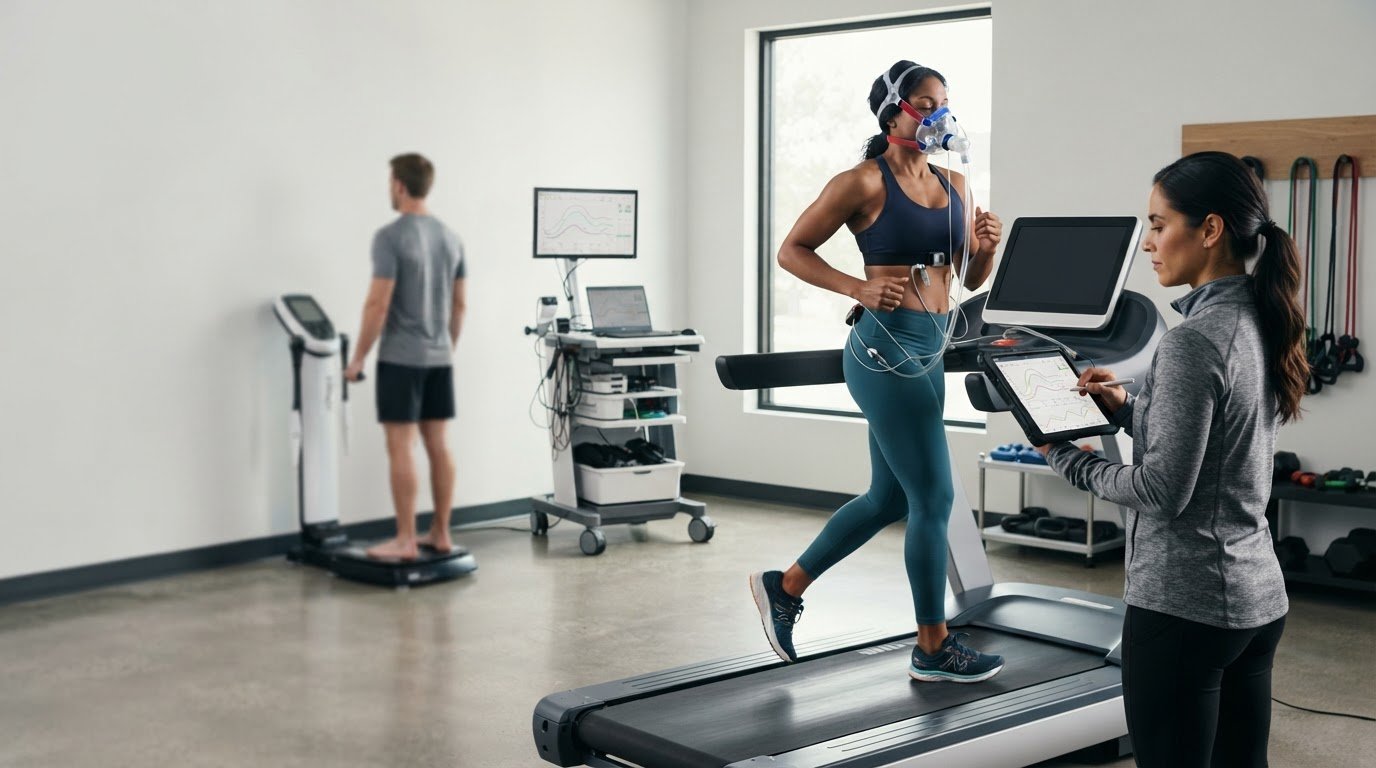
Could your training be working even when the scale barely moves? Data driven fitness testing looks beyond body weight to show what different measurements can, and cannot, tell you. The goal isn’t to collect more metrics. It’s to choose tests that answer useful questions, then use the results to make clearer decisions.
A generic plan may not reflect your starting point, and one unexpected result can make progress hard to judge. Different tests add different kinds of context: a DEXA scan assesses body composition and bone density, VO2 Max testing evaluates cardiorespiratory fitness, and a Resting Metabolic Rate test measures energy use at rest. None answers every question, so choosing the right test starts with knowing what you want to understand.
This article explains what common fitness tests measure, how to use a personal baseline to guide decisions, and how to track change without overreacting to a single result. You’ll also learn how DEXA, VO2 Max, and RMR testing can provide distinct inputs to a more informed fitness plan.
Key Takeaways
• Match each test to the question you want answered, whether it’s about body composition, aerobic capacity, resting energy use, or bone density.
• Use data driven fitness testing to establish a relevant personal baseline, not to chase every available metric.
• Interpret results in context. A measurement is one input to a decision, not a complete verdict on your fitness.
• Record testing conditions and relevant context so comparisons show trends rather than isolated fluctuations.
• Combine complementary measurements, such as DEXA, VO2 Max, and RMR testing, when your goals span distinct fitness domains.
What Is Data-Driven Fitness Testing, and Why Measure Beyond the Scale?
Data-driven fitness testing uses objective measurements to establish a personal baseline and inform fitness decisions. Rather than relying only on scale weight, visual impressions, or how hard a workout feels, it measures specific aspects of fitness that can be compared over time. The point isn’t to collect numbers for their own sake. It’s to select a measure that answers a question relevant to your goal.
A baseline gives you a reference for the area you want to understand. It can help you choose a focus and assess whether a change is relevant to your plan. But every result describes only the measure tested. It doesn’t represent total health or guarantee a particular outcome.
Fitness tests assess different components, each with a distinct purpose. The general overview of a Physical fitness test offers useful context: assessments examine selected capabilities rather than reducing fitness to one score. Choose a test based on the question you want answered, then interpret the result alongside your goals and relevant context.
What can a fitness assessment tell you?
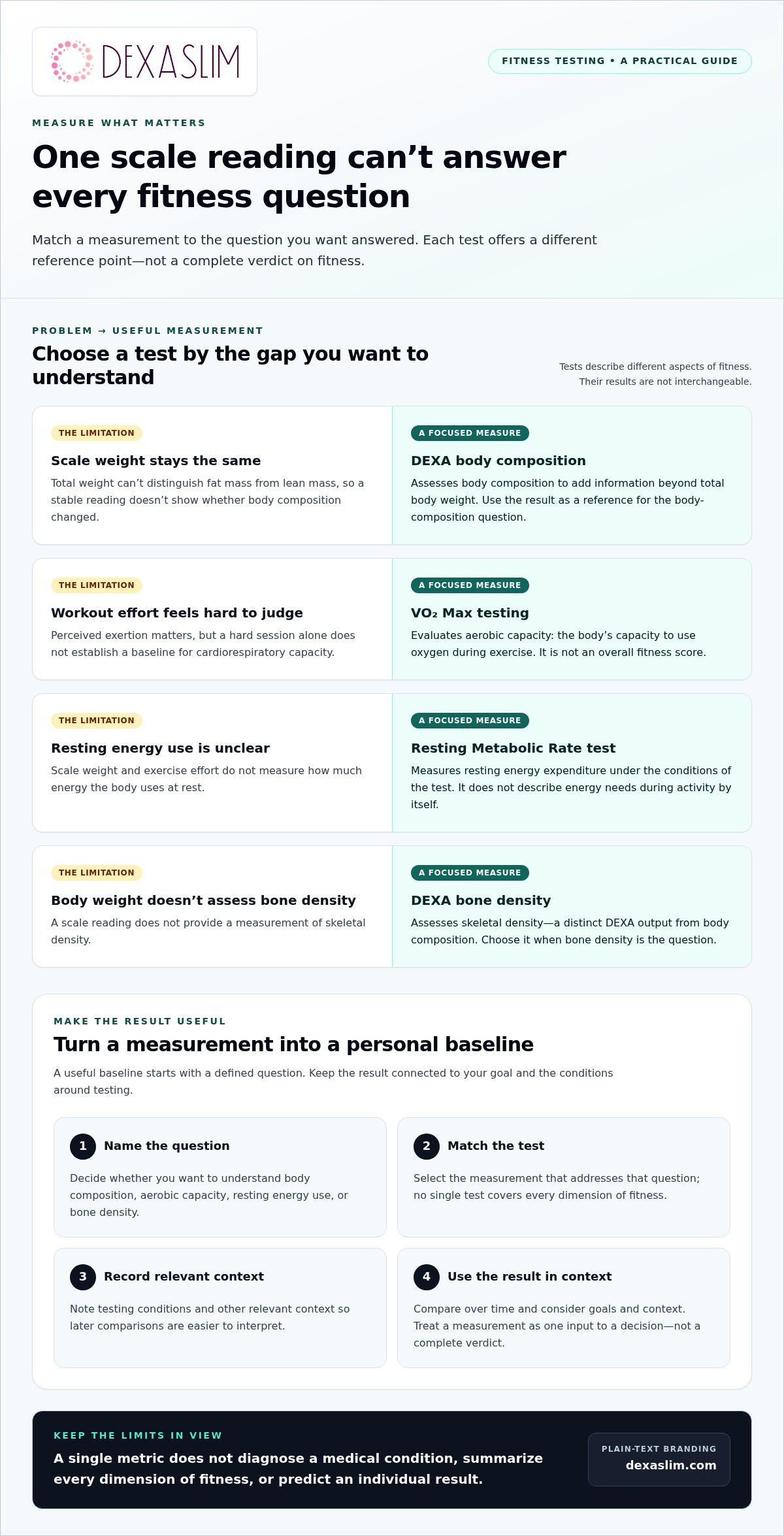
A DEXA scan assesses body composition and bone density. VO2 Max testing evaluates aerobic capacity. A Resting Metabolic Rate test measures energy expenditure at rest. These results aren’t interchangeable: they relate to body composition or skeletal density, cardiorespiratory capacity, and resting energy use respectively.
Start with the question, not the test. Do you want to understand body composition, assess aerobic capacity, measure resting energy use, or assess bone density? Your answer points to the relevant measurement. Then consider your goal and the conditions around testing. A result is most useful when you know what it measures and what it leaves out.
Why effort and scale weight are incomplete measures
The scale reports total body weight, but it can’t distinguish fat mass from lean mass. A stable reading therefore doesn’t tell you whether body composition has changed. Visual impressions have a similar limitation: they don’t quantify specific components or give you a consistent point of comparison. Use both as context, not as substitutes for a measurement suited to your goal.
Effort matters, but perceived exertion isn’t a direct measurement of cardiorespiratory capacity. Workouts that feel similarly demanding don’t necessarily reveal the same underlying capacity, and a hard session alone can’t establish a baseline. Objective testing adds a specific reference; your training experience helps put it in context.
Keep the limits of each measure in view. A single metric doesn’t diagnose a medical condition, summarize every dimension of fitness, or predict an individual result. The practical use of data driven fitness testing is to answer a defined question, establish a reference, and use that information as one input to a considered decision.
What Data-Driven Fitness Tests Measure: Body Composition, Capacity, and Metabolism
Fitness assessments are easier to interpret when each is tied to a specific question. A test may describe body composition, aerobic capacity, resting energy use, or bone density. These measurements can complement one another, but they don’t combine into a single verdict on fitness. First understand what an assessment measures, then interpret its output in light of your goal and the conditions around testing.
Use this comparison to connect a measurement with the question it can help address:
DEXA body composition
Assesses body composition. What does a scan show beyond total body weight?
DEXA bone density
Assesses skeletal density. What does the measurement indicate about bone density?
VO2 Max testing
Assesses aerobic capacity. How effectively can the body use oxygen during exercise?
Resting Metabolic Rate testing
Measures resting energy expenditure under test conditions. How much energy does the body use at rest during the assessment?
A measured output and its interpretation are not the same thing. A result describes a particular body-composition or capacity measure; what it means for training depends on your goals, baseline, and other relevant context. Keep the question focused, and don’t treat one result as a complete fitness score or a prediction of future performance.
Body composition, bone density, and DEXA
DEXA can assess body composition and bone density, which are related but distinct outputs. A body-composition result describes the makeup of the body, while a bone-density result concerns skeletal density. One doesn’t substitute for the other. For more detail on DEXA body composition scans and bone density scans, review the separate guides. Choose the assessment that matches the question you want answered.
VO2 Max and Resting Metabolic Rate testing
VO2 Max measures the body’s capacity to use oxygen during exercise, providing information about aerobic capacity rather than an overall fitness score. An RMR test measures resting energy expenditure under the conditions of the test; it doesn’t describe energy needs during activity by itself. Learn more about Resting Metabolic Rate testing and how to interpret its result in context.
Together, these assessments can provide distinct reference points without making any one test responsible for answering every question. If you’re considering body composition, aerobic capacity, or resting energy use, Dexaslim fitness testing can help you establish relevant data for your goals.
Which Fitness Test Fits Your Goal? Compare the Questions Each One Answers
Choose an assessment by identifying a decision you want to make. Understanding body composition calls for a different measurement than assessing endurance or resting energy use. This goal-first approach keeps data driven fitness testing focused: each test should add information relevant to your question, not simply another number to track.
Match the assessment to the question
For body composition, DEXA can assess tissue composition and provide information that total weight alone can’t. For endurance, VO2 Max testing evaluates aerobic capacity. It answers a different question than DEXA: not what the body is composed of, but its capacity to use oxygen during exercise. RMR testing measures energy expenditure at rest under test conditions. It can inform your understanding of resting energy use, but it isn’t a standalone calorie prescription.
| Goal | Relevant measurement | Question answered | Interpretation caveat |
|---|---|---|---|
| Understand body composition | DEXA body-composition assessment | What does tissue composition show beyond a change in total weight? | It describes measured body composition, not every factor affecting fitness. |
| Assess endurance capacity | VO2 Max testing | What does aerobic capacity indicate about oxygen use during exercise? | It isn’t a complete fitness score or a guarantee of future performance. |
| Measure resting energy use | Resting Metabolic Rate test | How much energy is expended at rest under test conditions? | It doesn’t prescribe calorie intake or represent energy use during activity. |
| Assess skeletal density | Bone density assessment | What does the measurement indicate about bone density? | It addresses skeletal density, not body composition or aerobic capacity. |
Know what a test cannot tell you
Every assessment measures defined factors under specific conditions. It doesn’t account for every influence on training or fitness, and one result can’t establish a complete health picture or guarantee future progress. Treat a measurement as a reference point, not a verdict.
Interpret results alongside factors that shape your day-to-day response, such as sleep, training history, nutrition, stress, and adherence. An aerobic-capacity measurement concerns a different domain than a body-composition result; neither explains on its own how consistently you train or recover. Context helps keep conclusions proportionate.
Combining assessments can add perspective when your goal spans more than one domain. For example, pairing a body-composition measure with an aerobic-capacity test provides information about distinct questions. More testing isn’t automatically better, though. Select measurements that can inform a decision you’re prepared to make, and treat the results as complementary inputs rather than an all-purpose score.
How to Turn Fitness Test Results Into a Useful Baseline
A result becomes useful when it connects to a clear goal and informs a measured next step. Define what you want to understand, establish a relevant baseline, adjust one training variable, then review the change. This gives each measurement a purpose and makes it easier to distinguish a meaningful pattern from a result that’s difficult to interpret.
Define a goal.
State the question you want to answer, such as whether aerobic capacity is changing or whether body composition is shifting.
Select a relevant baseline.
Choose a test that measures the area tied to your goal. Skip assessments that won’t inform a decision.
Make a focused adjustment.
Use the result to guide one relevant change to your training approach rather than changing several variables at once.
Review change.
Retest when the timing makes sense for the measure, goal, and expected pace of change. Compare the result with your baseline and note what else changed in the meantime.
This sequence makes data driven fitness testing a repeatable decision process. You don’t need to react to every result. Choose the clearest relevant signal, make a deliberate adjustment, and create a useful basis for review.
Prepare for a meaningful baseline
Before testing, follow the preparation instructions for that assessment. Requirements can differ, so don’t assume one routine applies to every test. Record context that could help explain the result later, including recent training, sleep, illness, or a change in your usual routine. Keep these notes with the measurement so you can refer to them when comparing results.
Consistent conditions make comparisons easier to interpret. Note relevant test conditions and use them as a reference for future assessments. If conditions differ, record what changed rather than assuming the results are directly equivalent. A simple log can help you avoid attributing every difference to your training plan.
Interpret change without overreacting
Compare like with like: review the same type of measure and check whether testing conditions were consistent. A single result is one data point, not proof of success or failure. If a number shifts unexpectedly, consider the context and your recent routine before making a major adjustment.
Retest timing should reflect what you measured and what you want to learn. A useful interval allows relevant change time to emerge, but no single schedule suits every assessment or goal. Use the clearest relevant signal to choose a focused next step, then observe how your training and results respond over time.
Dexaslim’s DEXA, VO2 Max, and Resting Metabolic Rate assessments provide distinct measurements for establishing a personal reference point. Explore Dexaslim assessment options to find testing that aligns with the question you want your baseline to answer.
How Dexaslim’s Fitness Testing Can Build a More Informed Picture
Once you’ve identified the fitness question you want to answer, select an assessment that measures that domain. Dexaslim offers diagnostic testing for body composition, bone density, cardiorespiratory performance, and resting energy expenditure. These measurements provide different kinds of information and can help establish a more informative starting point than scale weight alone. No single assessment gives a complete picture of fitness or guarantees a particular result.
A set of measurements for different fitness questions
DEXA scans serve two distinct assessment purposes: body composition and bone density. A body-composition scan can help answer questions about the body’s composition, while a bone density scan measures skeletal density. These outputs relate to different goals, so choose the one that matches what you want to understand.
VO2 Max testing assesses cardiorespiratory performance by measuring aerobic capacity. Resting Metabolic Rate testing assesses energy expenditure at rest under test conditions. Neither replaces the other: one focuses on capacity during exercise, the other on energy use at rest. Dexaslim also offers combined VO2 Max and DEXA testing for complementary measurements of aerobic capacity and body composition.
This is the practical value of data driven fitness testing: different assessments can clarify different parts of a fitness question without being treated as interchangeable. If your focus is endurance, a composition measurement won’t answer the central question. If you’re examining body composition, an aerobic-capacity result won’t show tissue distribution. Add a test only when it has a clear role in the picture you’re building.
Choose a clear next step
Write down the question you want your results to answer. Then choose the assessment that measures the relevant domain and use the result to inform your next decision. A measurement can help you refine what to track or how to approach training; it can’t promise a specific outcome or account for every factor affecting progress.
Keep your objective narrow enough to act on. You might want a body-composition reference, a measure of aerobic capacity, information about resting energy expenditure, or an assessment of bone density. You don’t need every test to begin. A relevant starting point is more useful than collecting data without a defined purpose.
Dexaslim offers testing across these distinct domains, including DEXA, VO2 Max, RMR, and combined VO2 Max and DEXA testing. Explore Dexaslim’s diagnostic testing and choose a relevant starting point for the question you want answered.
Make Your Next Fitness Decision More Informed
Your next step doesn’t need to be a complete testing plan. Start with one question that could affect how you train, then choose a measurement that can help answer it. That’s the practical advantage of data driven fitness testing: it turns a vague intention into a clear focus while leaving room to adapt as your goals and circumstances change.
Dexaslim offers medical-grade DEXA body composition and bone density scans, VO2 Max and Resting Metabolic Rate testing, and combined VO2 Max and DEXA testing. These are distinct ways to gather information, not promises of a particular outcome. A relevant baseline can help you decide what to track next and make your choices more personal.
Explore Dexaslim’s diagnostic testing and identify a starting point that fits the question you want answered. You don’t need every metric to move forward. Begin with the one that matters to you, then use what you learn to make your next decision with greater clarity.
Frequently Asked Questions
Can data-driven fitness testing tell me which workout to do?
No. Test results can inform your training priorities, but they don’t generate a complete workout plan. An aerobic-capacity result, for example, may help you decide whether endurance is a focus, while your available equipment, preferences, and recovery also shape the sessions you can follow. Use results alongside your training experience, then make a focused adjustment rather than treating a measurement as a command.
Is DEXA fitness testing useful if my weight is already stable?
It can be useful if your question concerns body composition rather than total weight. A stable scale reading doesn’t show whether body composition has changed, so a DEXA body-composition assessment may provide a different reference point. A DEXA bone density assessment may also be relevant if your goal concerns skeletal density. Choose the assessment based on the information you want, not on whether your weight is moving.
Can a smartwatch replace a clinical fitness test?
No. A smartwatch and a clinical fitness test serve different purposes. A wearable can help you observe day-to-day activity or monitor trends in the measures it tracks. A specific assessment, such as VO2 Max testing, evaluates a defined fitness domain in a testing setting. Use wearable data for ongoing context, but don’t assume it provides the same measurement or answers the same question as a clinical assessment.
How often should I repeat a fitness assessment?
There isn’t one retesting schedule for every measure or goal. Repeating a test is most useful when enough time has passed for the result to inform a decision, rather than simply produce another reading. Follow the assessment’s preparation guidance and note relevant conditions. If your routine or circumstances change substantially, record that context before comparing results.
Which data-driven fitness test should I start with?
Start with the question you most want to answer. Choose DEXA body-composition testing for a body-composition question, bone density assessment for skeletal density, VO2 Max testing for aerobic capacity, or RMR testing for resting energy expenditure. If you’re unsure which domain matters to your goal, write down the decision you want the result to inform. That makes it easier to select a relevant first measure.
Does a VO2 Max score measure my overall health?
No. A VO2 Max result measures a specific aspect of cardiorespiratory fitness, not every dimension of health. On its own, it can’t account for factors such as sleep, nutrition, stress, medical history, or other aspects of physical function. Treat the result as one piece of information about aerobic capacity. It isn’t a diagnosis or a complete summary of your health.