.svg)


What if a low bone-density scan is a starting point, not a final verdict? If you’re asking, “Can you rebuild bone density?” the evidence-based answer is that bone density can improve for some people. Results depend on what’s causing bone loss and which actions are appropriate for you.
A concerning scan can leave you wondering whether exercise, supplements, or medical treatment will make a difference. There isn’t a one-size-fits-all routine. The right plan may include weight-bearing and resistance exercise, adequate nutrition, addressing contributing factors, or clinician-prescribed medication.
This article explains what can support bone-density improvement, what may affect your progress, and why meaningful change takes time. You’ll also learn how clinicians use follow-up testing to assess trends and how a bone-density scan can establish a measurable baseline. Use the information to separate useful steps from guesswork, then build a plan with a qualified clinician that fits your fracture risk and can be tracked over time.
Key Takeaways
• Bone density can improve for some people, depending on the cause of bone loss and the plan used. A better scan result doesn’t automatically mean fracture risk is gone.
• Understand how bone remodeling works and which personal factors may shift the balance between bone formation and breakdown.
• Discuss the roles of strength and weight-bearing exercise, nutrition, supplements, and prescribed medication with a clinician before changing your routine.
• Build a measurable plan by discussing risk factors, possible causes, suitable actions, and follow-up timing with a qualified clinician.
• Use a bone-density scan to establish or monitor a baseline, not as a treatment or a guarantee of future improvement.
Can You Rebuild Bone Density? What Improvement Really Means
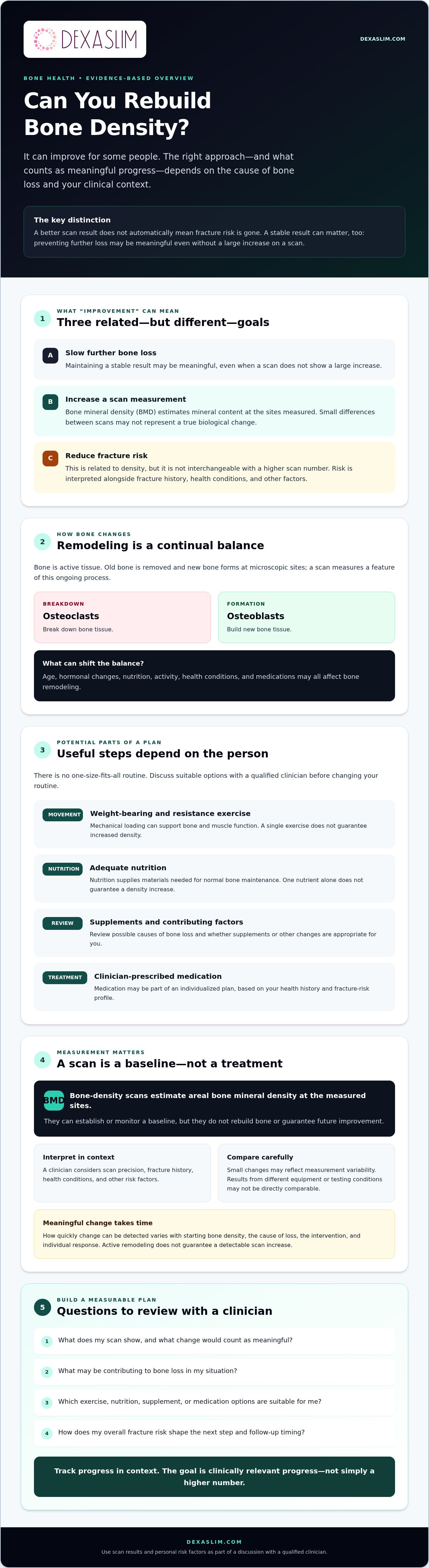
Yes, bone density can improve in some cases, but the outcome depends on why bone loss occurred and which interventions are appropriate. If you’re asking, “Can you rebuild bone density?” distinguish three possible goals: slowing further loss, increasing a scan measurement, and reducing fracture risk. These goals are related, but they aren’t interchangeable. Preventing additional loss can be meaningful even when a scan doesn’t show a large increase.
Bone change also takes time. A scan is a snapshot of a measured feature, not proof that bone has returned to a specific level or that fracture risk has disappeared. To understand what a change means, compare results in context rather than treating any shift as a definitive reversal.
For a visual introduction to strength training and impact exercise, watch this video from Rehab Science:
What does it mean to improve bone density?
Bone mineral density (BMD) is one measure of skeletal status. It estimates mineral content at the sites assessed, but it doesn’t capture every feature that contributes to bone strength. Bone is continually renewed through bone remodeling, a process in which old tissue is removed and new tissue forms. The balance can shift with age, hormonal changes, nutrition, activity, health conditions, and medications.
Bone-density improvement means a change in BMD that’s meaningful when considered alongside the test’s precision and your clinical context. Small differences between scans may not represent a true biological change. A clinician can interpret the measurements alongside your fracture history, health conditions, and other risk factors. A bone-density scan provides information for that discussion. It doesn’t rebuild bone or predict your individual outcome on its own.
Can osteoporosis be reversed?
There isn’t one outcome for everyone, and no plan can guarantee that osteoporosis will be reversed. The goals may be to slow bone loss, increase density, reduce fracture risk, or address more than one of these. Prognosis and treatment choices depend on a person’s health history and risk profile, so review results with a qualified clinician rather than relying on a scan number alone.
Start with the measurable facts: understand what your scan shows, clarify what change would count as meaningful, and ask how your overall fracture risk shapes the next step. A stable result can matter. The goal is progress that’s clinically relevant, not simply a higher number.
How Bone Remodeling Works and Why Density Changes at Different Rates
Your skeleton is active tissue, not a fixed structure. Through bone remodeling, old bone is resorbed and new bone is formed. Osteoclasts break down bone tissue, while osteoblasts build it. Biological signals and mechanical loading help regulate this cycle, but the balance can shift with age, health, and daily habits.
Remodeling happens continuously at microscopic sites, while a DXA scan estimates areal bone mineral density at the measured sites. A follow-up change is meaningful only when interpreted against the test’s precision and your clinical context. Active renewal doesn’t guarantee a detectable scan increase. Small differences can reflect measurement variability, and results from different equipment or testing conditions may not be directly comparable.
How formation and breakdown shape density
Bone responds to more than one input. Weight-bearing movement and resistance exercise create mechanical loading that can support bone and muscle function. Adequate nutrition supplies materials needed for normal bone maintenance. Neither a single exercise nor one nutrient guarantees increased density. For practical guidance on movement, nutrition, and safety, review Lifestyle modifications from NYU Langone Health.
The time needed to detect change varies. It depends on factors such as starting bone density, the cause of loss, the intervention, and the person’s response. A scan taken too soon may not show a clear trend. Follow-up timing should reflect clinical circumstances and the purpose of monitoring, rather than a universal schedule.
What can contribute to changing bone density?
Age-related changes, including the hormonal shifts associated with menopause, can alter the balance between resorption and formation. Low intake of nutrients important for bone health, limited physical activity, and some health conditions may also contribute. Certain medicines, including long-term use of some corticosteroids, can affect bone. Don’t stop or adjust a prescribed medicine on your own. Ask the prescriber to review its risks and possible alternatives in light of your bone health.
If bone loss seems unexplained or occurs alongside relevant symptoms or health history, a clinician may consider evaluating for secondary causes. That assessment is individualized. Connect your scan findings with your history, medications, and risk factors, then decide with a clinician whether further evaluation or a change in your plan is appropriate.
A bone-density scan can provide a baseline for that discussion, but it isn’t a treatment and can’t guarantee future improvement. If you need an objective measurement to discuss with your clinician, explore a bone density scan to establish or monitor a baseline.
Lifestyle Changes, Supplements, and Medication: What Can Help Bone Density?
If you’re asking, “Can you rebuild bone density?” think in terms of a coordinated plan, not one supplement or workout. Daily habits can support bone and physical function. Medication may be appropriate when fracture risk or medical history calls for it. Exercise and nutrition are valuable, but they don’t replace prescribed treatment when treatment is indicated.
Which daily habits support stronger bones?
Build activity around your abilities and fracture risk. Weight-bearing movement, such as walking, and resistance exercises can support bone, strength, and balance. Increase the challenge progressively, and ask a clinician or qualified exercise professional how to modify movements if you have osteoporosis, a prior fracture, pain, or balance concerns.
Prioritize a balanced diet with adequate calcium, vitamin D, and protein. Needs vary with age, diet, health, and other factors, so supplements aren’t automatically necessary. Review your intake and any supplement plan with a clinician, especially if you have health conditions or take medication. Avoid smoking and limit excessive alcohol as part of a broader bone-health strategy.
How do the options compare?
| Intervention | Potential role | Limitations | Discuss with a clinician |
|---|---|---|---|
| Weight-bearing activity | Loads bones and supports mobility. | Impact and intensity may not suit everyone. | Safe activities for your fracture and fall risk. |
| Resistance training | Builds muscle and supports strength and function. | Technique and progression matter. It isn’t a substitute for indicated treatment. | How to adapt exercises to your health and ability. |
| Food and supplements | Provides nutrients used in bone maintenance. | More supplements aren’t necessarily better. Needs vary. | Whether your intake is adequate and supplementation is appropriate. |
| Prescription medication | May reduce bone loss or, with selected therapies, stimulate bone formation. | Benefits, risks, and suitability differ by person. | How fracture history, risk, and medical factors shape choices. |
When might medical treatment be part of the plan?
A clinician weighs fracture risk, prior fractures, scan findings, health history, and other medical factors before recommending treatment. Options may include antiresorptive medicines, such as bisphosphonates, or bone-forming medicines for selected people at very high fracture risk. These treatments aren’t interchangeable, and the right choice is individual.
Supplements don’t replace assessment or prescribed osteoporosis treatment. Don’t start, stop, or change medication based only on a scan or online advice. Instead, review your options with a qualified clinician and agree on a plan that integrates safe activity, nutrition, treatment when appropriate, and follow-up measurement.
How to Build a Safe, Measurable Plan to Improve Bone Density
A reliable plan starts with your fracture risk, not a generic exercise or supplement routine. Ask a qualified clinician to connect your scan results with your health history, identify possible contributors to bone loss, and decide which actions make sense. If you’re wondering, “Can you rebuild bone density?” this sequence can help turn uncertainty into a plan you can monitor.
What should you discuss with a clinician first?
Bring any previous bone-density reports, your fracture history, a current medication and supplement list, and relevant health information. Ask whether your results or history suggest evaluating possible secondary causes, and whether medication or other treatment is appropriate. Discuss safe activity options too, especially if you’ve had a fracture, have diagnosed osteoporosis, or are concerned about falls. Don’t stop a prescribed medicine or begin high-impact exercise without guidance suited to your situation.
For broader information on what DEXA can assess, read this DEXA body composition scan guide. A body-composition assessment and a bone-density assessment are distinct. Confirm which measurements a particular scan includes before booking or interpreting results.
How can you tell whether the plan is working?
Agree on the purpose and timing of follow-up with your clinician. The right interval depends on your starting results, fracture risk, treatment, and whether another measurement would change clinical decisions. Frequent testing without a clear reason can add cost and uncertainty without making the plan more effective.
Compare results carefully. Ask whether scans used the same measurement sites and, when possible, the same equipment. Every measurement has some degree of precision error. A clinician can explain the facility’s precision and least significant change, the threshold used to judge whether a difference between measurements is likely to exceed expected measurement variability. A small shift alone may not prove that bone density has improved or worsened.
Track more than the scan number. Keep a record of agreed exercise and nutrition changes, medication use, side effects, falls, and fractures, then review these alongside follow-up results. This gives your clinician a fuller view of whether the strategy is working and whether it needs refinement.
For an objective starting point or a follow-up measurement to discuss with your clinician, explore a bone density scan. The scan provides information. It doesn’t treat bone loss or guarantee a particular outcome.
Use Bone Density Testing to Establish a Baseline and Guide Next Steps
If you’re asking, “Can you rebuild bone density?” a scan can help establish what your bone mineral density looks like now. It can’t rebuild bone, identify every cause of bone loss, or guarantee how your results will change. Treat testing as a measurement tool. It gives you and a qualified healthcare professional information to interpret alongside your health history and fracture risk.
What can a DEXA bone density scan tell you?
DEXA is an imaging-based method used to assess bone mineral density at the areas included in the scan. The resulting measurements can help inform an osteoporosis-risk evaluation, but they aren’t a complete picture of bone strength or your overall fracture risk. A scan also can’t determine on its own which treatment, if any, is right for you.
Interpretation depends on the scan report, the sites measured, relevant health information, and clinical assessment. Scan details and reporting can vary, so confirm what measurements and results information are included before testing. A clinician can explain what the findings mean for you and whether they should prompt further evaluation or a change in your care plan.
What are the next steps after a scan?
Use the result to start a focused conversation, not to make a treatment decision in isolation. Bring the report to a qualified healthcare professional and discuss:
• How the measurements relate to your health history and fracture risk.
• Whether possible contributors to bone loss need further evaluation.
• Which lifestyle steps or medical treatments may be appropriate for you.
• Whether and when follow-up testing could help assess change.
If you have an earlier scan, share its report too. Comparing results may help show a trend, but interpretation depends on factors such as measurement precision and whether the scans are appropriately comparable. Your clinician can help determine whether a difference is meaningful and whether another scan would guide a decision.
Dexaslim offers dedicated bone density scans using medical-grade DEXA technology to provide assessment data for a clinician-guided discussion. The scan is a measurement, not a treatment or a promise of improvement. If you want to establish a bone-density baseline, explore the bone density scan service and confirm which measurements and results information are included.
Turn Bone Health Uncertainty Into a Measurable Next Step
So, can you rebuild bone density? Sometimes, depending on the cause and the care plan. The more useful goal is to make informed decisions: understand your risk, choose actions with a clinician, and evaluate progress using appropriate measurements over time.
Bone health isn’t defined by a single scan result. A stable measurement may still matter, and any change needs interpretation alongside your history and fracture risk. Let objective information guide the conversation, not replace it.
Dexaslim offers dedicated bone density scans using medical-grade DEXA technology for bone-density assessment. A scan provides measurement data, not treatment or a guarantee of improvement. Use the results to support a discussion with a qualified healthcare professional about what comes next. Explore Dexaslim’s bone density scan to establish objective data for your next clinical conversation.
Clear information gives you a stronger starting point. Take the next step with purpose, and build a plan you can review and refine.
Frequently Asked Questions
Can you rebuild bone density naturally?
Bone density may improve naturally for some people, but lifestyle changes don’t guarantee a measurable increase or remove fracture risk. Progressive weight-bearing activity and resistance training, adequate nutrition, and avoiding smoking can support bone health. Calcium and vitamin D are important, but supplements are useful only when appropriate for your needs. If you have osteoporosis, a fracture history, or a concerning scan, discuss your plan with a qualified clinician instead of relying on lifestyle changes alone.
How long does it take to improve bone density?
There’s no universal timeline. Bone remodeling is continuous, but a change large enough to detect on a scan may take time and depends on your baseline, the cause of bone loss, your health, and the intervention. Don’t judge results by frequent scans or short-term expectations. Ask your clinician when follow-up testing could provide useful information, and compare results with measurement precision in mind.
Can exercise increase bone density after menopause?
Exercise can support bone health, strength, and balance after menopause, though it may not increase bone density for everyone. Menopause-related hormonal changes can affect bone loss, so adapt weight-bearing activity and resistance training to your health and fracture risk. If you have osteoporosis, a past fracture, pain, or balance concerns, ask a clinician which movements are safe before adding impact or increasing intensity.
Do calcium and vitamin D supplements rebuild bone density?
Calcium and vitamin D support normal bone health, but taking supplements doesn’t automatically rebuild bone density. Whether you need a supplement depends on your diet, health, and individual circumstances. Food may provide some or all of your needs. Ask a clinician to review your intake and medications, especially before starting supplements. Supplements shouldn’t replace assessment or prescribed osteoporosis treatment.
Can osteoporosis be reversed with medication?
Medication can reduce bone loss, lower fracture risk, or help increase bone formation, depending on the drug and the person. That doesn’t mean every case of osteoporosis can be fully reversed or that fracture risk disappears. Clinicians consider scan results, fracture history, overall risk, and medical factors when selecting treatment. Ask what goal your medication is intended to address and how your response will be monitored.
How do you know if your bone density is improving?
A follow-up bone-density scan may help show whether measurements have changed, but a small difference isn’t automatically meaningful. Ask how scan precision and the least significant change apply to your results. Your clinician should consider measurements alongside fracture history, risk factors, and treatment response. A stable result may also be useful if the goal is to prevent further loss, even without a clear increase.
Can a DEXA scan show whether bone density has changed?
Yes. Comparing DEXA results over time can show a change in measured bone mineral density, provided the scans are suitable for comparison. Measurement sites, equipment, and precision matter, so have a clinician review both reports rather than comparing numbers in isolation. A DEXA scan provides assessment data. It doesn’t explain every cause of bone loss, treat it, or guarantee future results.