
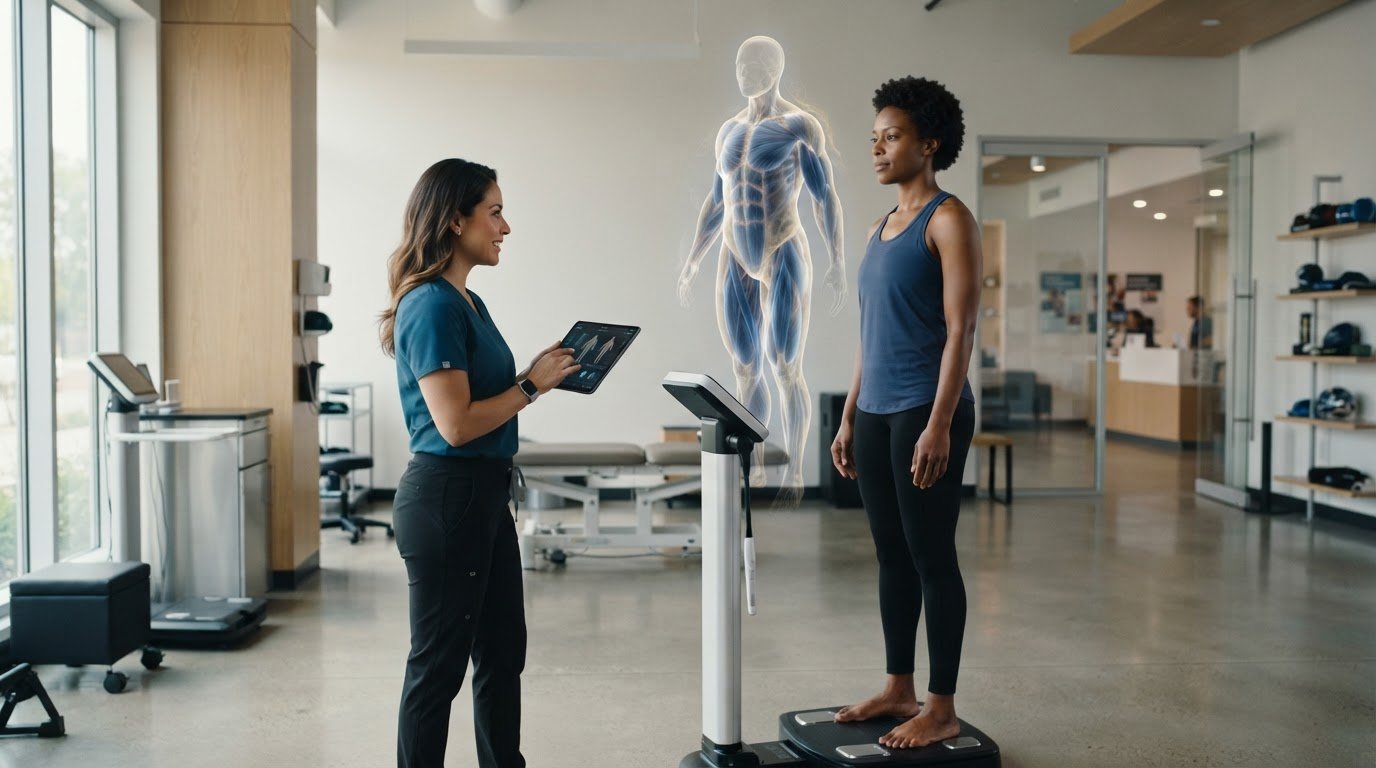
A lower number on the scale doesn’t automatically mean better athletic performance. Body composition testing for athletes measures how body weight is distributed between fat mass and fat-free mass, which includes muscle, bone, water, and other tissues. The result adds useful context to weight alone, but it isn’t a score of athletic potential.
It makes sense to want clear, objective data when training, nutrition, or body weight changes. The key is interpreting that data in context: sport, performance goals, health, and measurement method all matter. A single body-fat percentage does not define an ideal athlete’s body.
Learn what body composition measures, how common assessment methods work, and what their results can and cannot tell you. This guide explains how to interpret athlete body-fat ranges and why BMI cannot distinguish fat from muscle. Use measurements to understand your body, not to chase a number at the expense of performance or health.
Key Takeaways
• Body composition adds context to body weight by showing how fat mass and fat-free mass contribute to an athlete’s build.
• DEXA, bioelectrical impedance, skinfolds, and other methods estimate body composition in different ways, so results are best compared using a consistent approach.
• Use body-fat ranges as context, not targets. Sport, health, and individual performance goals all influence what a result means.
• BMI can’t separate muscle from fat, so it may not fully describe an athlete’s body composition.
• Measure with a clear purpose and interpret results alongside performance and health, rather than reacting to a single number.
What does body composition mean?
Body composition describes how body weight is divided between fat mass and fat-free mass. For athletes, results commonly report body-fat percentage and fat-free mass, which includes muscle, bone, water, and other cells and minerals.
Body Composition and Athletic Performance
Body composition relates to performance by showing how much of an athlete’s body weight comes from different tissues. This helps put weight changes in context: a change in muscle mass may matter differently from a change in total weight. A review of 29 studies found that increases in muscle mass were consistently related to better athletic performance.
Use the result alongside sport-specific performance metrics, not as a substitute for them. An endurance athlete might track pace, exercise capacity, and VO2 max; a strength athlete might focus on load lifted and power. VO2 Max Performance Testing measures aerobic performance, adding a separate data point rather than a body-composition estimate.
Body Fat and Performance
Body fat is both an energy reserve and a functional part of the body, so reducing it does not automatically improve performance. Fat can contribute to energy use during exercise, particularly during endurance activity.
The amount and distribution of body fat can matter, but so can the cost of losing it. Pushing body fat below an athlete’s natural range can disrupt hormones, increase fatigue and injury susceptibility, and compromise immune function. A leaner result alone does not show that athletic performance has improved.
Testing has several potential uses. Among 43 responses about why body composition is measured in athletes, 44% cited routine measurement of performance-related variables, 33% cited tracking the outcome of specific body-composition changes, and 23% cited health monitoring. These are reported reasons, not proof that testing improves performance.
Organizations such as the NCAA and NFL may use body-composition data to monitor athlete status, evaluate changes, or inform performance discussions. These figures do not establish a universal policy for either organization; their use and interpretation depend on the sport and the athlete’s circumstances.
Interpret results with the athlete and appropriate health and performance professionals, such as sports dietitians or sports physiologists. The International Olympic Committee recommends that multidisciplinary teams prescreen athletes for risks such as eating disorders before testing. Consider nutrition, training demands, position, and health status, especially when an athlete is thinking about changing weight or body fat.
For a fuller performance picture, compare body-composition results with outcomes that directly reflect the sport. Strength, speed, endurance, and VO2 max can show whether a change in estimated body composition aligns with what the athlete can do. Treat measurement as context for decisions, not a verdict on athletic potential.
Body composition assessment methods
Each assessment method estimates body composition using different measurements or assumptions. Keep the method’s limitations in mind when comparing results, particularly when tracking changes during training.
DEXA, BIA, and body density methods
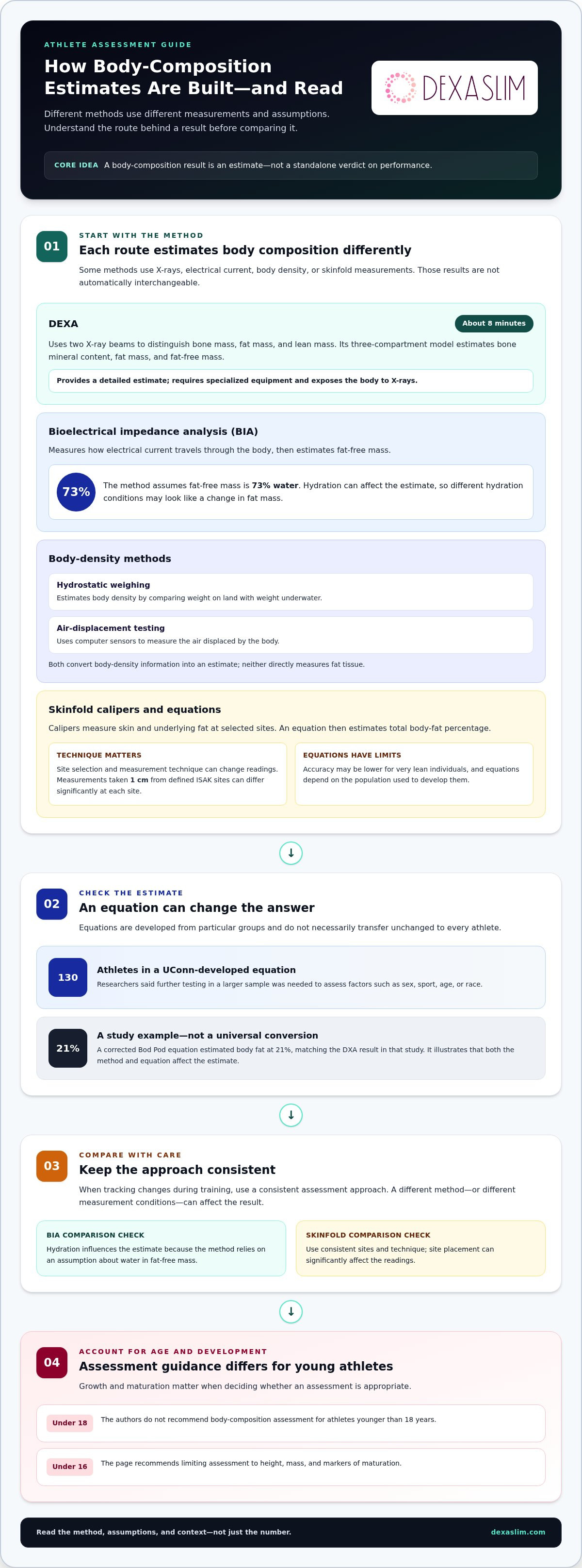
DEXA uses two X-ray beams to distinguish bone mass, fat mass, and lean mass. Its three-compartment model estimates bone mineral content, fat mass, and fat-free mass. A full-body DEXA scan takes approximately eight minutes. It provides a detailed estimate but requires specialized equipment and exposes the body to X-rays.
Bioelectrical impedance analysis, or BIA, estimates fat-free mass by measuring how electrical current travels through the body. The method assumes that 73% of fat-free mass is water. Hydration can therefore affect the estimate. A reading taken under different hydration conditions may not represent a true change in fat mass.
Hydrostatic weighing estimates body density by comparing a person’s weight on land with their weight underwater. Air-displacement testing uses computer sensors to measure the air displaced by the body. Both methods convert body-density information into an estimate of body composition rather than directly measuring fat tissue.
Skinfold measurements and equations
Skinfold calipers measure folds of skin and underlying fat at specific body sites. An equation then estimates total body-fat percentage from those measurements. Site selection and technique matter: measurements taken one centimetre from defined ISAK sites can differ significantly at each site.
Skinfold assessment is less accurate for very lean individuals. Equations also depend on the population used to develop them. UConn researchers developed an equation using data from 130 athletes, but said further testing in a larger sample was needed to assess effects such as sex, sport, age, or race.
A corrected Bod Pod equation produced a body-fat estimate of 21%, matching the DXA result in the study. That example illustrates why estimates depend on both the measurement method and the equation applied. It does not make equations interchangeable across athletes.
Age-appropriate assessment
For athletes younger than 18 years, the authors do not recommend body-composition assessment. For players under 16, the page recommends limiting assessment to height, mass, and markers of maturation. These approaches distinguish growth monitoring from adult-style body-fat estimation.
Age and development should inform the choice of assessment, particularly for female athletes whose bodies may still be changing. An estimate based on an adult method can distract from maturation and training context. For adult athletes, choose a method suited to the decision at hand and use it consistently when comparing future results.
Body composition measurement practices
Reliable sports science depends on repeatable measurements, not a single body-fat estimate. Standardize the method, technique, and timing so results reflect meaningful change rather than inconsistent testing.
Measurement Accuracy and Limitations
Accuracy depends on the method, the practitioner’s technique, and consistency across assessments. Skinfold calipers estimate total body fat from measurements at specific sites, and the method is less accurate for very lean athletes. According to UC Davis Sports Medicine, skinfold testing can predict body fat within plus or minus 3%.
Precision starts with correct site placement. Measurements taken one centimetre from defined ISAK sites have produced significant differences at each site. For ISAK anthropometric qualification, practitioners must report values within 10% of a Level 4 anthropometrist and repeated measurements within 7.5% of their own values.
Preparing for Testing
Keep conditions consistent around each assessment so comparisons are meaningful. Use the same measurement method and, when possible, the same trained practitioner. Record relevant context, such as recent training, and interpret results alongside the athlete’s routine rather than in isolation.
For skinfold testing, the practitioner should use defined ISAK sites and repeat measurements consistently. A one-centimetre shift can change readings, so accurate site location matters. With BIA, hydration can affect the estimate because the calculation relies on assumptions about body water.
Measurement Frequency
Frequency should match a clear purpose, such as tracking a planned body-composition change. Assessments are typically repeated every 8-12 weeks; testing more often can make short-term fluctuations harder to distinguish from meaningful trends.
The authors state that assessments exceeding 4-6 times per year are likely unnecessary, and the International Olympic Committee recommends testing as infrequently as possible. The IOC also advises testing only when there is a clear rationale and a benefit to the athlete. Avoid using one result as a permanent benchmark.
Apply these principles to every assessment: use a consistent method, document conditions, and compare trends instead of reacting to one reading. The International Olympic Committee and UEFA caution against using a single body-composition value as a benchmark. The IOC also recommends treating results as protected health information and obtaining the athlete’s consent before sharing them.
When interpreting skinfold changes, account for the method’s margin of error. A small shift may reflect site placement or technique rather than a real change in fat mass. For a sports team, align the assessment plan with the athlete’s goals and involve appropriate health and performance professionals. This keeps testing focused on useful decisions rather than frequent data collection.
Body-fat percentage ranges for athletes
A body-fat percentage range is a reference point, not a universal performance target. The range that fits one athlete may not fit another because sport, position, sex, and measurement method all affect interpretation. Use ranges to inform a sports medicine discussion, not to judge athletic potential from one estimate.
The American Council on Exercise lists athlete ranges of 6-13% for men and 14-20% for women. These broad categories offer general context, not a required percentage for every sport. A result within either range doesn’t establish that an athlete is optimally prepared, while a result outside it doesn’t by itself determine health or performance.
Sport-specific examples show why broad ranges need context. A professional football dataset included 343 Premier League and English Football League players and 939 DXA scans across 10 years. Body-fat percentages typically ranged from 11.6% to 15.4%, depending on position, ethnicity, and league. Values below 10% were rare in that dataset. Those findings describe those players, not a target for every athlete.
Examples from other sports vary. The listed body-fat range for male bodybuilders is 5-8%, while female bodybuilders are listed at 10-15%. Male marathon runners are listed at 5-11%. Cross-country skiers are listed at 7-12% for men and 16-22% for women. These differences demonstrate that sport-specific demands and athlete characteristics shape the numbers used for comparison.
Approximate safe minimum body-fat levels are listed as 5% for males and 12% for females. Treat these as cautionary reference points, not goals to approach. Pursuing an extremely low percentage can have physiological consequences, particularly when it falls below an individual’s natural range. The effect of a low result should be assessed alongside health, training, and nutrition, rather than judged by the percentage alone.
To interpret a result, first identify the reference group: does it match the athlete’s sex, sport, and position? Then consider how the measurement was made. Different methods estimate body fat differently, so comparisons are strongest when the method stays consistent. Finally, review the result alongside performance and health measures; a number alone cannot show whether a change in body composition benefits the athlete.
Athletes do not need to pursue one ideal body-fat percentage to succeed in sport. A position-specific comparison for a football player may offer useful context, for example, but it cannot set a personal target for a distance runner. Use ranges to support informed discussion, not to rank athletes or prescribe fat loss. A qualified sports medicine professional can interpret the percentage in relation to the athlete’s physiology and goals.
BMI and body fat
BMI compares a person’s weight with their height squared. It can flag body size for screening, but it does not distinguish muscle, bone, and fat. This limitation matters in sport: an athlete with substantial muscle mass may have a higher BMI without a high body-fat percentage. BMI alone cannot determine body composition or physical ability.
Adult BMI categories apply to adults over 20 years old. Even within that age group, the categories don’t reveal how much of a person’s weight is fat tissue versus lean tissue. A muscular athlete and an athlete with less muscle can share a BMI while having different body-fat levels. Use BMI as one broad measure, not a direct estimate of body fat.
Research examining body fat in athletes illustrates why the measures shouldn’t be treated as interchangeable. One study examined 826 American elite athletes. That sample size identifies the population studied; it doesn’t turn BMI into an individual body-fat test. To understand a particular athlete’s composition, consider a method that estimates fat mass and fat-free mass directly.
For example, the worked case of a male athlete with 12% body fat shows that body-fat percentage describes a different feature from BMI. The percentage estimates the share of body weight made up of fat. BMI reflects weight relative to height. A coach or athlete should not infer one value from the other, or assume that a higher BMI means excess fat.
Performance measures add another layer. VO2 max is often expressed relative to body weight in milliliters per minute per kilogram, while cycling FTP is often expressed as watts per kilogram. These metrics account for body weight in their own calculations. They still measure performance capacity, not body-fat percentage, and a change in weight can affect the ratio without explaining the underlying tissue change.
Interpret the measures together. If BMI rises while strength improves, the athlete may have gained muscle, but BMI alone can’t confirm that explanation. If an endurance athlete’s weight changes, consider whether relative VO2 max or watts per kilogram also shifts. Pair those performance indicators with a body-composition assessment when the decision depends on distinguishing fat mass from muscle mass.
For a direct body-composition measurement, Dexaslim’s 1 Session DEXA Scan can help athletes look beyond BMI and assess body composition using DEXA technology.
Survey respondents emphasizing body-fat percentage in athlete assessments were 68% in 2013 and 46% in 2022. Testing may help endurance athletes prone to injuries or with low bone density assess whether body fat is too low for proper functioning.
Dexaslim: 1 Session Dexa Scan
Dexaslim’s 1 Session Dexa Scan gives athletes a medical-grade DEXA assessment of body composition and bone density. It can add a more detailed baseline when weight or BMI alone doesn’t show how body mass is distributed. Use the results as context for performance and health discussions, not as a standalone target.
Choose measurements that match your question. A DEXA scan focuses on body composition, while VO2 Max Performance Testing evaluates aerobic performance. A Resting Metabolic Rate (RMR) Test provides another data point for understanding energy needs. These assessments answer different questions, so select based on the information you want to measure.
For a clearer view beyond the scale, contact Dexaslim to discuss a 1 Session Dexa Scan.
Turn measurement into a performance decision
Make your next step a clear decision, not another number to chase. Before scheduling body composition testing for athletes, decide what you want the result to inform: a training adjustment, a health discussion, or a more complete performance baseline. That purpose determines which measurements are useful and how to interpret them over time.
Connect the data to your own priorities. Consider how training feels, whether performance is changing, and what questions you still have about body composition. A measurement is useful when it supports a thoughtful action, not when it creates pressure to match someone else’s range.
If you’re ready to discuss a measurement that fits your goals, contact Dexaslim to discuss testing. Take the next step with a focused question and use the resulting information to guide your progress with confidence.
Frequently Asked Questions
What body composition tests are available for athletes?
Common options include DEXA, bioelectrical impedance analysis, Bod Pod, hydrostatic weighing, and skinfold measurements. The right choice depends on the question. Athletes tracking changes over time need consistent, comparable measurements, while those assessing fat distribution may value a detailed scan. For instance, a coach monitoring a training block should prioritize repeatability over switching methods between assessments.
How accurate are DEXA, Bod Pod, skinfold, and bioelectrical impedance tests?
No method provides a perfect, interchangeable measurement. DEXA distinguishes bone, fat, and lean tissue using X-rays; Bod Pod estimates body composition through air displacement. Skinfold results depend on caliper placement and practitioner technique, while bioelectrical impedance is affected by assumptions about body water. Treat each result as an estimate, and compare follow-up measurements using the same method and consistent procedures.
Which body composition test is best for athletes and sports performance?
The best test depends on the decision you need to make. Choose a method that answers your body-composition question, then pair it with a performance measure relevant to your sport. An endurance athlete, for example, could compare composition data with aerobic capacity, while a strength athlete could review it alongside strength performance. Composition results describe the body; they do not directly measure sporting ability.
What body fat percentage ranges are typical for athletes by sport and sex?
The American Council on Exercise lists athlete ranges of 6-13% for men and 14-20% for women. Sport-specific references differ: the ranges reported for male marathon runners and female cross-country skiers aren’t the same. Treat these figures as comparison points, not prescribed targets. A useful interpretation considers the athlete’s sport, position, health, and measurement method rather than applying one range to everyone.
What are the risks and limitations of body composition testing?
A result can be misused if it prompts extreme leanness or becomes a measure of an athlete’s worth. The International Olympic Committee recommends prescreening for risks such as eating disorders and treating results as protected health information, with consent before sharing. Testing also has limits: estimates vary by method, and a single result cannot establish whether an athlete is healthy or performing well.