

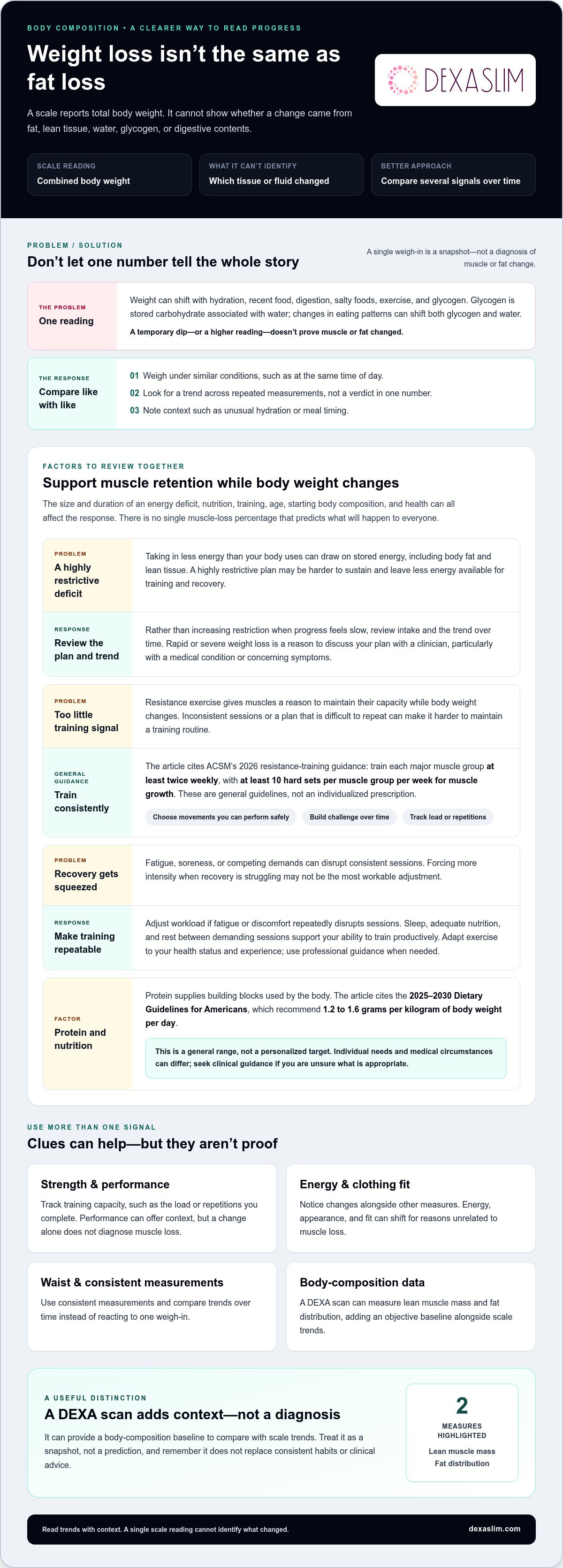
What if the scale is telling you your weight, but not what you’ve lost? If you’re asking, “why am I losing muscle and not fat,” the mismatch can feel frustrating: the number changes, but your shape, strength, or energy doesn’t respond as expected. A scale tracks total body weight. It can’t show whether that change came from fat, lean tissue, or shifts in water.
That uncertainty doesn’t mean your effort is failing, and a single weigh-in can’t diagnose muscle loss. Calorie restriction, protein intake, resistance training, age, and normal weight fluctuations can all affect the pattern. Look beyond one number and assess trends using several measures.
This article explains why weight loss may not match the fat loss you expect, which signs to interpret cautiously, and what habits can support muscle retention. You’ll also learn what to track next, from strength and waist measurements to body-composition data. A DEXA scan can measure lean muscle mass and fat distribution, giving you an objective baseline to compare with scale trends. It doesn’t replace consistent habits or clinical advice.
Key Takeaways
• Ask “why am I losing muscle and not fat” with the right context: scale weight alone can’t identify which tissues or fluid changes are behind a trend.
• Review your calorie deficit, resistance training, nutrition, and recovery before making major changes to your fat-loss plan.
• Use strength, energy, and clothing fit as clues, not proof. Each can change for reasons unrelated to muscle loss.
• Track trends over time with consistent measurements instead of reacting to a single weigh-in.
• A DEXA scan can provide a body-composition baseline by measuring lean muscle mass and fat distribution, adding context to your progress.
Why am I losing muscle and not fat? Start with what the scale measures
If you’re asking, “why am I losing muscle and not fat,” separate what you can observe from what the scale can tell you. A bathroom scale records your total body weight at one moment. It doesn’t identify how much comes from fat, muscle, water, or other contents in your body.
Weight loss is a decrease in total body mass; fat loss is a decrease in stored body fat, and the two are not interchangeable. A lower reading can reflect several kinds of change, while a higher reading doesn’t automatically mean you’ve gained fat. One weigh-in can’t reveal which tissue changed.
For a practical look at how nutrition relates to changing body composition, watch this video:
What does the scale actually tell you?
The reading includes fat and lean tissue, as well as water, stored glycogen, and the contents of your digestive system. Body composition describes how those components make up your body. A scale gives you the combined total; a body-composition assessment can help distinguish changes in fat and lean mass.
When and how you weigh can affect the result. A morning reading after using the bathroom may differ from an evening reading after meals and fluids. Hydration, recent food, and digestion all affect the number without showing whether muscle or fat has changed.
• Compare readings taken under similar conditions, such as at the same time of day.
• Look for a trend across repeated measurements, not a verdict in one number.
• Note relevant context, including unusual hydration or meal timing.
Can water or glycogen look like muscle loss?
Yes. Glycogen is stored carbohydrate in the body and is associated with water. If your eating pattern changes, particularly if you eat fewer carbohydrates, glycogen stores and the water associated with them may shift. The scale can move as a result, but that change alone doesn’t prove you’ve lost muscle or body fat.
Short-term fluctuations can also follow changes in fluid intake, salty foods, exercise, or the amount of food moving through your digestive system. Several factors can overlap. Don’t use a single weigh-in, a temporary dip, or how you look on one day to diagnose muscle loss.
Muscle changes require a different lens from routine fluid shifts. Sarcopenia is a type of muscle loss that occurs with aging and/or immobility. It is distinct from ordinary day-to-day changes on the scale. A DEXA scan can measure lean muscle mass and fat distribution to provide a clearer body-composition baseline. Treat it as a snapshot that adds context, not a diagnosis or prediction.
How calorie restriction, training, and recovery influence muscle retention
A fat-loss plan affects more than food intake. The size of the energy deficit, the training signal your muscles receive, and your ability to recover all influence how your body responds. If you’re asking, “why am I losing muscle and not fat,” assess these factors together rather than assuming one meal or workout explains the pattern.
Why can a calorie deficit affect lean tissue?
When you take in less energy than your body uses, it draws on stored energy. That can include body fat and lean tissue. The balance varies with factors such as the size and duration of the deficit, your starting body composition, nutrition, training, age, and health. There isn’t one muscle-loss percentage that predicts what will happen to everyone.
A highly restrictive plan may be harder to sustain and can leave less energy available for training and recovery. Instead of increasing restriction when progress feels slow, review your intake and the trend over time. Rapid or severe weight loss is a reason to discuss your plan with a clinician, particularly if you have a medical condition or symptoms that concern you.
How do training and recovery fit into the picture?
Resistance exercise gives muscles a reason to maintain their capacity while body weight changes. Use a progressive approach: choose movements suited to your ability, then build challenge over time through load, repetitions, or control. The ACSM’s 2026 resistance-training guidance emphasizes consistent training; it recommends training each major muscle group at least twice weekly, with at least 10 hard sets per muscle group per week for muscle growth. These are general guidelines, not an individualized prescription.
Recovery matters, too. If fatigue, soreness, or competing demands make it difficult to complete sessions consistently, adjust the workload rather than forcing more intensity. Sleep, adequate nutrition, and rest between demanding sessions support your ability to train productively. Adapt exercise to your health status and experience, and use professional guidance when needed.
• Choose resistance exercises you can perform safely and repeat consistently.
• Track performance, such as the load or repetitions you complete, to see whether your training capacity is holding steady.
• Adjust the plan if fatigue or discomfort repeatedly disrupts training.
Protein is another part of the equation because it supplies building blocks used by the body. The 2025-2030 Dietary Guidelines for Americans recommend 1.2 to 1.6 grams per kilogram of body weight per day. That general range isn’t a personalized target; individual needs and medical circumstances can differ. Aim for adequate nutrition overall, and seek clinical guidance if you’re unsure what’s appropriate for you.
A DEXA body-composition assessment can measure lean muscle mass and fat distribution, giving you a baseline to compare with your training and nutrition trends. Data can help you review your approach, but it can’t guarantee a specific outcome.
How to tell whether you may be losing muscle rather than fat
Feeling weaker or noticing a change in how clothes fit can prompt the question, “why am I losing muscle and not fat?” Treat these observations as signals to investigate, not as a diagnosis. A drop in lifting performance may reflect reduced recovery, changes in exercise, illness, stress, or other factors. Clothing fit can shift with body fat, water, digestion, and where changes occur.
Symptoms alone cannot confirm muscle loss; body-composition measurements provide more direct evidence of changes in lean mass and fat. Build your assessment from repeated observations rather than reacting to one difficult workout or weigh-in.
Which changes are clues, not proof?
A persistent decline in strength deserves a closer look, especially if movements that previously felt manageable are now difficult. Review training consistency, recovery, and nutrition before drawing conclusions. Fatigue or mood changes also matter, but they’re nonspecific and may have multiple causes, including factors unrelated to body composition.
Look for patterns. One low-energy day or a temporary performance dip tells you little on its own. If symptoms are persistent, severe, or unexplained, seek clinical advice rather than trying to diagnose the cause from weight or gym performance.
What measurements add useful context?
Each tracking method answers a different question. Scale readings show total weight trends, not which tissues changed. Strength records show how your performance is shifting, but strength can vary with exercise selection, effort, and recovery. Waist measurements and clothing fit can help track changes in size, but they don’t directly measure muscle or fat.
A body-composition assessment provides a more targeted view. DEXA measures lean muscle mass and fat distribution, offering a useful baseline for comparison. It’s still one measurement, not a diagnosis or a complete explanation of why change occurred. Interpret it alongside your routine, health context, and trends over time.
• Record weight under similar conditions and focus on the pattern, not daily fluctuations.
• Track the same strength exercises and note changes in load, repetitions, or how the movement feels.
• Measure your waist consistently, using the same technique and location each time.
• Compare body-composition results over time, rather than treating one assessment as a final verdict.
Keep conditions as consistent as practical. Weigh at a similar time and in similar circumstances. For strength, use the same exercise and comparable technique. For waist measurements, use the same reference point. Consistency makes trends easier to interpret and reduces the chance that ordinary variation will drive a major change to your plan.
Combine these signals instead of asking one measure to answer everything. If strength is holding steady while weight trends downward, that tells a different story than a sustained performance decline alongside a change in measured lean mass. A clearer evidence trail helps you decide what to review next without treating normal fluctuations as proof of muscle loss.
What to do next: adjust your fat-loss plan without guessing
If you’re asking, “why am I losing muscle and not fat,” don’t respond by cutting more food or adding punishing workouts. First, review what your plan is asking your body to do. Make one measured adjustment at a time, track a few indicators, and reassess the trend. That gives you a clearer basis for action than reacting to one reading.
Which habits should you review first?
Start with sustainability. Is your eating plan so restrictive that hunger, low energy, or inconsistent adherence makes it hard to follow? Are your meals varied enough to support adequate nutrition? Avoid chasing a precise calorie or nutrient target without considering your health, activity, and individual needs. A clinician or qualified nutrition professional can help personalize guidance.
Next, look at your training stimulus. Are you doing resistance exercise consistently? Are you maintaining or gradually progressing exercises you can perform safely? If workouts have become harder to complete, review whether your training load and recovery are balanced. More effort isn’t always a better strategy if it reduces consistency or leaves you unable to recover.
Check the basics before changing everything at once:
• Choose a sustainable eating pattern that supports adequate nutrition.
• Keep resistance training consistent and appropriate for your ability and health status.
• Allow time for recovery, and adjust training if fatigue or discomfort is disrupting sessions.
• Avoid adding supplements or aggressive restrictions as a substitute for reviewing the plan.
How can you track progress more clearly?
Choose a few measures that answer different questions. Track body weight under similar conditions and review the trend, not isolated readings. Record performance in a small number of repeatable strength exercises. If useful, include a waist measurement taken consistently. Too many metrics can create noise, so choose measures you can collect reliably and interpret calmly.
Keep a simple log with the date, weight, training performance, and relevant context, such as a major change in routine. Review it after enough time has passed to identify a pattern rather than responding to daily fluctuations. Repeating a measurement can help compare trends, but timing should suit the measure and your goals. A body-composition scan, for example, can add information about lean muscle mass and fat distribution when compared with a prior baseline.
Get medical input if weight changes are unexplained, symptoms are significant or persistent, or you have a health condition that could affect nutrition, exercise, or body composition. A scan can inform your picture, but it doesn’t diagnose the cause or replace clinical advice.
For a more objective baseline, schedule a DEXA body-composition scan to measure lean muscle mass and fat distribution. Use the results as one data point alongside sustainable habits, training records, and relevant clinical guidance, not as a promise of what will happen next.
Use body-composition data to clarify what is changing
When the scale, your appearance, and your training performance seem to tell different stories, body-composition data can help bring them into focus. A DEXA body-composition assessment measures lean muscle mass and fat distribution, giving you a more specific baseline than total weight or visual impressions alone. It can help answer “why am I losing muscle and not fat” with better information, not guesswork.
What can a DEXA body-composition scan clarify?
A scan provides a snapshot of lean mass and fat distribution at the time of measurement. That can help distinguish a change in total weight from a change in body composition. Appearance and clothing fit are useful personal observations, but they can’t identify which tissues account for a change. A DEXA result adds measurable context, not a complete explanation of how or why your body changed.
Use the result as a baseline. If you repeat an assessment later, comparing measurements can help you review whether your body-composition trend aligns with your training and nutrition approach. Keep the comparison grounded: results reflect specific points in time, and one scan cannot predict what will happen next.
How should you use the results?
Consider the findings alongside your training records, nutrition habits, health history, and other consistent measures. For example, if a result raises questions about lean mass, review whether your strength training and recovery have been consistent. Discuss the context with a qualified clinician when you need guidance tailored to your health. A scan can inform that conversation, but it doesn’t diagnose a medical condition or replace clinical advice.
For more detail on what body-composition assessment measures, explore Dexaslim’s DEXA Body Composition Scan guide. Use any measurement as one piece of evidence, not a verdict on your fitness or health.
Data is most useful when it leads to a thoughtful next step. Compare measurements under suitable conditions, focus on patterns rather than isolated results, and avoid changing your plan based on a single number. A scan can’t guarantee fat loss, muscle retention, or any future result. It provides a baseline to help you assess progress alongside the habits and guidance that shape your approach.
If you want a clearer starting point, consider Dexaslim’s body-composition assessment. It can add a measurable view of lean muscle mass and fat distribution to your progress tracking, alongside consistent habits and qualified clinical guidance.
Turn uncertainty into a clearer next step
If you’re still asking, “why am I losing muscle and not fat,” don’t let uncertainty push you toward a more extreme plan. Make your next move evidence-led: use a reliable baseline to guide what you review, then keep your habits consistent enough to understand the trend. Measurement can sharpen your questions, but it can’t replace clinical guidance or guarantee a particular outcome.
Dexaslim’s medical-grade DEXA scans assess lean muscle mass and fat distribution. Resting Metabolic Rate testing offers another data point for understanding your body. Choose the information that fits your goals and use it to support thoughtful decisions rather than chase a perfect number.
Explore Dexaslim body-composition testing to take a more informed next step. Use measurable data to refine your approach alongside sustainable habits and, when needed, qualified clinical guidance.
Frequently Asked Questions
Can you lose fat and gain muscle at the same time?
Yes, body recomposition can happen, though the pace and degree vary. It may be more achievable for someone new to resistance training, returning after a break, or changing an inconsistent routine. For example, a beginner may improve strength while following a modest fat-loss plan. Track strength and body-composition trends alongside weight, and don’t treat scale movement alone as evidence of muscle gain or fat loss.
Can a calorie deficit make you lose muscle?
Yes. A calorie deficit can lead to loss of both fat and lean tissue, particularly if the plan is overly restrictive or lacks resistance exercise and adequate nutrition. The risk and amount vary by person, so a deficit doesn’t automatically mean you’ll lose muscle. If your training performance is falling consistently or your eating plan feels unsustainable, reassess it rather than cutting intake further.
Why does my weight go down while my body looks the same?
Your appearance may not change noticeably at the same pace as your weight. Changes can be gradual, occur in areas you don’t easily notice, or be obscured by clothing, posture, and normal fluid shifts. If you’re wondering “why am I losing muscle and not fat,” don’t infer the answer from the mirror alone. Compare consistent waist measurements, training records, and, when useful, body-composition assessments over time.
Can low protein intake contribute to muscle loss during weight loss?
Yes, inadequate protein may make it harder to maintain muscle while losing weight, especially if you’re also not doing resistance exercise. Protein needs vary with body size, health, activity, and overall diet, so a single target won’t fit everyone. Review your regular meals and discuss an appropriate intake with a qualified clinician or nutrition professional if you have dietary restrictions, a medical condition, or uncertainty about your needs.
Can GLP-1 medication cause muscle loss while losing weight?
Weight loss during GLP-1 treatment can include changes in lean tissue as well as fat. Appetite reduction may also make it harder for some people to eat enough to support nutrition and training. This doesn’t establish what’s happening for any one person. If you use GLP-1 medication, discuss weight trends, strength changes, nutrition, and side effects with the clinician overseeing your treatment. Don’t change or stop medication on your own.
When should I talk to a clinician about unexplained muscle or weight changes?
Talk with a clinician if weight loss is unintentional or unexplained, strength keeps declining, or fatigue and other symptoms are persistent, severe, or interfering with daily activities. Seek individualized advice sooner if you have a condition or take medication that may affect appetite, activity, or body weight. Bring a record of weight trends, training changes, eating patterns, and symptoms. These details can help guide a more useful assessment.