.svg)


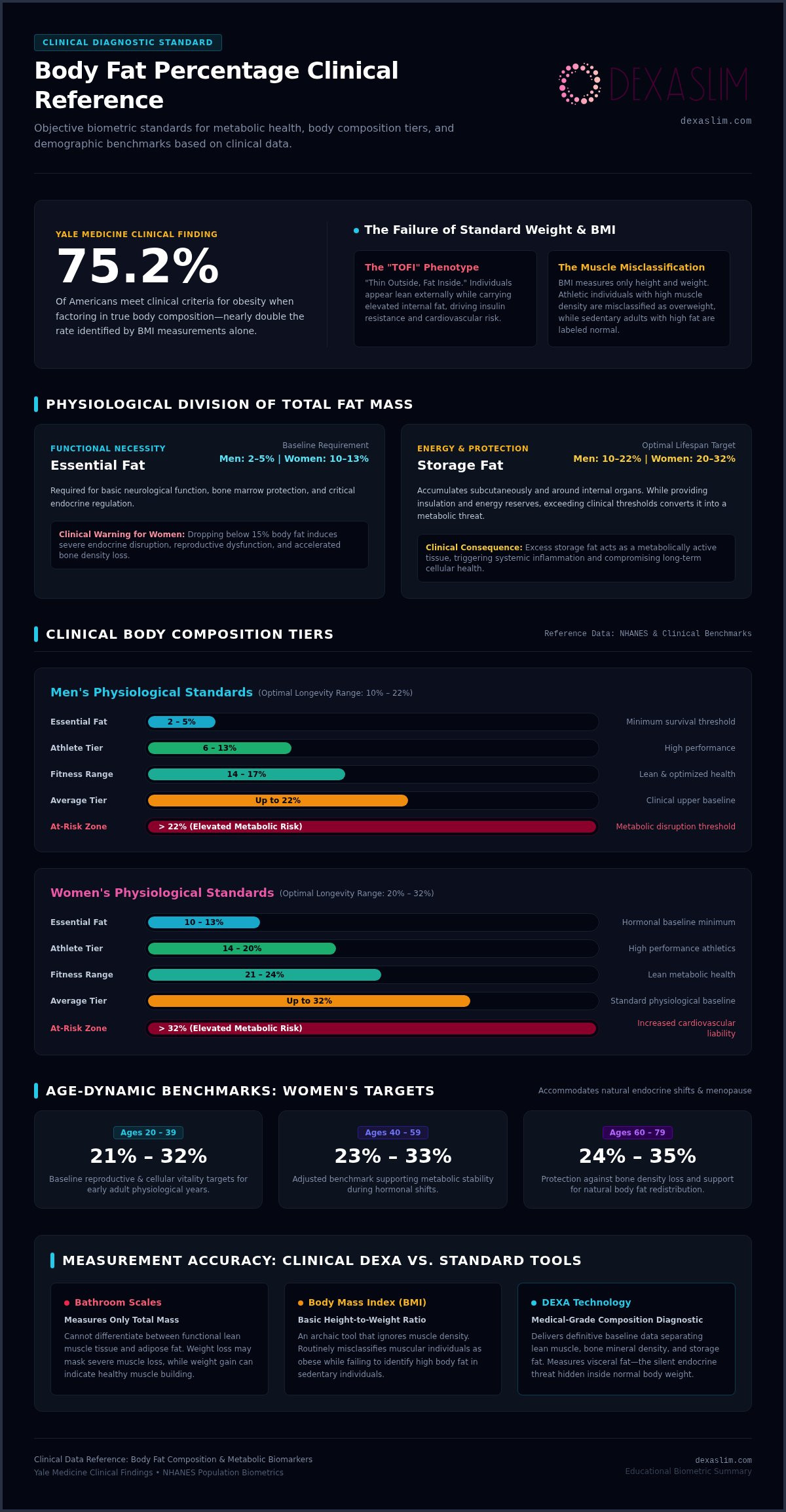
According to a Yale Medicine study, an estimated 75.2% of Americans meet the clinical criteria for obesity when factoring in body composition, nearly double the rate suggested by BMI alone. This stark data proves that your standard bathroom scale hides the real truth. If you're exercising consistently yet watching the weight refuse to budge, you're tracking the wrong metric. To unlock true metabolic efficiency and proactive longevity, you must establish an exact baseline. You must know exactly what is a healthy body fat percentage for your specific physiology.
It's frustrating to tolerate conflicting online charts or worry about the hidden health risks of a 'skinny fat' phenotype. You deserve diagnostic certainty. This guide delivers the precise clinical body fat ranges for your age and gender, shifting your strategy from intuition to objective measurement. You'll gain a clear understanding of your target biometrics, learn how to track composition accurately, and acquire a functional roadmap for long-term physical optimization.
Key Takeaways
• Identify the precise clinical ranges for your demographic to finally answer what is a healthy body fat percentage for your longevity goals.
• Learn why visceral fat acts as a dangerous endocrine organ and how to measure this hidden risk using medical-grade diagnostics.
• Stop relying on inaccurate home scales and transition to DEXA technology for a definitive, data-backed baseline of your body composition.
• Master the principles of body recomposition to optimize your metabolic rate and protect against age-related muscle loss.
• Transition from reactive weight management to proactive health optimization by leveraging precise biometric data and clinical interventions.
Beyond the Scale: Why Body Fat Percentage Is the Real Health Metric
Relying on a standard bathroom scale to evaluate physical health is an outdated practice. Total body weight tells you nothing about internal metabolic efficiency. To achieve true longevity, you must understand your precise body fat percentage, which is the exact ratio of your total fat mass to your total body mass. This single biometric dictates your true physical baseline. By focusing on composition rather than raw weight, you transition from guesswork to data-driven health optimization.
Fixating on total weight frequently masks dangerous internal realities. A rising number on the scale can signal positive muscle gain, while a falling number can indicate a hazardous loss of functional tissue. Knowing what is a healthy body fat percentage allows you to target fat loss while actively preserving lean muscle. This distinction is the foundation of proactive cellular health and metabolic longevity.
This structural clarity reveals a major medical paradox: individuals can appear perfectly lean externally while harboring dangerous levels of internal fat. This condition, known as TOFI (Thin Outside, Fat Inside), presents severe health risks. It drives insulin resistance, systemic inflammation, and cardiovascular disease despite a normal appearance. Objective data acts as the ultimate antidote to this uncertainty, exposing hidden health risks before they manifest as chronic disease.
The Failure of Body Mass Index (BMI)
Body Mass Index relies strictly on a basic weight-to-height ratio, completely ignoring the critical distinction between muscle and fat. This systemic flaw creates the BMI trap. Muscular individuals, athletes, and weightlifters are frequently misclassified as overweight or obese because muscle tissue is highly dense. Conversely, BMI routinely masks severe metabolic dysfunction in sedentary adults who possess low muscle mass and high body fat. It is an imprecise, archaic tool that fails the standards of modern wellness science.
Essential Fat vs. Storage Fat
Your total fat mass is divided into two distinct physiological categories:
Essential Fat
The baseline fat required for neurological function, marrow protection, and hormonal regulation. Women require significantly higher minimums (approximately 10 to 13 percent) than men to maintain reproductive and endocrine health.
Storage Fat
The accumulation of energy reserves located beneath the skin and around internal organs. While it provides insulation and protects vital structures, it becomes a severe metabolic liability once it exceeds clinical thresholds.
When storage fat crosses these clinical limits, it triggers systemic inflammation and compromises cellular health. Optimizing your body composition requires identifying the exact threshold where storage fat transitions from a normal energy reserve into a chronic physiological threat.
Clinical Body Fat Ranges: Standards for Men and Women
Clinical data dictates that a single, static standard for body composition doesn't exist. According to data from National Health and Nutrition Examination Surveys, average metrics in the population frequently exceed safe thresholds. For optimal longevity, general clinical ranges span 10 to 22 percent for men and 20 to 32 percent for women. These targets shift dynamically across your lifespan. A 60-year-old individual requires a different benchmark than a 20-year-old to account for natural hormonal adjustments and protect cellular vitality.
Understanding what is a healthy body fat percentage requires dividing biometrics into distinct physiological tiers. Essential fat sits at 2 to 5 percent for men and 10 to 13 percent for women. The high-performance athlete tier spans 6 to 13 percent for men and 14 to 20 percent for women, while fitness ranges require 14 to 17 percent for men and 21 to 24 percent for women. Average ranges reach up to 22 percent for men and 32 percent for women. Anything beyond these limits enters the metabolic at-risk zone. Don't mistake a highly depleted, shredded aesthetic for health; dropping below athlete thresholds often compromises immune function and bone density.
Healthy Body Fat Percentage for Women
Dropping below 15 percent body fat triggers severe endocrine disruption in women, frequently causing reproductive dysfunction and accelerated bone loss. Clinical benchmarks must scale upward with age to preserve metabolic health. Data published in June 2026 establishes target ranges at 21 to 32 percent for ages 20 to 39, 23 to 33 percent for ages 40 to 59, and 24 to 35 percent for ages 60 to 79. This progression accommodates the physiological impact of menopause, which naturally alters fat distribution toward the abdomen. To evaluate these systemic shifts accurately, establishing an objective baseline through a comprehensive Longevity Panel provides the exact biological data required for targeted health optimization.
Healthy Body Fat Percentage for Men
For men, body composition directly regulates natural androgen production. Dropping below essential thresholds degrades vital hormone synthesis, while entering the red zone of 25 percent or higher causes tissue aromatization, converting testosterone into estrogen and escalating cardiovascular risk. Proactive longevity requires finding the precise metabolic sweet spot. The clinical targets scale systematically by age: 8 to 19 percent for ages 20 to 39, 11 to 21 percent for ages 40 to 59, and 13 to 24 percent for ages 60 to 79. Prioritize long-term metabolic efficiency over temporary, unsustainable aesthetic extremes.
Visceral Fat: The Silent Killer Hidden in Your Percentage
Total body fat is only half the story. Subcutaneous fat is the "pinchable" tissue located directly under your skin. It is largely an aesthetic concern. Visceral fat is the metabolic predator. It wraps around your liver, kidneys, and intestines. This isn't passive storage. It's an active endocrine organ. It pumps out inflammatory cytokines and free fatty acids directly into your portal vein. This explains the TOFI paradox mentioned earlier. You can technically fall within the range of what is a healthy body fat percentage yet still possess lethal levels of internal adiposity. This hidden risk is why total mass metrics fail as a longevity strategy.
This toxic internal environment drives insulin resistance. It forces the pancreas to overproduce insulin, eventually leading to Type 2 diabetes. It hardens arteries. It triggers chronic heart disease. If you're only tracking your weight, you're blind to these internal variables. You need to know where your fat is located, not just how much you have. Precision diagnostics reveal these hidden threats before they manifest as clinical symptoms.
The Metabolic Danger of Internal Adiposity
Internal adiposity creates a state of permanent oxidative stress. It elevates C-reactive protein (CRP) and other markers of metabolic syndrome. Research confirms that a visceral fat area exceeding 100 cm² significantly increases cardiometabolic risk. In high-performance diagnostics, visceral adipose tissue (VAT) area is the most critical metric in a DEXA report because it correlates directly with all-cause mortality and systemic cellular decay. High VAT levels signal that your body is in a state of metabolic emergency, regardless of your clothing size.
Measuring What Matters: Visceral Fat Tracking
Calipers only measure what you can pinch. Home scales use electrical impedance that lacks the depth to penetrate the abdominal wall accurately. They cannot detect internal organ fat. Clinical imaging provides the only validated view of these hidden deposits. By targeting and reducing visceral fat, you don't just improve your waistline. You actively lower your biological age and reinforce your metabolic defense against age-related decline. Precision tracking is the only way to ensure your 'healthy' percentage isn't a mask for metabolic failure.
DEXA Scans vs. Home Scales: Measuring for Accuracy
Precision is the cornerstone of metabolic optimization. Determining what is a healthy body fat percentage requires a margin of error far lower than what consumer-grade hardware provides. Most people rely on smart scales utilizing Bioelectrical Impedance Analysis (BIA), yet these devices lack the diagnostic rigor necessary for longevity planning. If your data is imprecise, your intervention will be ineffective. Transitioning from home estimations to clinical diagnostics is the only way to secure a definitive physical baseline.
Why Your Smart Scale Is Lying to You
BIA technology functions by sending a low-level electrical current through the body. This current travels rapidly through water-rich muscle tissue but meets resistance when encountering fat. This method is fundamentally flawed because it measures hydration, not just adiposity. The hydration variable is volatile. Factors like caffeine intake, recent exercise, or a high-sodium meal can cause BIA readings to swing by 5 percent in a single day. You aren't losing or gaining five percent of your body fat in 24 hours; your scale is simply misinterpreting your water weight. Consistent 'wrong' data is worse than no data. It creates a false narrative of progress or failure, leading to strategic errors in your nutrition and training protocols.
The DEXA Advantage: Clinical Precision
Dual-energy X-ray absorptiometry (DEXA) is the medical gold standard. Unlike home scales, it utilizes a three-compartment model to differentiate between bone mineral density, lean soft tissue, and fat mass. It doesn't guess based on electrical resistance. It maps your physiology with sub-millimeter precision. This allows for the evaluation of regional fat distribution across the arms, legs, and trunk, exposing the visceral fat deposits that scales ignore.
DEXA also provides a critical metric for metabolic health: Appendicular Lean Mass (ALM). Knowing your exact muscle mass allows you to calibrate your Resting Metabolic Rate (RMR) Test with absolute accuracy. This synergy ensures your caloric targets are based on your actual metabolic engine rather than generic formulas. A medical-grade 1 Session Dexa Scan remains the only way to verify if you have reached what is a healthy body fat percentage with absolute certainty. Stop guessing at your composition and start managing your biology with clinical data.
Optimizing Your Composition: A Proactive Strategy
Reaching clinical biometrics requires shifting from traditional weight loss to tactical body recomposition. Generic caloric deprivation destroys functional tissue and compromises metabolic rate. True optimization demands that you simultaneously reduce adipose tissue and preserve lean muscle mass. This dual action strategy is the only way to establish a high functioning metabolism and achieve long term cellular vitality.
Progress relies on structured resistance training to elevate your baseline energy expenditure and enhance fat oxidation. To maximize this effect, combining body composition data with VO2 Max Performance Testing provides a complete cardiorespiratory and metabolic profile. This diagnostic synergy reveals your exact crossover point where your body shifts from burning fat to burning carbohydrates. When lifestyle adjustments alone fail to move you into the target range of what is a healthy body fat percentage, advanced clinical catalysts become necessary.
The Lean Mass Preservation Protocol
Losing weight too rapidly triggers a severe physiological penalty. Muscle mass naturally declines by 3 to 8 percent per decade after age 30, a condition known as sarcopenia. Aggressive, unmonitored dieting accelerates this loss, permanently damaging your basal metabolic rate. To counter this decay, you must implement a strict protein-sparing nutrition protocol during fat loss phases. For individuals struggling to protect lean mass while reducing high fat volumes, incorporating medically supervised GLP-1 Peptide Therapy alongside frequent diagnostic tracking ensures that weight loss is derived exclusively from fat stores rather than functional muscle.
Advanced Metabolic Interventions
Hormonal optimization acts as a powerful lever for body composition refinement. For men experiencing age-related androgen decline, clinically managed Testosterone Replacement Therapy restores the hormonal environment required to build lean mass and decrease visceral fat. Additionally, targeted Advance Peptide Treatment protocols enhance cellular repair, stimulate growth hormone secretion, and optimize overall metabolic efficiency. Stop relying on blind intuition to guide your health journey. You must schedule your DEXA scan at Dexaslim to establish your baseline and deploy a data-driven strategy for proactive longevity.
Master Your Metabolic Future Through Precision Data
Understanding what is a healthy body fat percentage is the foundational step in a proactive longevity strategy. You've seen the evidence. Standard scales fail to detect the toxic visceral fat that drives systemic inflammation and metabolic decay. Relying on intuition or outdated BMI metrics leaves your long-term vitality to chance. True physical optimization requires medical-grade diagnostic rigor and a commitment to data-backed interventions.
Stop guessing and start measuring. By utilizing medical-grade DEXA imaging, you reveal the exact distribution of your lean mass and adiposity. When lifestyle adjustments alone aren't enough to move the needle, expert-led peptide and TRT programs provide the clinical catalyst needed to reach your physiological targets. Combine these insights with comprehensive Longevity Blood Panels to gain a total view of your internal health. You possess the tools to redefine your biological age. Take decisive action today to secure your metabolic potential.
Book Your Clinical DEXA Scan and Metabolic Assessment at Dexaslim to establish your definitive baseline and begin your journey toward elite performance and longevity.
Frequently Asked Questions
Is 25% body fat healthy for a woman?
Yes, 25 percent body fat falls within the optimal fitness range for women. According to clinical data published in June 2026, the healthy range for women aged 20 to 39 spans 21 to 32 percent. This level supports vital hormonal regulation and reproductive health. However, total percentage is only one metric. You must verify that this fat is not concentrated viscerally around your internal organs to ensure true metabolic longevity.
What is the most accurate way to measure body fat at home?
No home measurement tool provides clinical grade accuracy. Smart scales and handheld devices utilize Bioelectrical Impedance Analysis, which fluctuates by as much as 5 percent daily based on your hydration and sodium intake. While skinfold calipers offer more consistency if used by a trained professional, they only evaluate subcutaneous fat. For a definitive baseline, you must utilize a medical grade 1 Session Dexa Scan to map internal adiposity accurately.
Can you be 'skinny fat' with a healthy body fat percentage?
You can possess a 'skinny fat' phenotype even if your total percentage appears acceptable on a standard chart. This condition occurs when an individual has dangerously low muscle mass combined with high levels of hidden visceral fat. Clinical diagnostics are essential to expose this metabolic profile. A Longevity Panel combined with precise composition mapping reveals if your current number is masking systemic inflammation, insulin resistance, or other hidden cardiovascular risks.
How often should I get a DEXA scan to track my progress?
Schedule a diagnostic scan every 3 to 6 months when you are actively pursuing body recomposition or medical interventions like GLP-1 Peptide Therapy. This frequency allows you to track lean mass preservation and fat oxidation trends with absolute precision. Frequent testing prevents the 'BMI trap' by confirming that your weight loss is derived from fat stores rather than functional muscle tissue. Quarterly assessments provide the data needed to refine your strategy.
Does drinking water affect my body fat percentage reading?
Hydration levels significantly skew results on home scales but do not impact clinical DEXA scans. Water conducts electricity, so being over-hydrated or dehydrated causes consumer scales to miscalculate fat mass by several percentage points in a single day. DEXA technology differentiates between water-rich lean tissue and fat mass using X-ray attenuation, making it immune to these daily fluctuations. This physiological precision is why medical imaging remains the gold standard for composition tracking.
What is a dangerously low body fat percentage for men?
Dropping below 5 percent body fat is clinically hazardous for the majority of men. This level of depletion compromises essential fat stores required for neurological function, marrow protection, and natural testosterone production. While elite athletes may briefly reach these extremes for competition, sustained levels below this threshold trigger metabolic shutdown and accelerated bone density loss. Proactive longevity requires maintaining a sustainable metabolic sweet spot rather than chasing depleted, shredded aesthetics.
How does body fat percentage affect my VO2 Max score?
High body fat acts as metabolic 'dead weight' that reduces your relative VO2 Max score. Because VO2 Max is measured in milliliters of oxygen per kilogram of body weight, excess fat mass forces your heart and lungs to work harder to move non-functional tissue. Utilizing a VO2 Max + DEXA (BCA) Bundle reveals the direct synergy between your composition and aerobic endurance. Reducing fat mass while preserving muscle is the most efficient way to improve cardiovascular performance.
Why does body fat increase as we age, and is it avoidable?
Body fat naturally increases due to hormonal shifts and the loss of 3 to 8 percent of muscle mass per decade. While this biological trend is common, it is not inevitable. Resistance training and clinical catalysts like Testosterone Replacement Therapy help preserve lean tissue and maintain metabolic rate. Knowing what is a healthy body fat percentage for your specific age bracket allows you to set realistic, data-backed goals to counter age-related metabolic decline.