

What if your VO₂ max score isn’t low or high, but simply being compared with the wrong group? That’s why vo2 max ranges can look inconsistent across charts. Age, sex, fitness level, and the source of the reference data all affect how a score should be read.
It’s reasonable to question a number that doesn’t match how you feel or train. A smartwatch estimate and a lab measurement aren’t interchangeable, and elite-athlete benchmarks can set an unrealistic bar for recreational exercisers. Start with the right comparison group, not the biggest number on a chart.
This guide explains how to choose a relevant reference group, why VO₂ max ranges vary, and what your score can and can’t tell you. You’ll also learn how wearable estimates differ from direct testing and when a measured baseline may help clarify your next steps. Dexaslim offers VO₂ Max Performance Testing to help put an individual result in context.
Key Takeaways
• Use vo2 max ranges as comparison points, not diagnoses or fixed limits.
• Choose reference data that matches your age, sex, and fitness context before interpreting your score.
• Use general-population, fitness, and sport-specific benchmarks for the purposes they were designed to serve.
• Before drawing conclusions, identify how your score was measured, the unit used, and the reference group behind it.
• A directly measured baseline can add personal context to population ranges. Dexaslim offers VO₂ Max Performance Testing for this purpose.
VO₂ Max Ranges: What the Number Measures and How to Read a Chart
VO₂ max measures the maximum rate at which your body uses oxygen during progressively demanding exercise. Relative VO₂ max is commonly reported in millilitres of oxygen per kilogram of body weight per minute (mL/kg/min), adjusting the value for body size.
A chart compares your result with a defined group. It doesn’t set a personal target, explain every aspect of fitness, or diagnose a medical condition. A category only has meaning alongside the chart’s age band, sex category, population, and measurement method.
For a visual introduction to age- and sex-based standards, watch this overview:
What VO₂ max ranges represent
Oxygen supports the energy production your muscles need during exercise. VO₂ max captures the highest oxygen uptake reached during demanding effort, expressed relative to body weight. It reflects cardiorespiratory capacity, but it isn’t a complete measure of athletic performance. Exercise economy and the ability to sustain effort also matter.
Reference categories compare results with population data, but they aren’t fixed biological limits. A person can fall below a category threshold and still improve fitness, while a high classification doesn’t guarantee a particular health outcome. For background on measurement and normalization, see the VO₂ max Wikipedia article.
How to use an age- and sex-based chart
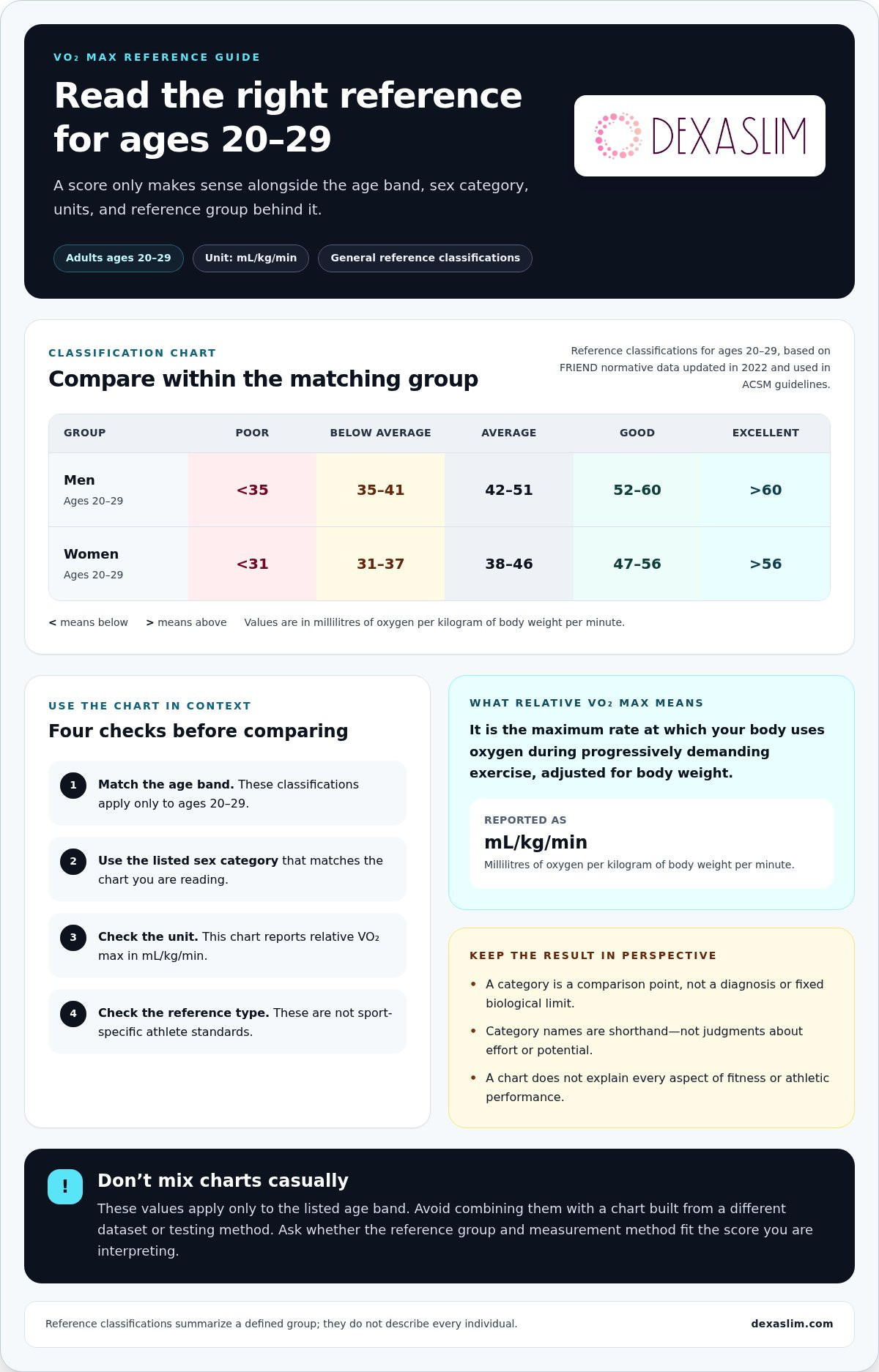
First match your age band and the chart’s sex category. Then check the units and whether the figures describe general-population norms, fitness classifications, or athlete benchmarks. The categories below are recent reference classifications for adults ages 20-29, based on FRIEND normative data updated in 2022 and used in ACSM guidelines. They are not sport-specific athlete standards.
VO₂ max classifications for ages 20-29 (mL/kg/min):
| Group | Poor | Below average | Average | Good | Excellent |
|---|---|---|---|---|---|
| Men, ages 20-29 | <35 | 35-41 | 42-51 | 52-60 | >60 |
| Women, ages 20-29 | <31 | 31-37 | 38-46 | 47-56 | >56 |
These values apply only to the listed age band. Don’t use them to classify someone in another age group or combine them with a chart built from a different dataset or testing method. Category names are shorthand for comparison, not judgments about effort or potential. Ask not only where your score falls, but whether the chart represents a group that fits you.
Why VO₂ Max Ranges Differ With Age, Sex, and Physiology
A reference chart reflects the people measured, the categories used, and the testing conditions. It doesn’t describe everyone in a group. VO₂ max ranges provide context, but a category can’t explain why one individual’s score differs from another’s.
How age and sex affect reference comparisons
Normative datasets commonly organize results into age bands and sex categories to make comparisons more relevant. The FRIEND data used in recent ACSM guidelines, for example, provides U.S. reference values for different age and sex groups. Each category summarizes observations from its source population. It doesn’t set a biological ceiling or describe every person’s capacity.
Age-related patterns describe groups, not an individual’s precise future. Fitness history, health, and physiology all influence how a person compares with an age-based reference. Avoid applying one decline rate to everyone or treating the difference between two group averages as a universal sex gap. The size of a reported difference depends on the dataset, its participants, and how results were measured and categorized.
Population averages don’t determine an individual’s score. Training, body composition, health, and test conditions can all differ from the group average.
Training, body size, and individual variation
Your training background affects which comparison is useful. A general-population norm describes a broad reference group; an athletic benchmark may represent people with sustained sport-specific training. Comparing a recreational exerciser with a trained endurance athlete can make a score seem unusually low without answering the more useful question: how does it compare with people of a similar age, sex category, and training context?
Body size also affects interpretation. Relative VO₂ max divides oxygen uptake by body mass, making it possible to compare people of different sizes. Absolute oxygen uptake reports total oxygen used without that adjustment. Because body mass is part of the relative calculation, a change in body weight can shift the relative score even if absolute oxygen uptake stays the same. The measures answer different questions, so check which one a chart reports.
Individual results also reflect the combined work of oxygen delivery and use, including circulation and the muscles’ ability to extract oxygen. Health status, recent exertion, and testing conditions can influence a result. A chart can’t account for every factor, and a single score isn’t a complete profile of fitness or health.
Use the reference group to frame your result, then consider the measurement method and conditions before comparing it with another score. Dexaslim offers VO₂ Max Performance Testing to establish a measured fitness baseline.
General-Population, Fitness, and Athlete VO₂ Max Ranges Compared
No single chart answers every VO₂ max question. A population norm, a fitness classification, and a sport-specific benchmark describe different comparison groups. Before interpreting vo2 max ranges, decide what you want to compare: your result with a broad reference group, a fitness category, or athletes whose sport and training are relevant to yours.
| Reference type | What it describes | Best used for | Key limitation |
|---|---|---|---|
| General-population norms | Scores from a defined population, often grouped by age and sex | Putting a personal result in broad population context | May not reflect training background or a specific sport |
| Fitness categories | Labels assigned to score bands within a named reference system | Understanding where a score falls within that system | Labels and cutoffs depend on the source; they aren’t universal |
| Sport-specific benchmarks | Scores observed in a defined athletic group or discipline | Comparing athletes with a relevant sport and training context | Not a default standard for recreational exercisers or the general public |
Which reference group fits your question?
For a general comparison with peers, choose a population dataset that matches its stated age and sex categories. Use one source consistently. Don’t combine a population chart from one study with a fitness classification or athlete table from another and treat them as a single scale.
If your question is about sport performance, use a benchmark based on athletes in a relevant discipline and comparable training context. The table above explains the purpose of each reference type, not score cutoffs. Without a comparable dataset, sport examples or numerical ranges could create a false impression of precision.
Training status changes the meaning of a label. “Excellent” in one system may mean a high ranking within a broad population, while an athlete chart may compare only a selected, highly trained group. Read the population and method behind a chart before acting on its category name.
Why elite scores are not everyday standards
Elite performances show what highly trained individuals can achieve under specific conditions. They aren’t ordinary reference ranges, medically required targets, or a fair test of a recreational exerciser’s effort. A score below an elite benchmark says little by itself about a person’s commitment or health.
Use a benchmark as context, not judgment. For performance comparisons, compare like with like. For a broader fitness reference, choose population data instead of defaulting to an athlete chart. To understand how formal measurement can add context, explore this laboratory VO₂ max test guide.
Dexaslim offers VO₂ Max Performance Testing to establish a measured personal baseline. A result can help contextualize general reference values without turning a group benchmark into an individual verdict.
How to Interpret Your VO₂ Max Score Without Overreading It
A score is useful only when you know how it was produced and what it’s being compared with. Follow these steps to interpret vo2 max ranges without treating one figure as a complete assessment of fitness or health.
Identify the measurement method.
A laboratory test measures oxygen uptake directly through gas exchange. A field test estimates it from exercise performance, while a wearable uses device data and an estimation method. These approaches don’t necessarily produce interchangeable results, so record the method alongside the score.
Check the unit.
Confirm whether the result is relative VO₂ max, usually shown in mL/kg/min, or absolute oxygen uptake. Don’t compare values in different units as if they measure the same thing.
Find the reference group.
Check the chart’s age band, sex category, population, and fitness classification. A value’s label depends on the source’s categories. An online calculator that doesn’t explain its reference data can’t provide a dependable comparison.
Consider the context.
Note the testing conditions and your relevant training and health context. When comparing results over time, keep the method and conditions as consistent as possible. A change may reflect measurement differences as well as a change in fitness.
Check the measurement before comparing the number
Direct laboratory measurement and estimates address related questions, but use different methods. A field test infers oxygen uptake from performance; a wearable estimates it using device data. Estimates from different devices may also use different inputs and calculations. Unless you know two methods agree, don’t treat a difference between their numbers as a real change in your physiology.
Read the test or device report closely. Look for the unit, how the value was obtained, and the reference group used to assign any category. If those details aren’t available, interpret the label cautiously instead of assuming it matches a published norm.
Use the score as context, not a verdict
VO₂ max is one measure of cardiorespiratory fitness, not a complete measure of health or athletic performance. Endurance performance also depends on lactate threshold, exercise economy, and how much of your capacity you can sustain. A higher score alone doesn’t establish overall health, guarantee performance, or determine an appropriate training plan.
A score comparison shows how a result relates to a reference group; it isn’t a clinical diagnosis. If a result is unexpected or raises health concerns, seek interpretation from a qualified health professional rather than drawing conclusions from a chart alone. Don’t use an elite benchmark or an unsourced calculator to set a personal target.
Dexaslim offers VO₂ Max Performance Testing to establish a measured personal baseline. Use an individualized result to add context to broad reference values, not as a verdict on your potential.
Establish a Reliable VO₂ Max Baseline With Testing
Population charts show how a score compares with a group. A personal baseline gives you another reference point: your own result, recorded with a known method and set of conditions. This can make vo2 max ranges less abstract and help you track cardiorespiratory fitness over time.
When a measured baseline can be useful
A directly measured VO₂ max result can provide a clearer starting point than an estimate from a wearable or field test. Wearables infer the value from device data, while laboratory testing measures oxygen uptake during exercise. Because the methods differ, don’t assume their results are equivalent or treat a change between methods as proof that your fitness changed.
A baseline is most useful when later results use a comparable method. It can help you track measurements over time and consider them alongside an appropriate population reference. Testing doesn’t improve aerobic capacity, guarantee progress, or predict a specific health outcome. It gives you a data point to interpret, not a result to overread.
Keep the purpose of each assessment clear. A VO₂ max test concerns aerobic capacity during exercise. A resting metabolic rate test measures energy expenditure at rest, so it answers a different question. Neither result substitutes for the other.
Use testing data to make the next comparison more meaningful
Keep a simple record for every measurement. Note the date, method, unit, and relevant testing conditions. Record the reference group too, including its age band, sex category, and whether it describes general-population norms, fitness categories, or athletes. These details help distinguish a meaningful trend from a difference caused by measurement or comparison choices.
When you review a future result, return to the same type of comparison. If the method or conditions differ, treat the new value as a separate data point rather than forcing a direct comparison. Don’t switch to an elite-athlete chart simply because it gives you a more ambitious target. A fair comparison matches the question you’re asking.
Dexaslim provides VO₂ Max Performance Testing as part of its cardiorespiratory and metabolic assessment services. The test can establish an individual fitness baseline and help put general reference values in context, without promising a particular result or outcome. Use it as one measure in a broader view of fitness, and keep the details that make future comparisons consistent.
For a measured starting point, explore VO₂ Max Performance Testing at Dexaslim.
Turn Your Score Into a Clear Next Step
Let your VO₂ max score guide a better question, not define your potential. Decide what you want to understand next, whether that’s establishing a baseline, tracking change, or putting your fitness in a more personal context. Use vo2 max ranges as a reference point, then focus on consistent measurements and progress that matters to your goals.
A measured result can make the next step more concrete. Dexaslim offers VO₂ Max Performance Testing, and the VO₂ Max + DEXA (BCA) Bundle combines VO₂ max testing with DEXA body composition assessment. Choose the option that fits the information you want to explore.
Explore Dexaslim VO₂ Max Performance Testing and take an informed step toward understanding your fitness baseline. Your score is a starting point for better questions and more purposeful progress.
Frequently Asked Questions
What is a good VO₂ max score?
A good score depends on your age, sex category, and the reference system used. There isn’t one cutoff that applies to everyone. A value classified as good in one chart may receive a different label in another because datasets use different populations and categories. Compare your result with a clearly identified chart that fits your group, and treat the label as context rather than a personal fitness verdict.
Is VO₂ max measured in ml/kg/min?
Yes. Relative VO₂ max is commonly reported in millilitres of oxygen per kilogram of body weight per minute, written as mL/kg/min. This unit accounts for body mass, unlike absolute oxygen uptake, which reports total oxygen use without dividing by weight. Check that two values use the same unit before comparing them. A number without its unit can be easy to misread.
Can a wearable give an accurate VO₂ max score?
A wearable can provide a useful estimate, but don’t assume it equals a directly measured laboratory result. Accuracy depends on the device and its estimation method. Estimates based on exercise data, such as a run, may be more accurate than those based on resting data. Use one device to follow your own trend, not to rank yourself against lab-tested norms.
Does VO₂ max naturally decline with age?
VO₂ max often trends lower with age at the population level, but the pattern isn’t identical for everyone. Activity level and training history matter, and consistent aerobic exercise can help limit age-related loss. A chart’s age bands describe group data, not an individual schedule. When comparing results over time, note whether your testing method and conditions were similar before attributing a change to aging.
Can two people with the same VO₂ max have different fitness levels?
Yes. Two people can share a VO₂ max value yet perform differently during exercise. One may have a higher lactate threshold, use less energy at a given pace, or sustain a larger share of their aerobic capacity. Sport demands matter too: a score alone doesn’t capture strength, movement skill, or event-specific conditioning. Use VO₂ max as one data point, then consider performance in the activity that matters to you.
Should I compare my score with an athlete's VO₂ max range?
Usually not, unless you’re an athlete comparing yourself with a relevant sport-specific group. Athlete benchmarks describe people selected for training and performance, so they can set an irrelevant standard for recreational exercisers. Choose a population reference for a broad comparison or a sport-specific source for an athletic question. Check how the scores were measured before comparing them, especially if one value comes from a wearable estimate.