.svg)


What if the most useful longevity test isn’t the one with the most impressive score, but the one that gives you a clear next step? Longevity testing for men can feel like a maze of biomarkers, biological-age claims, and results that are difficult to interpret. The answer isn’t to collect every number. It’s to build a relevant baseline and understand what each measurement can and can’t tell you.
A result rarely speaks for itself. Lab values need context, including your health history, medications, symptoms, and other findings. A reference range isn’t a complete picture of health, and one test rarely tells the whole story. Changes across comparable measurements may provide more context than a single result, but they still need careful interpretation.
This guide covers key testing categories that can contribute to a personal baseline, including blood markers, body composition, bone density, aerobic capacity, and resting metabolism. You’ll find ways to match a test to a question, prepare for testing, and review results without reacting to every fluctuation. Use the data to inform your next health discussion, not as a diagnosis or a promise about lifespan.
Key Takeaways
• Build a useful baseline by matching each measurement to a clear health or performance question.
• Use longevity testing for men to organize blood markers, body composition, aerobic fitness, and energy needs into distinct categories.
• Interpret results alongside symptoms, health history, medications, and testing conditions rather than relying on a reference range alone.
• Follow the preparation instructions for each test, then review findings with an appropriate clinical professional before making changes.
• Consider blood panels, DEXA, VO2 Max, and resting metabolic rate as complementary data sources, each offering a different perspective.
Why longevity testing for men starts with a clear health baseline
Longevity testing for men brings together selected measurements to establish and track health-related baselines. A focused plan can give you a starting point, identify questions to discuss, and show how specific measures change over time. Begin with the question you want answered rather than ordering tests simply to collect more results.
No single panel measures lifespan or captures every dimension of health. Blood markers, body composition, fitness, and metabolic measurements each offer different information. They can support a preventive healthcare approach by making certain aspects of health measurable, but they don’t guarantee a future outcome or replace clinical assessment.
For a useful overview of common longevity assessments, watch this video:
Screening data identifies measurements or patterns that may merit attention. Diagnosis requires clinical evaluation of the full picture. Keep that distinction in mind when reviewing a result. A number is information to interpret, not a stand-alone verdict about health.
What can a health baseline tell men?
A baseline records selected measurements at a particular point in time, giving you a reference for future comparisons and a focused health discussion. A single measurement describes one moment. Repeating a measurement under appropriately similar conditions may add context, but neither a single result nor a trend predicts an individual’s lifespan or guarantees a future outcome.
Use the data to frame practical questions: Which findings need interpretation? Which measurements relate to your goals? What, if anything, should be tracked again? Repeat testing should have a clear purpose and timing based on the test, the findings, and your clinical context.
Why testing needs personal context
Age, symptoms, family history, existing health conditions, medications, and personal goals all affect which measurements are relevant and how results are understood. The same value may mean different things for different people. A general checklist can’t account for those differences, and a result outside a laboratory reference range doesn’t automatically establish a diagnosis.
Share relevant health history and medication details when results are reviewed. Don’t use a longevity score to explain away new symptoms or a concerning finding. Seek appropriate clinical evaluation so the result can be considered alongside your history and the rest of the evidence.
Men’s longevity testing checklist: blood markers and broader measurements
Start with the question you want the data to answer. Longevity testing for men may include blood biomarkers, body composition, cardiorespiratory fitness, and energy needs. These categories provide different views of health and performance, so they aren’t interchangeable. There is no single test list that suits every man. Use established men's health screening guidelines as a reference for preventive screening, then consider additional measurements in light of your history, symptoms, and goals.
Blood biomarkers to discuss in a personalized checklist
Blood tests can provide structured information across several areas. Examples to discuss in context include HbA1c for blood sugar patterns, ApoB for cardiovascular risk assessment, hs-CRP as an inflammation marker, and testosterone for hormone-related questions. These are examples, not automatic requirements or a recommendation to order a complete panel. A marker is most useful when there’s a clear reason to measure it and a plan for interpreting the result.
Reference ranges and individual context matter. For more on what blood results can and can’t show, read this biomarker testing guide. A structured panel can help organize relevant findings for discussion. Dexaslim’s comprehensive longevity panel provides blood-marker data to support a personal baseline.
When to add fitness or body-composition measurements
Bloodwork doesn’t measure physical capacity or body composition. Consider adding another type of assessment when it answers a separate question:
DEXA
Assesses body composition and bone density, giving you a structural baseline distinct from blood markers. Explore the DEXA body composition scan guide.
VO2 Max
Evaluates cardiorespiratory fitness, providing performance information that blood tests don’t capture.
Resting metabolic rate
Measures energy use at rest, a separate data point from body composition and fitness capacity.
Choose measurements with a clear purpose, then review each result as one part of a broader picture. If blood-marker data is relevant to your baseline, explore Dexaslim’s comprehensive longevity panel.
How to interpret men’s longevity test results without overreading them
A lab report provides a measurement and a reference range. Individual clinical assessment considers the result alongside symptoms, health history, medications, and other findings. A value outside the range may warrant follow-up, but it doesn’t automatically signal disease. A value inside the range doesn’t prove that every aspect of health is on track.
An isolated result is a data point, not a diagnosis. Treat it as a prompt for informed review, not a verdict or a reason to start treatment on your own.
Reference ranges, trends, and context
Reference ranges describe results within a defined comparison group and can vary by test and laboratory. They don’t guarantee health or illness, and “optimal” has no universal meaning unless it’s tied to a clear, evidence-based standard. When comparing results over time, note whether the same test and similar conditions were used. Symptoms, recent illness, medications, and other clinical details may also affect interpretation.
Trends can add context, but they don’t remove the need for interpretation. If a result is unexpected, a qualified clinician can assess whether repeat measurement or further evaluation makes sense for you.
| Result type | What it may indicate | What it cannot establish |
|---|---|---|
| HbA1c | A measure related to blood sugar over time | A complete assessment of metabolic health on its own |
| ApoB | Information relevant to cardiovascular risk assessment | Your overall cardiovascular risk or a diagnosis by itself |
| hs-CRP | An inflammation-related signal that needs context | The cause of inflammation or a specific condition |
| Testosterone | Hormone-related information to interpret alongside symptoms | A diagnosis or treatment need from one result alone |
Testosterone results require particular care
Not every man needs testosterone testing. A result is most meaningful when there’s a relevant clinical question, such as symptoms that warrant assessment. Interpretation may depend on the broader health picture and how the measurement was obtained. Don’t treat a single number as proof of a hormone condition or as a reason to pursue testosterone therapy. Symptoms or concerning findings call for appropriate clinical evaluation.
Use longevity testing for men to build a clearer record, not to chase isolated “optimal” values. Review results alongside relevant context, then determine whether follow-up is appropriate.
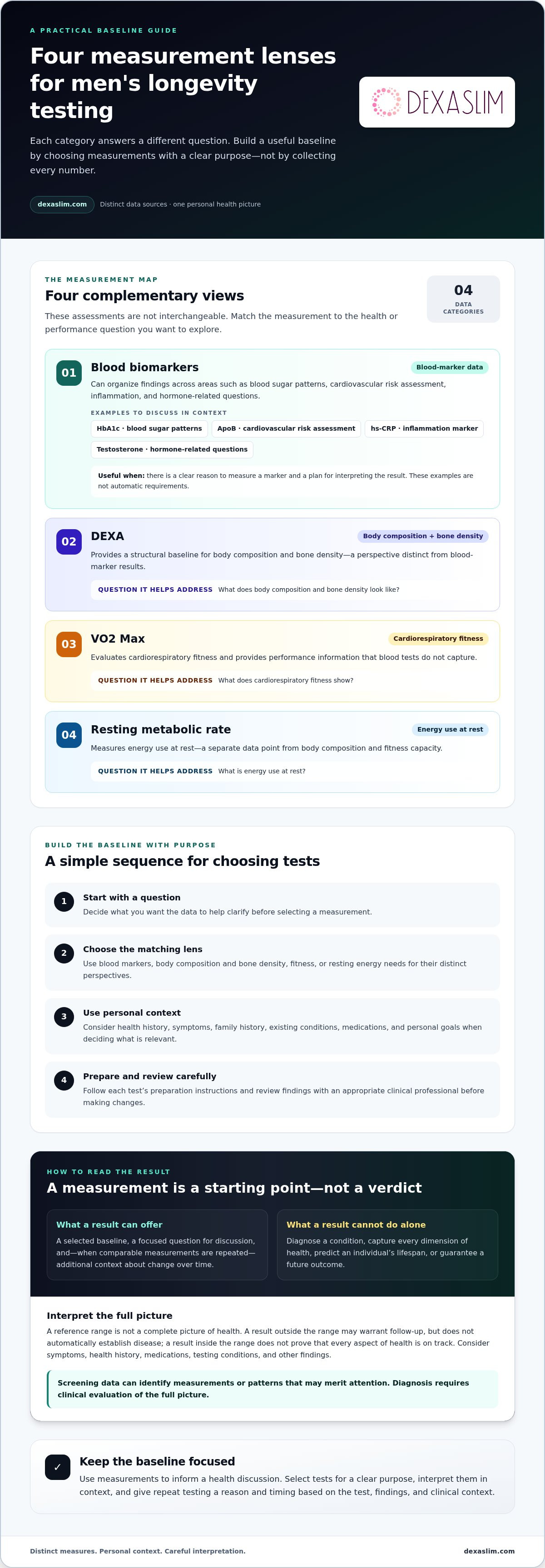
A practical checklist for planning, completing, and reviewing longevity tests
Make each test answer a question. This simple workflow keeps longevity testing for men focused on measurements that can inform a useful discussion, rather than data collection without a plan.
Define the question.
Choose a goal, concern, or baseline you want to understand. Decide what information could help guide a future discussion or decision.
Review your context.
Organize relevant symptoms, health history, family history, and current medications. Note recent changes that may help explain a result.
Select measurements.
Match each test to the question it can address. Avoid adding tests without a clear purpose or a plan for reviewing the findings.
Complete testing as instructed.
Follow the specific preparation instructions for your selected test. Requirements can differ, so don’t assume every test has the same preparation. Don’t change medication use unless the instructions or an appropriate clinician directs you to.
Review results and plan next steps.
Discuss significant or unexpected findings with an appropriate clinician. Decide whether follow-up, repeat measurement, or no further action is appropriate in your circumstances.
Before testing: define the decision the data should support
Start with a practical prompt: “What do I want to understand, and how might the answer inform a next step?” You might want to establish a baseline, explore a specific concern, or track a measurement related to a personal goal. Bring organized notes on symptoms, health history, and medications. This context can help keep test selection focused and make the results review more useful.
Preparation depends on the test. Read the instructions for the exact measurement you’re completing and follow them carefully. Don’t apply advice intended for a different test, such as fasting or changing medication, unless your test instructions or clinician call for it.
After testing: turn results into a review plan
Save the report and record the test date, testing conditions, medications, and relevant changes in your health or routine. These notes can make later comparisons more informative. A changed result may reflect a true shift, different testing conditions, or other context. Compare results only when the methods and circumstances make the comparison meaningful.
Set the follow-up timeline based on the findings and your clinical context, not a universal schedule. One result may call for discussion; another may not need an immediate repeat. Separate collecting data from deciding what to do with it. Review the evidence, clarify what remains uncertain, and agree on a proportionate next step.
To establish an objective baseline, explore Dexaslim longevity testing, including blood panels and separate body-composition and performance assessments.
How Dexaslim supports a data-led longevity testing plan for men
A strong testing plan isn’t a race to collect the most results. It starts with a specific question, then matches that question to a measurement that can provide relevant data. Dexaslim offers distinct assessment categories that can help build a health and performance baseline for longevity testing for men. Use the findings to inform discussion and tracking, not as a diagnosis or a guarantee of future health outcomes.
Match the measurement to the question
Each assessment captures a different part of the picture. Choose based on what you want to understand, and consider how the result fits alongside other relevant information.
Longevity blood panels
Provide structured blood-marker data for discussion of measured biomarkers and areas such as metabolic health. Their value lies in reviewing relevant findings in context, not treating a panel as a complete picture of health.
DEXA
Assesses body composition and bone density, providing a structural baseline that bloodwork can’t provide.
VO2 Max testing
Evaluates cardiorespiratory fitness, adding performance data to a broader assessment.
Resting metabolic rate testing
Measures energy use at rest, a separate data point from fitness capacity or body composition.
These measurements are complementary, not interchangeable. A blood panel provides biomarker data; a DEXA scan assesses body composition and bone density; VO2 Max and resting metabolic rate testing focus on fitness and energy use. Choose assessments according to your goals and the questions you want your baseline to help answer.
Build a baseline, then review the data
Start with a focused set of measurements. Record the test date and relevant context, then review the results as part of an informed health discussion. If you repeat a measurement, using a consistent method and similar conditions can make comparisons more useful. Interpretation and follow-up depend on your results and individual circumstances.
Dexaslim’s comprehensive longevity panels provide blood-marker data. DEXA, VO2 Max, and resting metabolic rate tests offer separate views of body composition, fitness, and energy use. Selected measurements can create a more structured baseline without implying that any one test predicts lifespan or guarantees an outcome.
Choose a purposeful starting point. Explore Dexaslim’s testing services and select an assessment that fits the health or performance data you want to track.
Turn your health data into a focused next step
Longevity testing for men is most useful when each measurement answers a relevant question. Blood biomarkers, body composition, cardiorespiratory fitness, and resting energy needs offer different views. Choose tests with a clear purpose instead of chasing every available result.
Keep interpretation grounded. Reference ranges are not diagnoses, and individual findings need to be considered alongside symptoms, health history, medications, and testing conditions. A baseline can support informed discussion and tracking, but it can’t predict lifespan or guarantee a health outcome.
Dexaslim offers comprehensive longevity blood panels, medical-grade DEXA body-composition and bone-density scans, VO2 Max testing, and resting metabolic rate testing. Each provides a distinct source of data for building a personal baseline. Identify the question you want to answer, then choose a measurement that fits.
Explore Dexaslim’s diagnostic testing options to choose a practical starting point for a more informed health discussion.
Frequently Asked Questions
What does longevity testing for men include?
Longevity testing for men can include selected blood biomarkers and separate assessments of body composition, cardiorespiratory fitness, or resting energy needs. There’s no universal panel, and the right combination depends on factors such as age, health history, symptoms, and goals. Dexaslim’s comprehensive longevity panel provides blood-marker data. Review the panel details to understand the measurements included, and discuss findings with a clinician in context.
Which blood tests should men consider for longevity?
No single blood-test list applies to every man. Depending on the health question, a clinician may consider metabolic, cardiovascular, inflammatory, or hormone-related markers. For example, HbA1c, ApoB, hs-CRP, and testosterone each relate to different areas of assessment, but they aren’t automatic requirements. For each selected test, clarify what it measures, why it’s relevant to you, and what it can’t establish on its own.
Is longevity testing the same as a full health checkup?
No. Longevity testing focuses on selected measurements and doesn’t replace primary care, a physical examination, or evaluation of symptoms. A blood panel provides information about measured biomarkers, not every aspect of health. Dexaslim offers specialized testing, including longevity panels and performance assessments. If you have symptoms or a concerning result, seek appropriate clinical evaluation rather than relying on a screening measurement to explain or resolve it.
Can a blood test tell how long a man will live?
No blood test can reliably predict an individual man’s lifespan. Biomarkers describe specific measurements at a point in time, and their meaning depends on clinical context. A favorable result isn’t a guarantee of future health, just as an abnormal result isn’t a prediction of disease or lifespan. Testing is most useful when it helps frame a reasonable next step, such as further discussion or follow-up guided by clinical judgment.
How often should men repeat longevity tests?
There’s no single repeat schedule for every person or test. Timing depends on the measurement, previous findings, changes in health, and clinical judgment. Follow the preparation instructions for the specific test, and discuss follow-up timing with an appropriate clinician. Frequent retesting doesn’t automatically improve health. Before repeating a measurement, consider what question the new result should answer and whether the method and conditions allow a meaningful comparison.
Does a testosterone test show whether a man needs treatment?
No. A testosterone result alone doesn’t establish a diagnosis or determine whether treatment is appropriate. Symptoms, clinical context, and appropriately assessed test results all inform evaluation. Not every man needs testosterone testing or treatment, and a single number shouldn’t be treated as a reason to start therapy. Testosterone replacement is a clinical treatment decision, not a general longevity strategy or a shortcut to interpreting other health concerns.
Are DEXA and VO2 Max tests part of longevity testing?
They can contribute distinct baseline data, but they measure different things from blood tests and aren’t mandatory for everyone. DEXA assesses body composition and can assess bone density. VO2 Max testing evaluates cardiorespiratory fitness. Neither replaces blood-marker testing, and bloodwork doesn’t measure these same areas. Consider these assessments according to your health or performance goals, then interpret results in context rather than treating them as a complete picture.