.svg)


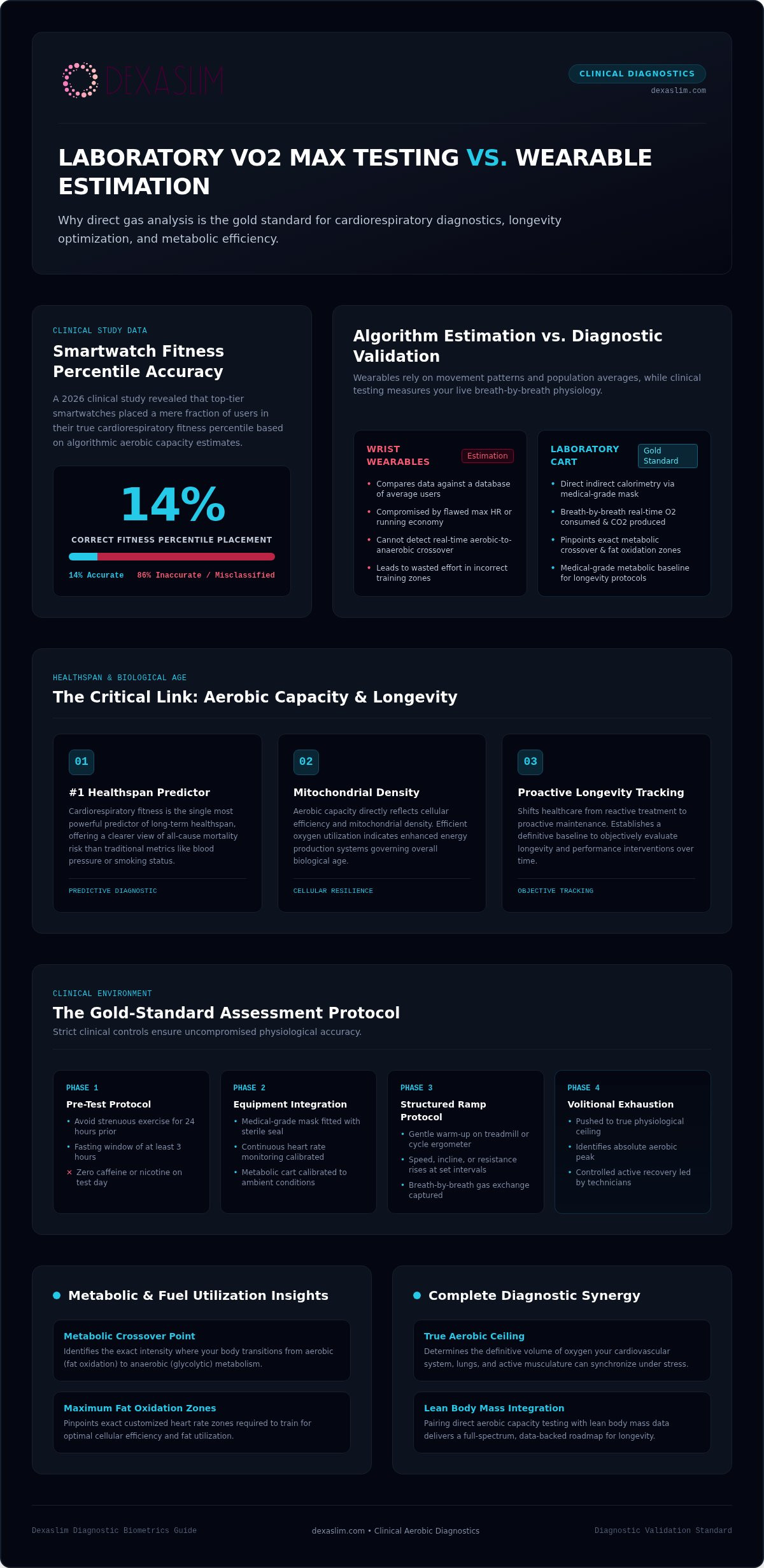
A 2026 clinical study revealed that top-tier smartwatches placed a mere 14 percent of participants in the correct fitness percentile based on estimated aerobic capacity. If you rely on a wrist-based device to track your cardiorespiratory health, you are training through guesswork. Why invest in a laboratory vo2 max test when your phone or watch gives you a daily estimate? Because algorithm-based estimation is not diagnostic validation.
It's frustrating to waste effort training in the wrong heart rate zones while remaining uncertain about your true cardiovascular health and biological age. You demand precision. Discover how a clinical-grade laboratory vo2 max test eliminates wearable guesswork to unlock your precise metabolic and cardiovascular baseline. This guide details how direct gas analysis establishes a definitive cardiorespiratory baseline, identifies your exact zones for maximum fat oxidation, and provides the ultimate metric to track your proactive longevity interventions.
Key Takeaways
• VO2 max is the single most powerful predictor of healthspan, offering a clearer view of all-cause mortality risk than traditional metrics like blood pressure or smoking status.
• A professional laboratory vo2 max test utilizes direct metabolic cart diagnostics to eliminate the significant individual error ranges inherent in consumer smartwatch algorithms.
• Clinical assessment identifies your precise metabolic crossover point, revealing the exact heart rate zones required to maximize fat oxidation and cellular efficiency.
• Reliable results depend on strict adherence to pre-test protocols, including controlled fasting and peak physical effort to reach true volitional exhaustion.
• Integrating aerobic data with lean body mass analysis provides a complete, data-backed strategy for proactive longevity and performance optimization.
The Limits of Wearable Estimation: Why You Need a Laboratory VO2 Max Test
Your smartwatch is guessing. While consumer wearables provide convenient daily snapshots, they rely on heart rate proxies and proprietary algorithms to estimate your VO2 max. These devices do not actually measure your physiology; they compare your movement data against a database of the average user. If your max heart rate is set incorrectly or your running economy deviates from the norm, your data is compromised. Real progress requires an objective physical baseline, not a software estimation.
A laboratory vo2 max test represents the maximum volume of oxygen your body utilizes during intense exercise. It is the definitive measure of how well your heart, lungs, and muscles synchronize under stress. Relying on wrist-based sensors creates uncertainty that leads to wasted effort in incorrect training zones. Direct laboratory evaluation is the only definitive way to eliminate fitness training guesswork and secure a medical-grade metabolic profile.
What Is a True Laboratory VO2 Max Test?
Clinical testing utilizes indirect calorimetry via a specialized metabolic cart. During the assessment, you wear a medical-grade mask that forms a sterile seal, capturing every breath you take. The system performs a breath-by-breath analysis to measure precise oxygen consumption and carbon dioxide output in real time. Unlike a watch, the cart detects exactly when your body shifts from aerobic to anaerobic metabolism. This reveals your precise metabolic crossover point and identifies how efficiently your cells utilize fuel at varying intensities. Gas exchange analysis stands as the clinical standard for determining metabolic efficiency and your true aerobic ceiling.
The Critical Link Between Aerobic Capacity and Longevity
Cardiorespiratory fitness is the single most powerful predictor of long-term healthspan. High VO2 max scores correlate with a dramatic reduction in all-cause mortality, often exceeding the protective benefits of avoiding smoking or managing high blood pressure. This metric serves as a window into your cellular health. Efficient oxygen utilization indicates high mitochondrial density, which directly governs your overall biological age. When you improve your aerobic capacity, you are not just getting faster; you are optimizing the energy production systems that sustain every organ in your body. By prioritizing a laboratory vo2 max test, you shift from reactive healthcare to proactive maintenance. You establish a clear physical baseline to track the clinical interventions that keep your biological systems resilient against the diseases of aging.
Inside the Clinical Environment: What to Expect During an Aerobic Capacity Assessment
Stepping into a performance lab should feel like entering a mission control center for your health. Forget the misconception that a laboratory vo2 max test is reserved for elite marathoners or Olympic cyclists. This diagnostic tool is the gold standard for determining cardio-respiratory fitness for anyone pursuing a longer, more resilient life. You are not an intruder in this space; you are a data-driven strategist seeking the ultimate baseline.
Preparation is simple but non-negotiable. Arrive in standard athletic attire and well-fitted running shoes. You must avoid strenuous exercise for 24 hours prior and maintain a fasting window of at least three hours to ensure metabolic data remains untainted by recent caloric intake. Caffeine and nicotine are strictly prohibited on the day of the test. Clinical technicians lead the entire session, ensuring your safety while precisely calibrating the equipment to your unique physical profile.
The Step-by-Step Testing Protocol
The process begins with equipment integration. Technicians fit you with a medical-grade metabolic mask and continuous heart rate monitoring sensors. This mask captures every milliliter of expired air for real-time gas analysis. Once calibrated, you begin a gentle warm-up on a treadmill or cycle ergometer. The intensity then increases through a structured ramp protocol, where speed, incline, or resistance rises at set intervals. The session concludes only when you reach volitional exhaustion, the point where you can no longer maintain the required pace. This peak effort is essential to capture your true physiological ceiling.
Clinical Monitoring and Safety Frameworks
Safety is the clinical priority. Technicians monitor your respiratory exchange ratio (RER) throughout the test. This metric confirms when you have reached a true maximal effort by analyzing the ratio of carbon dioxide produced to oxygen consumed. Constant physiological tracking allows for immediate adjustments, making the test accessible for all fitness levels, from beginners to advanced athletes. Every stage is customized to your current baseline, ensuring you are pushed to your limit without compromising safety. If you are ready to stop guessing and start measuring, consider booking your VO2 Max Performance Testing session to secure your definitive longevity metrics.
Wearables vs. Gold-Standard Lab Testing: The Precision Metrics
Smartwatches do not measure your lungs. They track your wrist pulse and run the numbers through a generalized formula. While a fitness tracker offers an effortless estimate during your morning jog, it cannot capture the physical reality of gas exchange. A laboratory vo2 max test replaces these speculative algorithm models with direct, unyielding physical data. It stands as the gold standard for determining cardio-respiratory fitness because it analyzes actual breath, not pulse proxies.
Consumer wrist sensors fail to accurately track rapid physiological shifts. When you transition from a steady jog to an all-out sprint, your heart rate lags behind the actual oxygen demand of your muscles. Independent research demonstrates that individual deviations from a true lab-measured baseline can reach 10 to 15 percent on commercial trackers. This mathematical margin of error is too wide for precision training. Clinical metrics provide the only reliable foundation for designing targeted longevity protocols that optimize every minute of your exercise routine.
Why Smartwatch Algorithms Fall Short
Environmental variables distort wearable estimates instantly. High heat, poor hydration, sleep deprivation, and uneven terrain alter your heart rate without changing your actual aerobic capacity. Your watch interprets a heat-induced spike in heart rate as a drop in fitness. Furthermore, commercial software relies on heart rate variability and pre-programmed demographic equations. These proprietary commercial formulas generalize your data based on population averages instead of personalizing your results. They assume your body behaves exactly like the statistical norm, ignoring your unique metabolic profile.
The Irreplaceable Data Captured by a Metabolic Cart
A clinical metabolic cart captures critical biometrics that smartwatches are fundamentally blind to tracking. Chief among these are your exact ventilatory thresholds (VT1 and VT2). The cart tracks the precise point where your breathing accelerates relative to your oxygen consumption, signaling a shift in energy systems. Continuous carbon dioxide monitoring reveals your exact cellular fuel crossover point, the precise heart rate where your body stops burning fat and shifts entirely to carbohydrates. Additionally, the test captures your absolute peak heart rate under clinical duress. Knowing this exact ceiling allows you to calibrate training zones with absolute certainty, ensuring your high-intensity intervals hit the precise mark required for mitochondrial optimization.
Decoding Your Results: Transforming Biometrics into a Precision Longevity Protocol
Raw numbers without application are useless. A laboratory vo2 max test delivers a comprehensive clinical data sheet detailing your exact physiological response to exertion. Instead of staring at an isolated, arbitrary score on a screen, you must decode these metrics to reshape your weekly exercise routines. Shifting your focus from generic duration targets to precise, data-backed physiological zones forces your body to adapt at a cellular level. This structured approach establishes a clear framework for tracking improvements over time, ensuring your training drives biological optimization.
Execution requires precision. If you are ready to convert raw biometrics into an actionable healthspan strategy, secure your clinical data sheet by scheduling your VO2 Max Performance Testing session today.
Finding Your Precise Ventilatory Thresholds
The clinical data sheet exposes two critical metabolic boundaries that define your current aerobic capacity:
Ventilatory Threshold 1 (VT1)
This marks the boundary for optimal fat oxidation and base endurance. Below this heart rate, your body relies primarily on oxygen and lipids for fuel, maximizing metabolic efficiency.
Ventilatory Threshold 2 (VT2)
This represents your anaerobic threshold. Beyond this point, lactic acid accumulates rapidly in the bloodstream, and your muscles burn carbohydrates exclusively until reaching volitional exhaustion.
Knowing these exact markers prevents overtraining, protects cellular health, and accelerates cardiovascular development by removing guesswork from your pacing.
Calibrating a Weekly Cardiovascular Strategy for Healthspan
True cardiovascular optimization demands a polarized training structure based on your clinical thresholds. Allocate approximately 80 percent of your weekly cardiovascular volume to low-intensity Zone 2 training, keeping your heart rate strictly below VT1. This high-volume, low-stress protocol builds mitochondrial density and enhances cellular energy production. Dedicate the remaining 20 percent of your routine to high-intensity interval training targeted precisely at your true maximal oxygen capacity, pushing past VT2 to force structural cardiac adaptations. This data-driven pacing maximizes fat loss while completely preserving hard-earned lean muscle mass, ensuring your training directly extends your functional healthspan.
Optimize Your Performance Baseline with Dexaslim Diagnostics
Stop tolerating the fitness frustration born from inaccurate wearable metrics and unverified training routines. Dexaslim stands as your premier destination for advanced cardiorespiratory and metabolic testing. We replace vague intuition with clinical truth. Objective biometric data serves as the ultimate antidote to wasted gym hours and stagnant healthspan markers. By executing a laboratory vo2 max test, you transition decisively from traditional, reactive healthcare to data-driven human performance optimization. You take absolute command of your internal trajectory.
The Power of the VO2 Max + DEXA (BCA) Bundle
True physiological mastery requires evaluating both your internal engine capacity and your physical chassis. The VO2 Max + DEXA (BCA) Bundle delivers this exact diagnostic synergy by pairing gas exchange analysis with advanced body composition imaging. Tracking hidden visceral fat alongside your cardiorespiratory limits provides an uncompromising, multidimensional longevity profile. Lean mass measurements from the DEXA scan allow you to refine your cardiorespiratory power-to-weight ratio with mathematical exactitude. Knowing your precise muscle mass lets you calculate how effectively your body distributes oxygen per kilogram of functional tissue. This combined protocol represents the most efficient, data-dense diagnostic experience available for modern self-optimization.
Take Control of Your Biological Trajectory
Don't wait for age-related decline to force a medical intervention. Our streamlined booking process is designed specifically for busy, health-conscious individuals who demand empirical evidence over speculation. You select your time, complete the clinical protocol, and receive immediate delivery of actionable reports. These comprehensive data sheets give you the exact blueprints required to guide your daily nutrition and target your weekly exercise zones. Your biological age is entirely malleable when guided by precise metrics. Secure your laboratory vo2 max test and body analysis session at Dexaslim today to lock in your definitive baseline and command your future health.
Secure Your Physiological Future
Precision is the only path to optimized longevity. You've seen how wearable algorithms fail to capture the reality of gas exchange. A laboratory vo2 max test provides the medical-grade metabolic cart diagnostics necessary to stop training by intuition. By identifying your exact ventilatory thresholds, you can finally calibrate a cardiovascular strategy that protects your heart and builds mitochondrial efficiency. This is not just about performance; it's about extending your functional healthspan through objective measurement.
Pairing these aerobic insights with the VO2 Max + DEXA (BCA) Bundle creates an uncompromising, multidimensional view of your internal health. You receive actionable, data-driven longevity reporting that translates complex biometrics into immediate daily action. Don't let software estimates dictate your biological trajectory. Use clinical truth to refine your nutrition, protect your lean muscle, and maximize every minute of your training.
Stop guessing and measure your true physiological baseline by booking your VO2 Max Performance Testing session today. Take command of your cellular health. Your future self will thank you for the data you act on now.
Frequently Asked Questions
How long does a laboratory VO2 max test session take?
A full appointment requires approximately 45 to 60 minutes from arrival to departure. The actual exercise portion on the treadmill or cycle ergometer lasts only 8 to 12 minutes. The remaining time is dedicated to pre-test equipment calibration, mask fitting, a controlled warm-up, and a detailed post-test physiological review. This structured timeline ensures maximum data accuracy without unnecessary physical exhaustion.
How accurate are smartwatches compared to a clinical VO2 max lab test?
Smartwatches are significantly less accurate than a clinical test. Wrist-based wearables rely on pulse tracking and generalized population algorithms to estimate your aerobic capacity. Independent studies show these trackers have individual error ranges reaching 10 to 15 percent. A laboratory vo2 max test utilizes direct gas analysis via a metabolic cart, completely eliminating software guesswork to secure your precise baseline.
What should I wear and how should I prepare for my laboratory test?
Arrive wearing standard athletic attire and supportive running shoes. Preparation requires a strict three-hour fasting window to keep your baseline metabolic data clear of digestive interference. Avoid strenuous exercise for 24 hours prior to your appointment. You must completely avoid caffeine, alcohol, and nicotine on the day of the test to ensure your heart rate response remains completely natural.
Can everyday fitness enthusiasts take a clinical aerobic capacity test?
Clinical testing is fully accessible to everyday health seekers and longevity enthusiasts. The protocol is not reserved exclusively for elite athletes. Technicians customize the progressive intensity ramp to your current physical capabilities, ensuring absolute safety. Anyone looking to optimize their training zones, track biological aging, or eliminate guesswork from their cardiovascular routine can execute this diagnostic assessment.
What specific metrics are measured during a laboratory metabolic test?
The metabolic cart captures a comprehensive array of respiratory biometrics. The primary metrics include your absolute volume of oxygen consumption, carbon dioxide production, and peak heart rate under stress. The test identifies your exact Ventilatory Threshold 1 and Ventilatory Threshold 2. These markers reveal your precise metabolic crossover point, showing exactly when your cells shift from burning fat to burning carbohydrates.
How often should I repeat a laboratory VO2 max test to track progress?
Schedule a laboratory vo2 max test every six months to track your physiological progress accurately. This timeframe gives your cardiovascular system and mitochondria sufficient time to adapt to new training protocols. Re-testing twice a year allows you to refine your heart rate training zones based on real physical gains, ensuring your longevity interventions remain highly personalized and effective.