.svg)

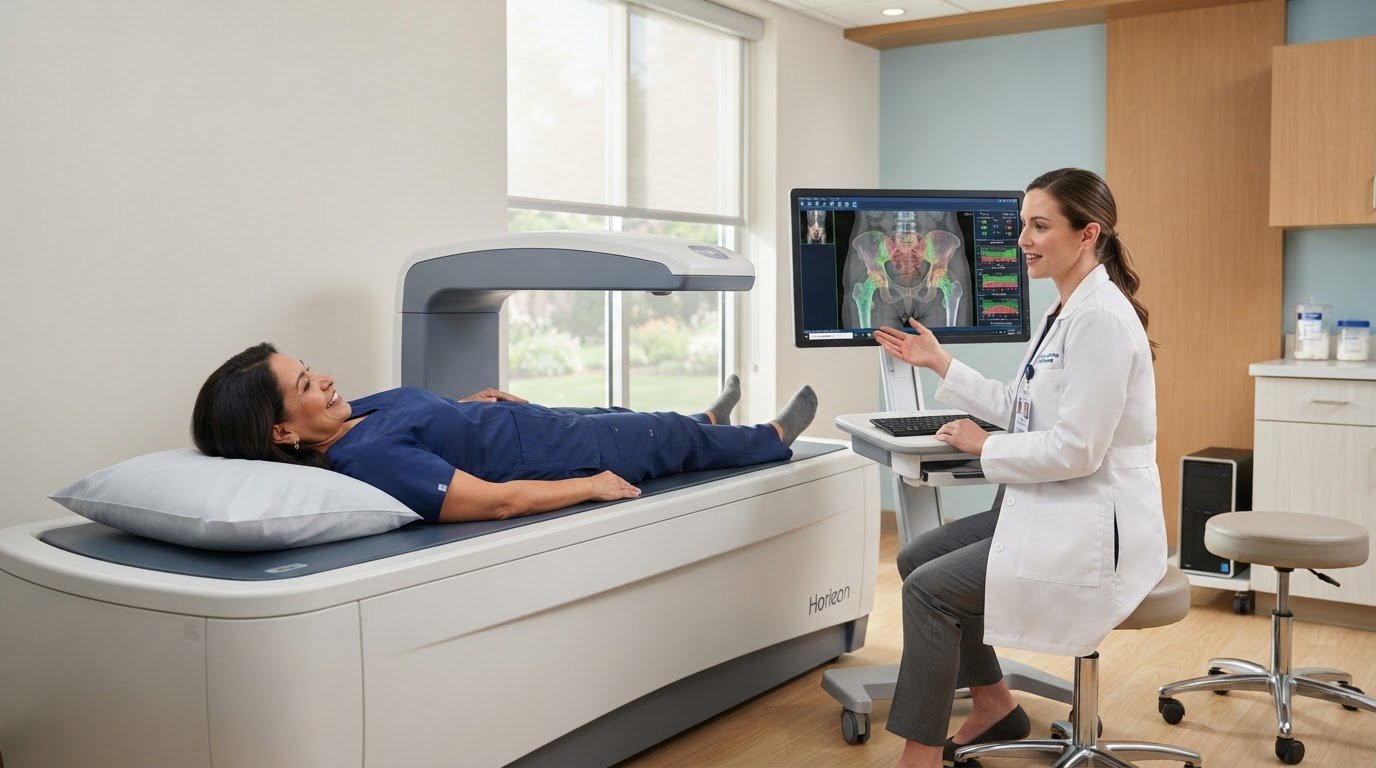
A bone density scan gives you an objective measurement, not a complete verdict on your bone health. A DEXA evaluation estimates bone mineral density, but the result needs context, including your health history and other risk factors, before it can inform decisions.
If you’re considering a scan, first clarify what you want to learn. A dedicated bone density assessment measures a different set of metrics from a DEXA body composition scan, which estimates fat and lean mass. Choosing the right assessment starts with matching its purpose to your question.
This guide explains what a bone density scan can and can’t establish, how to compare evaluation options, and what to expect before and during an appointment. You’ll also learn how T-scores fit into a broader care discussion, along with practical details about preparation and radiation exposure. Dexaslim uses medical-grade DEXA technology for dedicated bone density assessments, providing an objective measurement to discuss alongside your personal health history.
Key Takeaways
• Learn what a bone density scan measures and why the result is one part of assessing bone health, not a guarantee about fracture risk.
• Understand how DEXA estimates bone mineral density and what its findings can contribute to a clinical discussion.
• Match the assessment to your goal: bone density, body composition, and other imaging answer different questions.
• Prepare by following your appointment instructions and gathering relevant health history and prior imaging to share with your clinician.
• See how a dedicated DEXA assessment from Dexaslim can provide an objective measurement to inform next steps with your clinician.
Bone Density Scan: What It Measures and Why the Result Matters
A bone density scan estimates bone mineral density, commonly using DEXA technology. The measurement can help a clinician evaluate bone health and consider osteoporosis risk alongside your medical history and other relevant information.
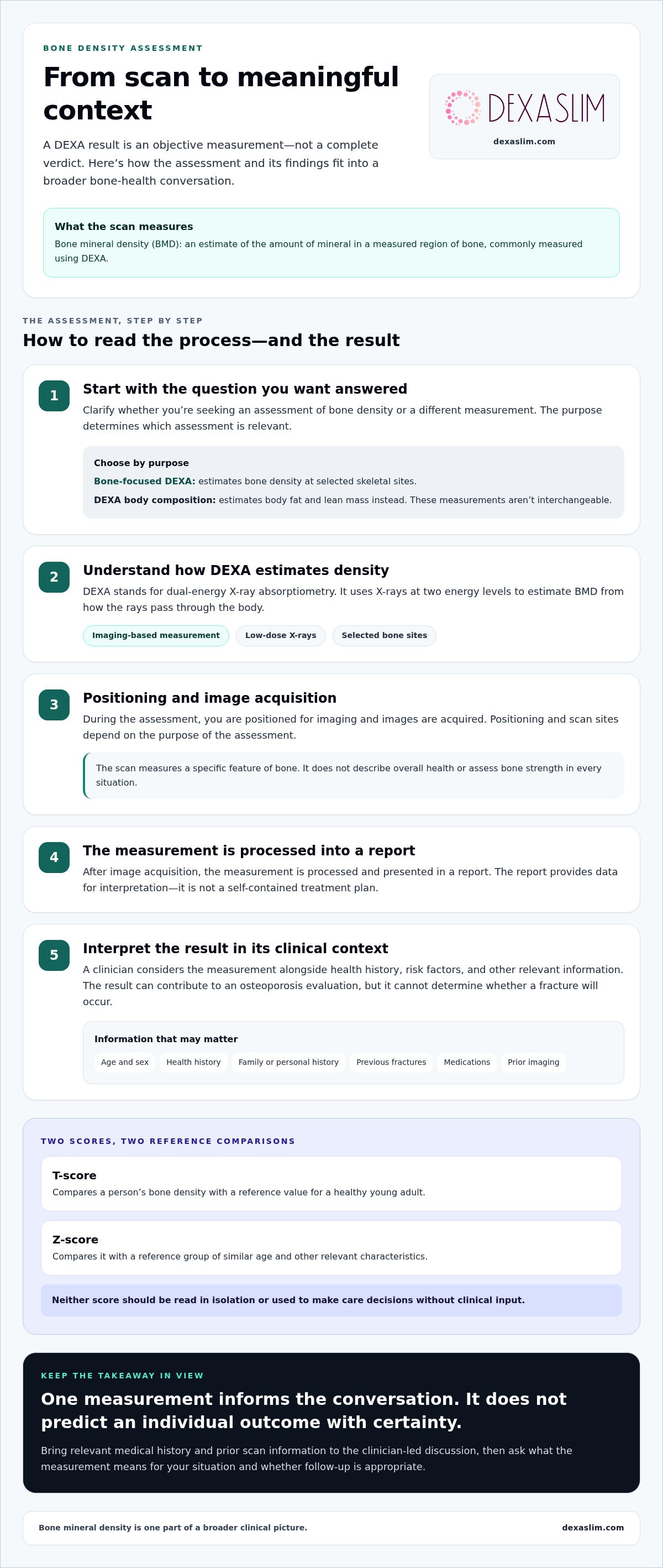
Bone mineral density is an estimate of the amount of mineral in a measured area of bone. Clinicians use it as one indicator when evaluating bone health and osteoporosis risk. The scan measures a specific feature of bone. It does not describe overall health, assess bone strength in every situation, or determine whether a fracture will occur.
What does a bone density scan actually measure?
Bone mineral density, often shortened to BMD, describes how much mineral is present in a measured region of bone. A DEXA scan uses low-dose X-ray measurements to estimate BMD. Learn more about Dual-energy X-ray absorptiometry (DEXA), the imaging method commonly used for this assessment.
The scan site and protocol depend on the assessment’s purpose. A bone-focused assessment evaluates density at selected skeletal sites. A DEXA body composition scan estimates body fat and lean mass instead. The measurements aren’t interchangeable, so choose the assessment that matches the question you want answered rather than assuming every DEXA scan measures bone density.
Think of the result as one defined data point, not a complete picture. It can contribute to an osteoporosis evaluation, but it cannot establish fracture certainty on its own. A clinician interprets the measurement in context, including your health history and other risk factors. If your history or prior results raise questions, share that information so the clinician can consider what the number means and what discussion should follow.
Who may benefit from discussing a scan?
The decision is individual. Age, sex, family or personal health history, previous fractures, medications, and other factors may inform a clinician’s assessment. No single detail automatically means everyone should be scanned. A bone density scan may be worth discussing when you or your clinician have a specific question about bone health or want an objective measurement to add to a broader evaluation.
Bring the context, not just the question. Share relevant medical history, medications, past fractures, and previous imaging with a qualified clinician. Earlier scan results may help the clinician decide whether a new measurement is useful and how to interpret it alongside previous information. Screening decisions should reflect your circumstances and current clinical guidance, not a one-size-fits-all rule.
Use the result to guide a focused conversation. Ask what the measurement indicates, how it relates to your personal risk factors, and whether follow-up is appropriate. Dexaslim provides dedicated bone density assessments using medical-grade DEXA technology, giving you an objective measurement to discuss with your clinician.
How DEXA Measures Bone Density and What the Results Can Tell You
DEXA stands for dual-energy X-ray absorptiometry. The technology uses X-rays at two energy levels to estimate bone mineral density from how the rays pass through the body. In a bone density scan, the result is an imaging-based measurement, not a direct test of whether a fracture will happen.
A bone density value describes one aspect of bone. A person’s overall fracture risk depends on that value and the broader clinical picture. Your clinician may consider the result alongside your health history, risk factors, and other relevant information. The measurement can inform an evaluation, but it cannot predict an individual outcome with certainty.
What happens during a DEXA bone density assessment?
The general process involves positioning for imaging, acquiring the images, and reviewing the resulting report. Positioning and scan sites depend on the assessment’s purpose. Dexaslim uses medical-grade DEXA technology for dedicated bone density assessments. For a patient-friendly overview of the procedure and its purpose, see MedlinePlus Bone Density Scan Information.
After image acquisition, the measurement is processed and presented in a report. The report provides data for interpretation, rather than a self-contained treatment plan. Bring prior scan information and relevant medical history to the clinician-led discussion, especially if the evaluation is part of ongoing monitoring. Meaningful comparison depends on the clinical context and the details of the assessments being reviewed.
How should readers think about T-scores and Z-scores?
A T-score compares a person’s bone density with a reference value for a healthy young adult. A Z-score compares it with a reference group of similar age and other relevant characteristics. These scores frame the measurement in different ways. Neither should be read in isolation or treated as a complete statement of health.
Interpretation depends on the person’s circumstances and applicable clinical guidance. The relevance of a score may depend on factors such as age, health history, and why the assessment was performed. Avoid drawing conclusions from an isolated score or using it to make care decisions without clinical input.
For a deeper explanation of how scores are interpreted, see Osteoporosis Bone Density Scan: Interpreting T-Scores. Use that information to prepare questions, then discuss what the report means for your own situation with a qualified clinician. If you’re seeking an objective measurement for that conversation, Dexaslim’s dedicated bone density assessment provides a direct next step.
Choosing a Bone Density Scan: Compare Purpose, Method, and Follow-Up
Choose an assessment based on the question you need answered. A bone-focused evaluation, a body composition scan, and imaging for another clinical purpose measure or reveal different things. The technology may overlap, but the purpose and interpretation do not. Before booking, clarify whether you’re seeking information about bone density, fat and lean tissue, or another health question. Consider how the findings will be used in a broader care discussion.
Bone density scan versus body composition DEXA
A bone density scan estimates bone mineral density to contribute to an assessment of bone health. A body composition DEXA focuses on fat and lean tissue. Neither automatically substitutes for the other. Dexaslim offers both dedicated bone density assessments and DEXA body composition scans, so select the assessment that matches the measurement you’re seeking.
The title DEXA Body Composition Scan: The Clinical Gold Standard for Health and Longevity (2026) covers the body composition purpose in greater detail. Keep the distinction clear: body composition data doesn’t answer the same question as a dedicated bone assessment.
| Assessment | Main purpose | What it helps address |
|---|---|---|
| Bone density assessment | Estimate bone mineral density | Provides a measurement to inform discussion of bone health and osteoporosis risk |
| Body composition DEXA | Assess fat and lean tissue | Provides body composition information, not a dedicated bone evaluation |
| Other imaging | Answer a different clinical question | May show structures or findings relevant to its specific purpose; it isn’t automatically equivalent to a dedicated bone density assessment |
Which decision criteria matter before booking?
Use these criteria to make your choice:
Define the goal.
Are you seeking bone health information or body composition data? Select the assessment designed to address that question.
Consider clinical guidance.
If a clinician has recommended a scan or follow-up, use that recommendation and your personal history to shape the next step.
Match the report to the purpose.
Confirm that the assessment provides information about the measurement you want. A report about fat and lean mass won’t replace bone density findings.
Plan for interpretation.
Scan findings need context. Discuss what they mean for you with a qualified clinician, and don’t treat them as a substitute for individualized medical care.
Good selection starts with a clear question and ends with a useful conversation about the findings. Dexaslim’s dedicated bone density assessment uses medical-grade DEXA technology to provide an objective measurement for discussion alongside your health history. Keep the purpose specific, then use the result as one input in clinician-led decision-making.
Preparing for a Bone Density Scan and Using the Findings
Good preparation starts with accurate information, not assumptions. Instructions can vary by appointment, so follow the guidance provided for your scan rather than applying a universal checklist. Gather relevant context to help a clinician interpret the findings alongside your health history.
What should you do before the appointment?
Use this sequence to get organized:
1. Review your appointment instructions. Follow the clinic’s current directions. Don’t change medications or make preparation decisions based on generic advice unless your care team instructs you to.
2. Gather relevant records. Bring prior scan reports or imaging information, if available, along with a current medication list and relevant health conditions. This helps your clinician consider the new measurement in context.
3. Flag pregnancy or possible pregnancy. Tell the clinical team before imaging if you’re pregnant or think you may be. They can discuss the appropriate next step for your circumstances.
Follow your appointment instructions and bring relevant health information, including prior imaging and a current medication list. Clear, complete context helps keep the evaluation focused on your individual situation.
What should happen after the scan?
Review the findings with a qualified clinician. A measurement or score needs to be interpreted alongside your personal history, risk factors, prior results, and the reason for the assessment. Avoid treating a single number as a diagnosis or using it alone to decide what care you need.
Next steps depend on the findings and clinician judgment. They may include monitoring over time or further evaluation, depending on what the report shows and how it fits your health picture. If you have previous results, bring them to the discussion so changes can be considered in context rather than viewed as isolated figures.
Use the report to guide focused questions: What does this finding mean for me? How does it compare with relevant prior information? Is follow-up appropriate, and if so, what should guide its timing? For additional report-focused guidance, look for DEXA Scan Results Explained: Reading Your Clinical Report. The goal is to translate the measurement into an informed discussion, not a self-diagnosis.
If you’re ready to add an objective measurement to a clinician-led bone health discussion, book a dedicated bone density assessment with Dexaslim.
Book a Dedicated Bone Density Scan with Dexaslim
You’ve learned what a bone density measurement can contribute and why it needs clinical context. Choose an assessment built for the question you want answered. Dexaslim offers a dedicated bone density assessment using medical-grade DEXA technology, providing an objective measurement to inform a discussion with your clinician.
What Dexaslim's bone density scan is designed to assess
This service focuses on bone density. It’s separate from DEXA body composition analysis, which assesses fat and lean tissue. The assessments have different purposes, so select the one that aligns with your goal. A dedicated bone assessment provides bone-focused information to bring into a broader conversation about your health history and individual risk factors.
DEXA provides a measurement, not a guarantee about future health or a stand-alone determination of whether you have a disease. Your clinician can interpret findings in context and discuss whether further evaluation or follow-up is appropriate. Objective data can make a care discussion more informed, but it doesn’t replace individualized medical guidance.
Take the next step with informed expectations
Prepare to make the appointment useful. Gather relevant health information and any prior scan reports you have. Follow the instructions provided for your appointment, and share relevant details with your clinician so the measurement can be considered alongside your personal history. Bring questions about why the assessment is being considered or how its findings may fit into your care.
Dexaslim’s dedicated assessment offers a focused way to obtain bone density information. The value is a clear measurement to support a clinician-led conversation, not a promised diagnosis or outcome. Review the bone density scan service and appointment information on Dexaslim’s website to understand the next steps and prepare for your evaluation.
Choose data that answers the right question. Explore Dexaslim’s bone density scan appointment information and take the next step toward an informed discussion about your bone health.
Make Your Next Step a Measured One
Better decisions start with a clear question. If you’re considering a bone density scan, connect the decision to your personal health history and guidance from a qualified clinician. The measurement can add useful information to that conversation, while interpretation and next steps remain specific to you.
Dexaslim offers dedicated bone density assessments using medical-grade DEXA technology, with single-session diagnostic appointments. Bring relevant prior reports or health information to your clinical discussion. The goal is an objective measurement you can put into context, not a number interpreted in isolation.
Take a focused next step. Explore Dexaslim’s bone density scan and review the appointment information. With the right question and relevant context, you can move forward with a more informed conversation about your health.
Frequently Asked Questions
What does a bone density scan show?
A bone density scan estimates bone mineral density, giving clinicians one measurement to consider when evaluating bone health. It doesn’t provide a complete diagnosis or guarantee whether a fracture will occur. Interpretation depends on context, including your medical history, risk factors, and reason for testing. If you’ve had a fracture or have earlier scan results, share that information with a qualified clinician and discuss what the findings mean for your next steps.
Is a bone density scan the same as a DEXA scan?
DEXA, also called DXA, is a commonly used technology for assessing bone density, so people often use the terms interchangeably. But a specific DEXA appointment can have a different purpose. A dedicated bone assessment focuses on bone density, while DEXA body composition analysis focuses on fat and lean tissue. Before your appointment, make sure the selected assessment is designed to provide the measurement you’re seeking.
Does a bone density scan use radiation?
Yes. DEXA uses X-rays, so the scan involves exposure to ionizing radiation. The amount depends on the specific protocol, so don’t rely on an unsourced dose or comparison when weighing individual considerations. Tell the clinical team if you’re pregnant or may be pregnant before imaging. They can discuss your circumstances and the appropriate next step. Share any questions about radiation with the team before the assessment begins.
Can a bone density scan diagnose osteoporosis by itself?
No. Scan measurements can support an osteoporosis evaluation, but diagnosis and care decisions depend on clinical context and applicable guidance. A clinician may consider your age, health history, risk factors, and other findings rather than relying on one result alone. Don’t interpret a score in isolation or use it to decide on treatment. For more detail on score interpretation, see the article Osteoporosis Bone Density Scan: Interpreting T-Scores.
How often should you get a bone density scan?
There isn’t one repeat interval that fits everyone. Timing depends on your initial findings, risk profile, health history, and whether another measurement could affect care decisions. A clinician may weigh a change in your health circumstances differently from a stable history and result. Follow an individualized recommendation rather than scheduling repeat scans automatically. Ask what the next measurement would help clarify and how its result could guide follow-up.
Do you need to prepare for a bone density scan?
Preparation can vary by clinic and appointment, so follow the instructions you receive rather than assuming standard rules apply. Bring prior scan reports if available, and be ready to share relevant health information and medications. Don’t stop or change medication unless your clinician tells you to. If you’re pregnant or could be pregnant, tell the clinical team before imaging so they can discuss your situation and the appropriate plan.
Can younger adults get a bone density scan?
Yes, a scan may be considered for a younger adult when there’s a specific clinical question, but age alone doesn’t determine whether it’s appropriate. A clinician can weigh personal history, risk factors, and the reason for testing. For example, a relevant health concern may prompt a different discussion than a request for routine screening without a defined reason. Talk through your circumstances with a qualified clinician before deciding whether an assessment fits your needs.