.svg)

The most reliable weight loss accountability comes from stacking three things: low-burden tracking you’ll actually keep doing, regular human check-ins, and goals specific enough to measure weekly. Research on evidence-based frameworks shows daily self-report can stay light and still work, while clinical measurement (DEXA, resting metabolic rate) is a precision upgrade for people who plateau or want certainty, not a requirement to start.
TL;DR:
- Light, low-burden tracking methods like weekly average weight, meal photos, and passive activity data are sufficient for sustained accountability and high adherence.
- Weekly check-ins should focus on specific metrics such as average weight, habit completion rate, and one obstacle to maintain structure without overwhelming users.
- Clinical tools like DEXA scans and metabolic rate tests provide valuable insights during plateaus but are not necessary for regular tracking.
- Building a recurring schedule for check-ins and setting measurable weekly goals enhances motivation and long-term maintenance.
- Accountability systems should be flexible and tailored, with group or partner options depending on individual response, to prevent abandonment or burnout.
Table of Contents
- What Is Weight Loss Accountability, Practically Speaking?
- How Do You Choose a Support Group or App?
- What Do Clinical Weight Loss Programs Do Differently?
- Scale Weight, Body Composition, or Behavior: What Should You Track?
- How to Build a 6-Week Accountability Plan
- Why Mindset Shapes Whether Accountability Sticks
- What Gets in the Way of Staying Accountable
- Does Accountability Actually Affect Long-Term Maintenance?
- Is a Partner or a Group Better for Accountability?
- Balancing Compassion, Consistency, and Data
- When Precision Testing Sharpens Your Accountability Plan
- Sources
- FAQ
What Is Weight Loss Accountability, Practically Speaking?
Weight loss accountability means building a system where someone, or something, notices whether you did what you said you’d do. That’s it. It’s not a personality trait, and it’s not about willpower. It’s structure.
The research backs this up in a way that surprises people who assume more tracking equals better results. A 2026 study on the ENHANCE framework found that combining smart-device data with minimal self-report produced very high daily adherence, and the group-level trend model explained most of the smoothed weight variance. Translation: people stuck with a light-touch system, and that light-touch system still generated data clean enough to guide real coaching decisions. Heavy logging isn’t the requirement. Consistent, low-friction logging is.
Set goals you can actually measure weekly
Vague goals (“eat healthier,” “move more”) don’t give you or a partner anything to check. Specific, measurable goals do. Instead of “exercise more,” try “three 30-minute walks by Friday.” Instead of “eat better,” try “log dinner five nights this week.” Set a cadence up front, weekly is usually the right unit, since day-to-day weight swings from water and sodium make daily judgment calls unreliable.
Daily micro-habits vs. weekly checkpoints
Some things work best as daily habits because they’re small and don’t require thought: taking a morning weight, snapping a food photo, hitting a step target. Other things belong at the weekly level because they require reflection: reviewing the week’s trend, adjusting calorie targets, deciding whether to change your workout split. Trying to make every decision daily leads to overreaction to normal noise. Save the big calls for the weekly review.
Structured check-ins: what to actually share
A check-in works better with a template than a vague “how’s it going?” Share three things each time: your weekly average weight (not a single day’s number), your habit completion rate (how many of your planned actions you actually did), and one obstacle from the week. Whether the other side of that check-in is a partner, a coach, or a group thread, this three-part structure keeps it fast and useful. A cohort study on genomic-enhanced digital coaching found that each additional coaching session was associated with more weight loss, and engagement with logging and coaching sessions correlated strongly with outcomes in that Digbi Health cohort. More structured contact, even brief contact, moves the needle.
Low-burden tracking that doesn’t burn you out
- Weekly mean weight, not daily readings taken at face value. Average five to seven days to smooth out water retention and sodium swings.
- Photo logs of meals, which take seconds and remove the need for detailed calorie math on busy days.
- Step or activity counts from a phone or wearable, tracked passively so there’s nothing to remember.
- A single weekly self-report question, like rating adherence to your plan on a 1 to 5 scale, which research on survey length shows keeps adherence high without overwhelming users.
Pro Tip: Weigh yourself at the same time each morning, but only look at your weekly average, not the daily number. The daily number is noise; the weekly trend is signal.
How Do You Choose a Support Group or App?
Fitness accountability partners, apps, and weight loss support groups all work through the same mechanism: somebody notices if you disappear. The format you pick should match your personality and your tolerance for social pressure, because the wrong fit gets abandoned in two weeks.
Four common formats each carry tradeoffs. A one-on-one accountability partner gives you direct, personal check-ins but depends entirely on that one person staying consistent. A small group of four to eight people spreads the responsibility around so no single relationship carries the whole system, and peer accountability in small committed groups tends to combine social reinforcement with low cost. A large public forum offers constant activity and anonymity but can feel impersonal and is easy to lurk in without ever engaging. A moderated coaching program, where a professional runs group check-ins, adds real structure but usually costs more.
Before committing to any app or group longer than two weeks, run it through this checklist:
- Low friction: Can you log a check-in in under 60 seconds from your phone?
- Clear check-in structure: Does it ask for specific numbers (weight, steps, habit completion) rather than open-ended chat?
- Positive moderation: Are admins actively removing shaming comments or unsolicited diet advice?
- Measurable output: Does it show you a trend line or weekly summary, not just a feed of posts?
- Streak and photo features: Do these exist without becoming the whole point of the app?
- Wearable integration: Can it pull step or heart-rate data automatically instead of asking you to type it in?
Give any new tool a 7 to 14 day trial before deciding. That’s long enough to see whether the check-in rhythm fits your schedule and whether the community tone feels supportive rather than competitive.
Watch for a few red flags. Groups that reward extreme before-and-after photos over sustainable habits tend to push disordered patterns. Apps that lock basic trend data behind a paywall after a free trial can leave you stranded mid-plan. And any group where moderators, or the crowd, comment on your body without your asking is a reason to leave, not a reason to try harder.
What Do Clinical Weight Loss Programs Do Differently?
Clinician-led programs consistently outperform unstructured self-directed attempts on one dimension in particular: contact frequency. A literature review of accountability frameworks in medical weight loss programs found that team-based structures, built around multidisciplinary staff, scheduled coaching contacts, and objective metrics, are a consistent thread across programs that sustain patient engagement.
More coaching contact correlates with better outcomes: in one digital cohort, each additional coaching session was tied to greater weight loss, and a large majority of participants in that program lost weight overall, according to research on genomic-enhanced digital care.
Three elements from clinical programs are worth borrowing even if you never set foot in a clinic:
- A multidisciplinary view, meaning you look at more than one metric. Weight alone hides a lot; a program that also tracks activity, sleep, or biomarkers catches problems weight-only tracking misses.
- Scheduled contact on a calendar, not “whenever you feel like it.” Clinical programs succeed partly because the check-in date is fixed in advance, removing the decision of whether to reach out.
- Objective metrics alongside self-report, so a coach or partner isn’t relying only on your word for how the week went.
You can replicate the scheduling piece for free: put a recurring weekly check-in on your calendar the same way a clinic would book an appointment. The objective-metrics piece is where clinical measurement earns its place. If your weight has stalled for four to six weeks despite consistent logging, or if you genuinely don’t know whether you’re losing fat or muscle, that’s the point where a clinician-led program or a body composition scan stops being a luxury and starts being useful information.
Scale Weight, Body Composition, or Behavior: What Should You Track?
Your bathroom scale lies to you constantly, not maliciously, just mechanically. Daily weight swings 2 to 4 pounds from water retention, sodium, hormonal cycles, and how much food is still moving through your system. Treating any single day’s number as truth is how people quit after a “bad” Tuesday that was really just a salty dinner.
The fix is averaging. Take your weight most mornings, then look only at the seven-day rolling average. Analysis behind the ENHANCE framework treats daily self-reports and smart-device readings as signals to be corrected and smoothed, rather than as ground truth on their own, which is exactly why the group-level model explained over 90% of trend variance despite noisy daily inputs. Your instinct to trust the raw number less and the weekly trend more is backed by the same math that framework uses.
Behavioral markers deserve equal weight to the number on the scale. Consistency, did you hit your planned habit days this week, tends to predict long-term success better than any single weigh-in. Food photos and activity streaks are behavioral signals worth logging precisely because they’re leading indicators; the scale is a lagging one that shows results weeks after the behavior that caused them.
Pro Tip: If your weekly average hasn’t moved in a month but your clothes fit differently, trust the clothes. Body composition can shift, less fat, more muscle, without total weight changing at all.
This is where clinical testing becomes genuinely useful rather than optional overkill. A DEXA scan measures fat mass, lean mass, and bone density directly, revealing whether a weight-loss plateau is actually a fat-loss plateau or whether you’ve been recomposing quietly. A resting metabolic rate test tells you what your body actually burns at rest instead of relying on generic calculator estimates that can be off by hundreds of calories a day.

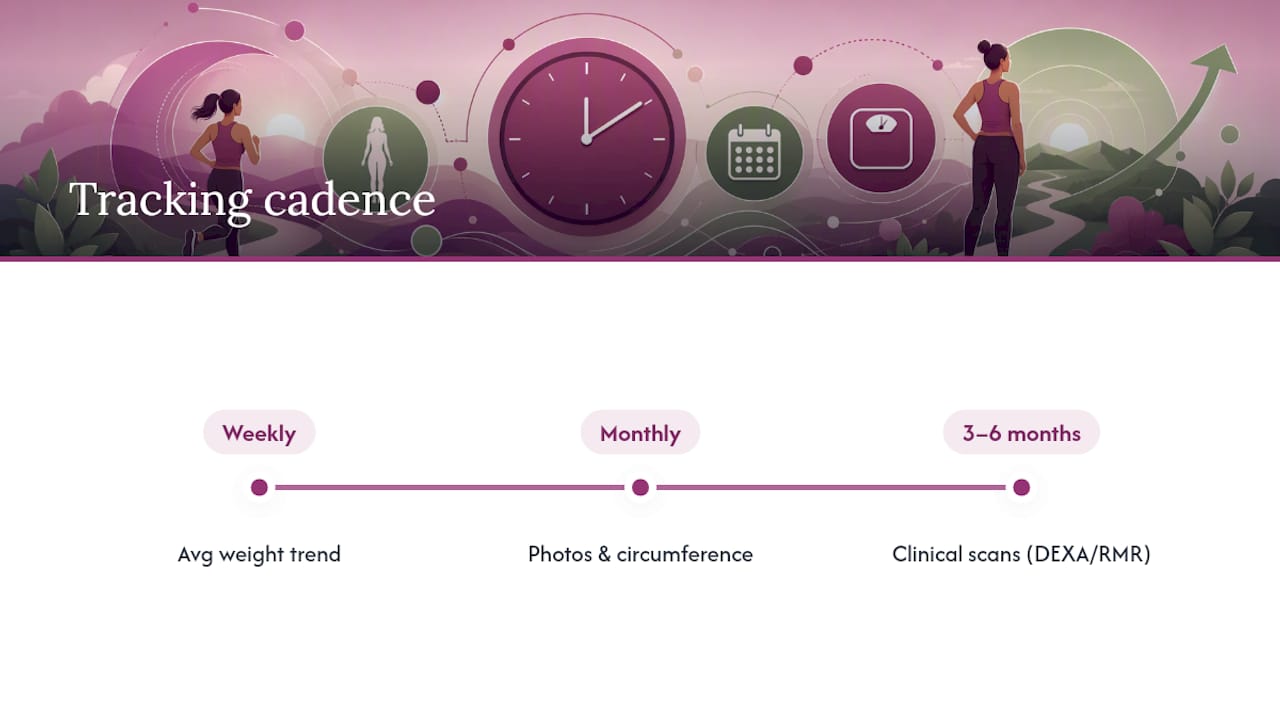
A sensible cadence: weekly averaged weight for the ongoing trend, monthly circumference or photo measurements for a mid-range check, and a clinical scan every three to six months if you use one, timed around plateaus or major plan changes rather than out of routine.
How to Build a 6-Week Accountability Plan
Here’s a plug-and-play structure. Adjust the specifics, but keep the shape.
Weeks 1 to 2: Establish the baseline.
- Set one specific, measurable goal (example: “walk 8,000 steps five days a week”).
- Choose your tracking stack: daily weigh-in, weekly average calculation, and a food photo log.
- Schedule a recurring weekly check-in, same day, same time, with your partner, group, or coach.
- Log daily micro-habits without judging the numbers yet; you’re collecting a baseline.
Weeks 3 to 4: Add structure.
- Start comparing week-over-week averages instead of daily numbers.
- Introduce one new habit only after the first is running on autopilot.
- Use your weekly check-in to report three things: average weight, habit completion percentage, and one obstacle.
Weeks 5 to 6: Review and adjust.
- Look at the six-week trend line, not any single data point.
- Decide whether to hold, increase, or scale back your targets based on that trend.
- If progress has stalled despite consistent logging, this is your checkpoint to consider a body composition scan for clearer data.
Check-in scripts don’t need to be complicated:
- To a partner: “This week’s average was X, down/up from last week. I hit my habit target 5 of 7 days. My obstacle was evening snacking.”
- To a group: Post the same three numbers publicly; groups respond better to consistent short updates than long personal essays.
- To a coach: Add one specific question, “should I adjust calories given this trend?”, so the check-in produces a decision, not just a report.
If two consecutive weekly averages move in the wrong direction, that’s your signal to adjust, not panic. Adjustment might mean tightening the habit, changing the goal’s measurability, or bringing in a clinical data point to see what’s actually happening under the surface.
Why Mindset Shapes Whether Accountability Sticks
Accountability systems fail less from bad design and more from psychology working against them. Self-efficacy, your belief that you can actually follow through, predicts adherence better than motivation does, because motivation fluctuates hourly while self-efficacy is built slowly through small completed actions.
This is why starting with an achievable goal beats starting with an ambitious one. Hitting “three walks this week” builds the belief that you’re someone who follows through. Missing “exercise every day” erodes it, even if you got close. Each small win compounds into the confidence that carries you through the weeks when motivation genuinely disappears, and it will disappear; that’s normal, not a sign the plan failed.
Mindset around setbacks matters just as much. People who treat a missed week as data, “what got in the way?”, rather than as a character flaw stay in the system longer. People who treat it as proof they’re failing tend to quit the whole structure over one bad week. The goal isn’t perfect adherence. It’s a system that survives your imperfect weeks.
What Gets in the Way of Staying Accountable
The most common barrier isn’t lack of willpower. It’s friction, too many steps between “I should log this” and actually doing it. Every extra tap, every complicated food diary entry, is a chance to skip the habit entirely. The fix is simplification: fewer fields, faster logging, automatic data pulls from a wearable wherever possible.
A second major barrier is inconsistent check-in partners. If your accountability partner flakes on check-ins for two weeks straight, the whole system quietly collapses, because the structure depended on someone else showing up. Building redundancy, a group instead of a single partner, or a scheduled calendar reminder that doesn’t depend on another person’s availability, protects against this.
A third barrier is treating a plateau as failure instead of information. Weight loss isn’t linear, and a flat week or month doesn’t mean the plan stopped working. It usually means it’s time to look at a different metric, body composition, activity trend, or sleep, rather than abandon tracking altogether.
Finally, life disruption, travel, illness, work stress, derails more accountability plans than any dietary mistake. The strategy isn’t to avoid disruption; it’s to define a minimum viable version of your habits ahead of time, so a busy week means doing less, not doing nothing.
Does Accountability Actually Affect Long-Term Maintenance?
Short-term weight loss is common. Keeping it off is where accountability systems prove their worth or reveal their weaknesses. The programs and studies that track outcomes past the initial loss phase consistently point to the same pattern: people who maintain some ongoing check-in structure, even a lightweight one, hold onto more of their progress than people who stop all monitoring once they hit a goal weight.
This tracks with the coaching-frequency finding from the Digbi Health cohort, where continued engagement correlated with continued results rather than a one-time effect that faded once contact stopped. Accountability isn’t a launch mechanism you use to get started and then discard. It’s closer to maintenance infrastructure, something you scale down but rarely eliminate entirely.
The practical version of this for most people is a step-down structure: weekly check-ins during active loss, shifting to biweekly or monthly check-ins during maintenance, with a plan to escalate back to weekly if the trend line turns the wrong direction for more than two or three weeks. The goal isn’t to check in forever at high intensity. It’s to never fully return to zero visibility into your own trend.
Is a Partner or a Group Better for Accountability?
Neither format wins universally. The right choice depends on what kind of accountability actually motivates you, and being honest about that upfront saves weeks of wasted effort in the wrong structure.
Individual accountability, one partner or one coach, offers depth. Check-ins can go deeper into specific obstacles, and there’s no diffusion of responsibility; if your partner doesn’t hear from you, they notice immediately. The downside is fragility: the entire system depends on one relationship staying consistent, and if that partner gets busy or drops off, you’re left with nothing.
Group accountability trades some of that depth for resilience. A small committed group spreads social reinforcement across several people, so one person’s bad week doesn’t collapse the whole structure. Groups also introduce mild social comparison, seeing others post consistent updates, which some people find motivating and others find stressful.
A reasonable rule of thumb: if you respond well to one-on-one attention and don’t want your numbers visible to strangers, pick a partner. If you’re motivated by seeing consistent activity from others and want a backup if one relationship goes quiet, pick a group. Some people run both at once, a private partner for detailed check-ins and a group for daily motivation, and that combination isn’t overkill; it’s just redundancy in a system where redundancy tends to help.
Balancing Compassion, Consistency, and Data
Most weight loss advice treats consistency like a moral test. It isn’t. The people who keep their systems running longest are the ones who built in room for a bad week without treating it as proof the whole plan failed. Compassion and consistency aren’t opposites here; a system rigid enough to survive an off week is more consistent, long-term, than one that demands perfection and quietly gets abandoned the first time it isn’t met.
Personality matters more than most guides admit. Some people thrive on public group energy; others find it draining and do better with a single quiet check-in. Neither is wrong, and forcing yourself into the wrong format is a common, avoidable reason accountability plans die in week three.
Start with the lightest system that gives you real signal: weekly averages, a short check-in, a specific goal. Add clinical precision, a scan, a metabolic test, only when you hit a genuine question the lighter system can’t answer, like whether a stalled scale means a stalled plan or a body quietly recomposing underneath it.
— Fitpal
When Precision Testing Sharpens Your Accountability Plan
Behavior-based accountability, check-ins, logging, weekly averages, gets most people most of the way there. But it can’t tell you whether a stalled scale means your plan stopped working or your body is quietly trading fat for muscle underneath it. Specialized clinical-grade data can turn a guessing game into a clear next decision.
A DEXA scan shows fat mass, lean mass, and bone density directly, the same gold-standard method clinical researchers rely on A resting metabolic rate test tells you what you actually burn at rest instead of a generic formula’s guess. VO2 max performance testing and a longevity panel round out the picture for anyone training seriously or managing broader health markers alongside weight.
These tools work best for people who’ve been consistent with behavioral tracking for a few months but hit a wall: the scale won’t budge, or clothes fit differently than the number suggests. Folding a scan result into your existing check-in routine gives your weekly review one more solid data point, alongside your averaged weight and habit log, and often clarifies whether to hold steady or adjust. A Dexa Scan runs $179, and current pricing for the full range of services is available on the Dexaslim pricing page. Find a location near you and book a scan when your plan hits a plateau you can’t explain with logging alone.
Sources
- Novel energy balance tracking to support personalised AI health coaching: a real-world evaluation of the ENHANCE framework | International Journal of Obesity
- Leveraging Genomic Associations in Precision Digital Care for Weight Loss: Cohort Study - PMC
This article is general information, not a substitute for advice from a qualified doctor. Consult a qualified healthcare professional about your own circumstances before acting on anything here.
FAQ
How can I hold myself accountable for weight loss?
Combine a specific measurable goal with a scheduled weekly check-in, whether that’s a partner, group, or coach, and a low-burden tracking habit like weekly averaged weight. Research on the ENHANCE framework found this kind of light daily tracking still produced high adherence and reliable trend data.
What is the 3-3-3 rule for weight loss?
Definitions of this rule vary across sources and it isn’t tied to a specific clinical study, so treat any version you find as general guidance rather than an established framework. The common version suggests three meals, three snacks, and three servings of vegetables daily, but check the source before treating it as medical advice.
What are the psychological effects of losing weight?
Weight loss often shifts self-efficacy, the belief that you can follow through on goals, which tends to reinforce further behavior change when progress is visible. Mood and body image effects vary widely by individual, and setbacks or plateaus can affect motivation as much as progress does.
How do I bring up weight loss with someone else without being hurtful?
Focus on specific health behaviors you’re both working on together rather than commenting on appearance or weight directly. Framing it as a shared accountability effort, offering to check in together rather than critiquing, tends to land better than unsolicited advice.
Do I need a DEXA scan to track weight loss accountability?
No. Weekly averaged weight, habit logging, and check-ins cover most of what accountability requires day to day. A DEXA scan becomes useful specifically when the scale plateaus and you need to know whether you’re losing fat, muscle, or both.